


MHEC vs HPMC: Which Fits Your Formula?
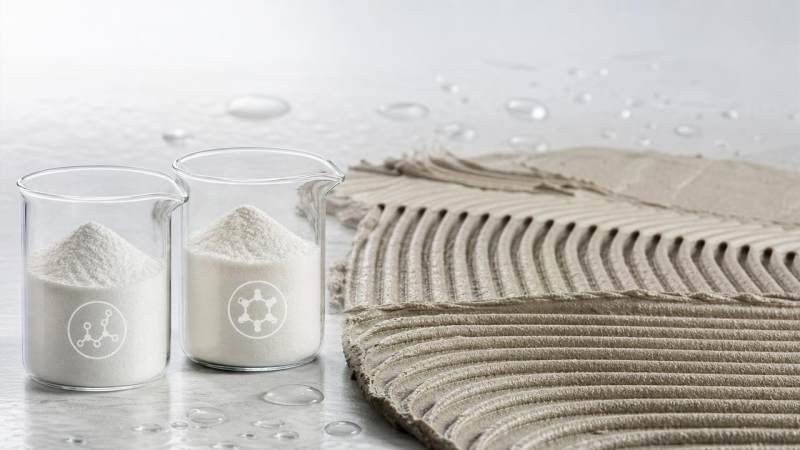
Selecting between HPMC and Methyl Hydroxyethyl Cellulose (MHEC) can significantly affect water retention, workability, open time, sag resistance, and overall formulation stability.
For technical evaluators working with dry-mix mortars, tile adhesives, renders, or construction chemical systems, the right cellulose ether depends on measurable performance targets.
This guide compares MHEC and HPMC from a formulation perspective, helping you assess suitability, compatibility, processing behavior, and quality consistency.
The practical answer: neither is universally better
For most construction formulations, HPMC and MHEC overlap in function but differ in performance balance under specific application and climate conditions.
HPMC is often selected for broad availability, viscosity flexibility, reliable thickening, and balanced water retention across standard cement-based systems.
Methyl Hydroxyethyl Cellulose (MHEC) is often preferred where workability, extended open time, smoother consistency, and improved thermal gel behavior matter more.
The best choice is not based on chemistry name alone, but on mortar behavior after mixing, standing, spreading, combing, and curing.
Technical evaluators should compare both products at equivalent viscosity grades, similar substitution levels, and realistic dosage ranges before approving a replacement.
What technical evaluators usually need to decide first
Before comparing cellulose ethers, define the performance problem you are trying to solve in your current formula or new development project.
If the issue is rapid water loss, poor substrate wetting, or weak cement hydration, water retention becomes the primary screening criterion.
If the issue is poor trowel feel, dragging, lumping, or unstable viscosity after standing, workability and rheology deserve closer attention.
If tile adhesive skins too quickly or loses adhesion in hot weather, open time and surface film behavior become more important.
If vertical slip occurs after application, evaluate sag resistance together with polymer powder dosage, aggregate grading, and total binder content.
A cellulose ether rarely works independently, so the evaluation should include cement type, fillers, RDP, starch ether, retarders, and defoamers.
Key chemistry differences and why they matter in formulas
HPMC stands for hydroxypropyl methylcellulose, while MHEC is commonly understood as methyl hydroxyethyl cellulose or hydroxyethyl methylcellulose in construction markets.
Both are nonionic cellulose ethers, meaning they generally show good compatibility with cement, lime, gypsum, polymers, pigments, and many additives.
The difference lies in substitution groups, which influence hydration speed, gel temperature, water binding, rheological profile, and performance under heat.
HPMC contains methoxy and hydroxypropoxy groups, contributing to strong thickening ability, predictable viscosity development, and widely tested application performance.
MHEC contains methyl and hydroxyethyl substitution, often giving a different hydration profile, smoother mortar feel, and strong water retention in selected systems.
In practice, supplier grade design, viscosity method, particle treatment, and purity can matter as much as whether the label says HPMC or MHEC.
Water retention: the first performance gate
Water retention is critical because cement-based mortars need sufficient water for hydration, substrate bonding, strength development, and reduced early cracking.
Both HPMC and Methyl Hydroxyethyl Cellulose (MHEC) can deliver high water retention when properly selected and dosed in dry-mix products.
HPMC performs reliably in many standard tile adhesives, wall putties, renders, repair mortars, and self-leveling auxiliary systems.
MHEC may show advantages in formulations requiring longer moisture availability, especially where open time and application tolerance are critical.
However, water retention should not be judged only by laboratory filter paper tests, because application behavior can differ under real substrates.
Evaluate water retention together with setting time, final strength, surface drying, adhesion, and shrinkage, rather than maximizing one number alone.
Workability and rheology: how the mortar feels under the trowel
For applicators, workability often decides whether a technically acceptable formula becomes commercially accepted in the field.
HPMC normally gives dependable viscosity build, good body, and stable handling in many dry-mix mortar systems.
MHEC can provide a creamier texture and smoother spreading in some cementitious formulations, depending on particle size and grade design.
For tile adhesives, the best cellulose ether should allow easy combing while preserving ridge shape after the notched trowel passes.
For renders and plasters, it should support pumpability, reduce sticking on tools, and prevent excessive slump after application.
When testing, observe initial mixing, five-minute maturation, remix behavior, thirty-minute standing viscosity, and application feel on absorbent substrates.
Open time and adjustment time in tile adhesive systems
Open time is one of the most important differentiators for tile adhesives, especially in warm, dry, or windy jobsite conditions.
A formula with poor open time may look acceptable during mixing but fail when tiles are placed after surface skinning begins.
MHEC is often evaluated when formulators need longer open time, better wet transfer, and more forgiving application windows.
HPMC can also provide strong open time performance, particularly when paired with suitable RDP, optimized cement, and correct sand grading.
The practical comparison should include tensile adhesion after different exposure intervals, not only fresh mortar appearance.
Technical evaluators should test standard open time, extended open time, adjustment time, and adhesion after heat aging if export markets require it.
Sag resistance and anti-slip behavior
Sag resistance depends on the combined rheology of cellulose ether, starch ether, RDP, filler packing, cement content, and water demand.
HPMC grades with suitable viscosity and modification can provide strong anti-sag performance for wall tile adhesives and vertical renders.
MHEC can also support sag control, but its smoother flow may require careful balancing with thixotropic agents or starch ether.
If a mortar is too stiff, it may resist sag but become difficult to spread and reduce wetting under the tile.
If it is too fluid, application feels easy but vertical slip, low ridge stability, and reduced thickness control may occur.
The target is not maximum viscosity, but a controlled shear-thinning profile that spreads easily and recovers structure quickly.
Thermal behavior and climate sensitivity
Construction chemicals are often used across different climates, so temperature sensitivity becomes a practical procurement and formulation concern.
Cellulose ethers show thermal gelation behavior, and substitution structure affects the temperature at which viscosity changes under heating.
MHEC is often associated with higher gel temperature ranges than some HPMC grades, which may benefit hot-weather application stability.
That said, actual gel temperature varies by supplier specification, viscosity grade, substitution level, salt content, and production process.
For tropical markets, summer construction, or high-temperature storage, evaluators should test viscosity stability and application behavior after thermal conditioning.
For cold-weather use, hydration speed, dissolution completeness, and early viscosity development may become more important than high-temperature resistance.
Compatibility with RDP, HPS, cement, and additives
Most modern construction formulas use cellulose ether together with redispersible polymer powder, hydroxypropyl starch ether, retarders, accelerators, or air-entraining agents.
HPMC and MHEC are nonionic, so they usually remain compatible with many inorganic binders and polymer additives.
However, compatibility can still vary because salts, pH, cement alkali content, and dispersant systems influence hydration and viscosity development.
In tile adhesive, RDP improves adhesion and deformability, while cellulose ether controls water retention, open time, and fresh mortar rheology.
In wall putty and skim coat, cellulose ether affects smoothness, polishing behavior, water demand, and surface finish quality.
In gypsum-based systems, setting control and hydration interaction should be tested carefully because viscosity alone cannot predict total performance.
Dosage strategy: how to compare fairly
A fair comparison requires testing HPMC and MHEC at similar viscosity levels and within the same formulation framework.
Do not replace one product by equal weight only, because efficiency, water demand, and rheological response may differ significantly.
Start with the current proven dosage, then run a small matrix using slightly lower, equal, and slightly higher dosage levels.
Measure water demand, wet density, viscosity after maturation, trowel feel, sag, open time, adhesion, and compressive or flexural strength.
For high-viscosity grades, small dosage changes can strongly affect consistency, so use accurate weighing and controlled mixing procedures.
The most reliable conclusion comes from application testing plus standard lab measurements, not from certificate viscosity values alone.
Cost efficiency is not only unit price
Many buyers compare HPMC and MHEC by price per kilogram, but technical evaluators should calculate cost per performance result.
A cheaper cellulose ether may increase water demand, reduce open time, require more RDP, or create unstable batch quality.
A higher-priced grade may be more economical if it allows lower dosage, fewer complaints, wider climate tolerance, or better production stability.
Also consider logistics reliability, viscosity consistency, substitution control, moisture content, ash level, and supplier response speed during troubleshooting.
For large-scale dry-mix production, batch-to-batch stability can be more valuable than a small difference in raw material price.
Cost efficiency should therefore include formulation robustness, field acceptance, complaint reduction, and total additive package optimization.
When HPMC is usually the better fit
HPMC is often a strong choice for standard cement-based tile adhesives, renders, masonry mortars, skim coats, and general dry-mix applications.
It is suitable when formulators need predictable thickening, broad viscosity options, stable supply, and proven performance across many market formulations.
HPMC may also be preferred when existing production lines, technical standards, and customer approvals already rely on HPMC-based specifications.
For manufacturers seeking wide viscosity control, grades from low to very high viscosity can support different product categories.
In formulations where anti-sag, water retention, and consistency are already balanced, switching to MHEC may not bring enough benefit.
In that case, optimization of HPMC viscosity, dosage, and additive combination may be more efficient than changing cellulose ether type.
When MHEC may be the better fit
MHEC may be preferable when the formulation needs smoother workability, longer open time, or stronger performance tolerance under warm conditions.
It is also worth evaluating when customers complain about poor spreadability, fast surface drying, weak wet transfer, or unstable application feel.
For premium tile adhesives, renders, and specialized mortars, MHEC can help tune the balance between water retention and workability.
Some suppliers describe MHEC as HEMC, so technical teams should confirm naming, specification, and test methods before comparison.
For example, Methyl Hydroxyethyl Cellulose (HEMC) can be assessed where formulation teams require targeted open time and rheology adjustment.
The final decision should still be validated through application trials, because grade design differs substantially between manufacturers.
A practical evaluation workflow for formulation approval
Begin by defining the benchmark formula and recording current issues, including mixing behavior, water demand, open time, sag, and adhesion values.
Select two or three HPMC grades and two or three MHEC grades with comparable viscosity ranges and suitable particle treatment.
Run controlled dry blending, fixed mixing time, consistent water addition, and defined maturation time to reduce experimental variation.
Measure fresh mortar properties first, then perform application tests on realistic substrates under standard and stressed environmental conditions.
After initial screening, adjust dosage and water level to find the most efficient performance point for each cellulose ether.
Finally, validate pilot production behavior, storage stability, packaging compatibility, and field application before approving commercial replacement.
Quality indicators to request from suppliers
Technical evaluators should request viscosity method, viscosity tolerance, moisture content, ash content, pH range, particle size, and gel temperature data.
For construction applications, also ask for recommended dosage ranges, typical use cases, and internal application test results.
Certificates are useful, but they should be supported by retained samples, traceable batches, and responsive technical service.
If the supplier offers only generic data, it may be difficult to troubleshoot field problems or optimize complex formulations.
Jinan Ludong Chemical produces cellulose ether solutions for construction and chemical applications, with controllable HPMC viscosities from 400 to 200,000 CPS.
Such viscosity flexibility can help evaluators screen different mortar systems without changing supplier communication and quality management channels.
Common mistakes when switching between HPMC and MHEC
The first mistake is assuming identical viscosity labels mean identical application behavior, even when test concentration and temperature differ.
The second mistake is changing cellulose ether without adjusting water addition, because hydration and thickening efficiency may alter workable consistency.
The third mistake is testing only fresh viscosity while ignoring open time, adhesion, sag, storage stability, and final strength.
The fourth mistake is evaluating one laboratory batch and approving immediately, without pilot-scale mixing or field-condition application trials.
The fifth mistake is treating cellulose ether as a simple thickener, rather than a multifunctional modifier of water retention and rheology.
A disciplined comparison avoids unnecessary reformulation cycles and gives purchasing teams stronger evidence for supplier and grade decisions.
Final recommendation: choose by performance target, not by label
If your formula is stable, cost-effective, and accepted by applicators, HPMC may remain the most practical and reliable choice.
If your main challenges involve open time, hot-weather workability, smoother spreading, or moisture tolerance, MHEC deserves structured evaluation.
For technical evaluators, the strongest decision comes from side-by-side testing under realistic application conditions and measurable acceptance standards.
Compare water retention, workability, sag resistance, open time, adhesion, strength, dosage efficiency, and batch consistency before selecting the final grade.
In short, HPMC and Methyl Hydroxyethyl Cellulose (MHEC) are not competitors in theory, but tools for different formulation priorities.
The right cellulose ether is the one that delivers stable production, reliable field performance, and the best total value for your application.
Send Your Inquiry
We welcome your cooperation and we will develop with you.
