


Methyl Hydroxyethyl Cellulose (MHEC) Market Outlook for 2026
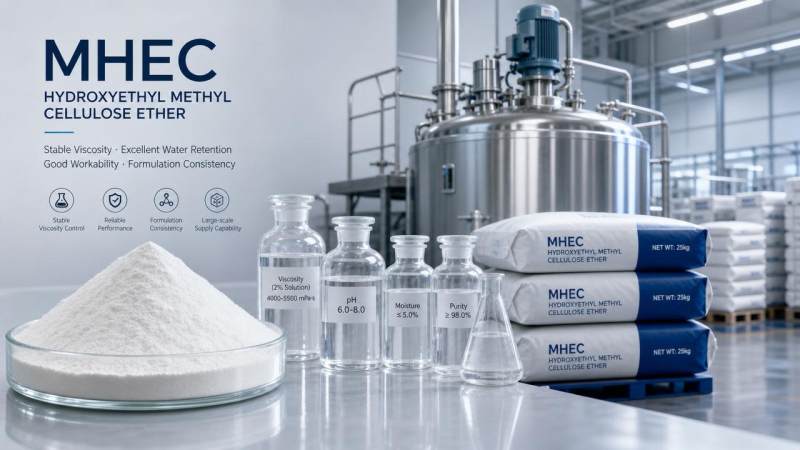
Methyl Hydroxyethyl Cellulose (MHEC) market outlook for 2026 is becoming a key reference for business leaders seeking stable growth in construction chemicals and industrial applications. As global demand shifts toward efficient, high-performance cellulose ethers, companies are focusing on supply reliability, product consistency, and scalable manufacturing. With integrated production capabilities and a strong product portfolio, Ludong Chemical is well positioned to support customers looking for dependable MHEC-related solutions in a competitive global market.
What MHEC Means for Industrial Buyers in 2026
For decision-makers, Methyl Hydroxyethyl Cellulose (MHEC) is not just a formulation input. It affects water retention, thickening behavior, workability, open time, and batch consistency in construction and specialty chemical systems. In 2026, these factors will matter even more as procurement teams balance cost control with performance stability.
In practice, buyers compare MHEC suppliers on viscosity range, salt tolerance, dispersion performance, production stability, and delivery reliability. The market is also shaped by tighter project timelines and more demanding application environments, which means technical support and supply continuity can matter as much as price.
Market forces shaping demand
- Construction materials continue to require better water retention and sag resistance for mortars, tile adhesives, and wall systems.
- Industrial buyers are reducing formulation risk by favoring suppliers with stable lot-to-lot consistency and controllable viscosity grades.
- Export-oriented companies increasingly evaluate suppliers on responsiveness, documentation, and scalable production capacity.
How to Evaluate MHEC Supply Capability Before You Buy
For procurement teams, the biggest risk is buying cellulose ether by name alone and discovering that the material does not match the application. A useful evaluation framework should include technical performance, production scale, quality control, and service response. Ludong Chemical’s integrated production and trading model helps buyers reduce coordination friction across sourcing, specification confirmation, and order execution.
The table below summarizes the main criteria that business leaders should check before approving a Methyl Hydroxyethyl Cellulose (MHEC) supply partner.
This comparison shows why capable cellulose ether suppliers are favored in 2026: they help buyers avoid hidden costs caused by unstable viscosity, slow communication, or inconsistent batch behavior. Ludong Chemical’s annual capacity of 45,000 tons and viscosity control from 400 to 200,000 CPS give procurement teams more room to align product choice with project requirements.
Which Applications Are Most Sensitive to MHEC Performance?
The strongest demand for Methyl Hydroxyethyl Cellulose (MHEC) remains in construction chemistry, where formulation stability directly affects jobsite performance. However, industrial applications also demand reliable thickening and suspension behavior, especially where process consistency is tied to downstream productivity and product appearance.
The following table helps buyers quickly identify where MHEC selection has the greatest commercial impact.
For companies with multiple end uses, a single generic grade is often not enough. Procurement should map each formulation to its required viscosity window, water retention target, and mixing behavior. That is where a supplier with broad cellulose ether capability can shorten evaluation cycles and improve launch readiness.
What Makes Ludong Chemical Relevant to 2026 Buying Decisions?
Jinan Ludong Chemical Co., Ltd., established in 2020, is a large-scale global manufacturing enterprise focused on cellulose ethers, trading, and integrated services. Its portfolio includes HPMC, RDP, and HPS, which gives buyers a broader solution path when they are optimizing construction formulations rather than sourcing a single ingredient in isolation.
The company’s traditional and intelligent automated production model is especially relevant for customers that need both flexibility and repeatability. For corporate buyers, this matters because stable manufacturing often translates into more predictable delivery, fewer specification deviations, and smoother project execution.
Why integrated production matters
- It reduces handoff risk between production, trading, and technical service.
- It supports faster response when a formulation needs adjustment or a project schedule changes.
- It gives buyers a clearer path from sample confirmation to bulk supply.
If your team is comparing cellulose ether suppliers, it is also worth noting related product options such as Detergent-grade HPMC. While not a direct substitute for every MHEC system, it can be relevant when buyers need to evaluate broader ether chemistry for formulation planning or multi-category sourcing.
How Should Buyers Compare MHEC Options on Cost and Performance?
In 2026, the lowest unit price is rarely the best decision. Total cost should include rejection risk, process instability, technical trial time, and delayed shipments. Decision-makers should compare MHEC options on performance fit, consistency, service support, and logistics rather than treating all grades as interchangeable.
The table below provides a practical comparison that can be used during supplier review meetings.
For enterprise buyers, the integrated model often creates lower hidden cost even when the nominal price is not the lowest. That is especially true when project delays, product returns, or inconsistent application behavior would be expensive to fix after delivery.
What Should Procurement Teams Ask Before Final Approval?
A strong MHEC purchasing process is built on clear questions. Before final approval, procurement and technical teams should confirm target application, required viscosity range, packaging needs, documentation, and delivery window. This reduces mismatch between commercial terms and actual process requirements.
- What is the exact application, and which performance indicator matters most?
- Which viscosity range is acceptable for the current formulation?
- How consistent are test results across batches and shipment lots?
- What is the expected lead time for samples and bulk orders?
- Can the supplier support related cellulose ether or construction additive needs?
Ludong Chemical’s product range and production scale make it easier to discuss these questions in a structured way. For buyers managing multiple SKUs, that can shorten the sourcing cycle and reduce internal alignment delays between R&D, procurement, and operations.
FAQ: Common Concerns About Methyl Hydroxyethyl Cellulose (MHEC)
How do I choose the right MHEC grade?
Start with the application requirement, not the product name. Focus on viscosity, water retention, dispersion, and the final working time needed in the formulation. A supplier that offers a broad controllable range can help narrow the choice faster.
What is the biggest risk in MHEC procurement?
The biggest risk is buying a grade that looks acceptable on paper but behaves differently in production. Inconsistent viscosity or poor compatibility can trigger rework, delay shipment, and increase formulation cost.
How can buyers reduce supply disruption?
Work with suppliers that have integrated manufacturing, clear batch control, and the ability to scale capacity. That approach is more suitable for companies with recurring demand or time-sensitive projects.
Is MHEC only relevant to construction chemicals?
No. While construction is the core demand center, MHEC also supports other industrial systems that need thickening, suspension, and consistency control. The exact fit depends on the formula and end-use requirements.
Why Contact Ludong Chemical for 2026 Planning?
If your team is planning 2026 sourcing, the most useful next step is a practical technical conversation. Ludong Chemical can support parameter confirmation, product selection, sample discussion, delivery planning, and quotation alignment for cellulose ether-related requirements. This is especially valuable when your project needs stable supply, multiple grades, or tighter specification control.
For business leaders, the real advantage is not just buying a chemical; it is securing a supply framework that supports formulation stability, production continuity, and faster decision-making. If you need to evaluate Methyl Hydroxyethyl Cellulose (MHEC) market options for 2026, contact us to discuss the grade, target viscosity, packaging format, and application scenario that best fit your business.
Send Your Inquiry
We welcome your cooperation and we will develop with you.
