


NRMM2026 Kunshan Summit Highlights China's EV Hydraulic Systems for NRMM Decarbonization
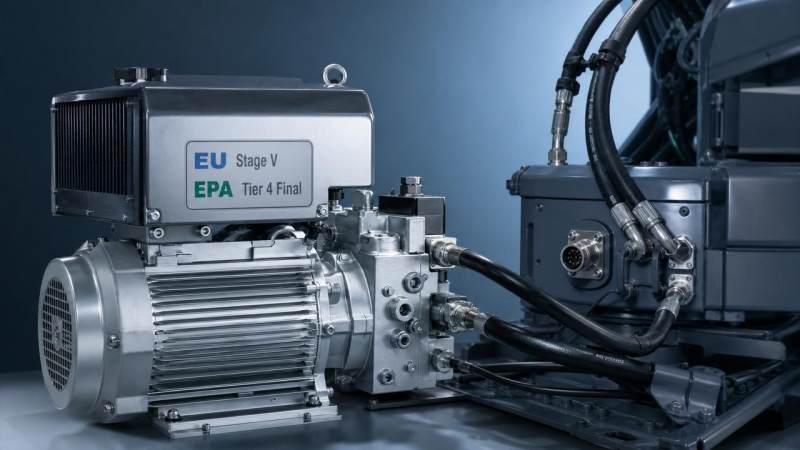
At the ninth Global Non-Road Mobile Machinery (NRMM) Technology Summit (NRMM2026), held in Kunshan on May 21–22, 2026, new performance and certification data on Chinese-made electric hydraulic systems were presented—triggering strategic attention from international OEMs in construction, agriculture, and material handling equipment sectors. The event signals a measurable shift in global powertrain sourcing, particularly where zero-carbon timelines and thermal reliability are critical.
Event Overview
The ninth Global Non-Road Mobile Machinery (NRMM) Technology Summit (NRMM2026) took place in Kunshan on May 21–22, 2026, under the theme ‘Diversification: Towards a Zero-Carbon Future’. Publicly disclosed test results showed that domestically produced high-power-density electric drive hydraulic pump units (30–80 kW) maintain 92.3% efficiency stability across an operating temperature range of −25°C to 55°C. These units have obtained dual regulatory certification: EU Stage V (formerly Tier 5) and U.S. EPA Tier 4 Final. Multiple international OEMs confirmed they are accelerating integration of these Chinese electric hydraulic systems to replace diesel-based powertrains, shortening time-to-market for zero-carbon machinery by 6–9 months.
Industries Affected
Original Equipment Manufacturers (OEMs) in Construction & Agricultural Machinery
OEMs face tightening regulatory deadlines for zero-emission off-highway equipment in Europe and North America. With certified, thermally robust electric hydraulic systems now available from Chinese suppliers, their internal development cycles for electrified attachments, loaders, and tractors can be shortened. Impact manifests in reduced validation time for hydraulic subsystems and faster whole-machine certification paths—especially where thermal derating has previously delayed field deployment.
Hydraulic Component Suppliers (Non-Chinese)
Established suppliers of diesel-hydraulic integration solutions—particularly those without parallel EV hydraulic platforms—may experience competitive pressure in mid-power applications (30–80 kW). The availability of pre-certified, drop-in-capable electric pump units shifts design leverage toward system-level integrators rather than component-level vendors, especially in cost- and timeline-sensitive markets.
Power Electronics & Motor Manufacturers
Suppliers of inverters, traction motors, and motor controllers serving the NRMM segment may see increased demand for interoperability testing and co-engineering support. The reported efficiency stability implies tight thermal management and control algorithm integration—raising the bar for compatibility with third-party actuators and pumps used in modular electric powertrain architectures.
Aftermarket & Retrofit Service Providers
With OEMs accelerating zero-carbon product launches, retrofit demand for legacy diesel machines may plateau earlier than anticipated in Tier 1 export markets. Service providers should monitor OEM announcements for platform-specific electric hydraulic upgrade kits—not just full machine replacements—as early adoption signals suggest phased electrification at the subsystem level.
What Relevant Enterprises or Practitioners Should Focus On
Track OEM procurement announcements—not just technical roadmaps
Several international OEMs have confirmed accelerated integration, but formal supplier lists and volume ramp timelines remain undisclosed. Practitioners should prioritize monitoring public tender notices, supply chain disclosures in quarterly reports, and partner announcements—not only R&D white papers—to distinguish strategic intent from engineering feasibility.
Assess thermal envelope requirements for target regional deployments
The −25°C to 55°C operational stability is certified, but real-world duty cycles vary widely (e.g., Nordic forestry vs. Gulf Coast port operations). Companies evaluating adoption should benchmark their own application-specific thermal profiles against this validated range—and avoid assuming equivalency across all ambient or load conditions.
Distinguish certification scope from system-level compliance
EU Stage V and EPA Tier 4 Final certifications apply to the electric hydraulic pump unit as a standalone component—not the full machine. OEMs still bear responsibility for whole-machine emissions, safety, and electromagnetic compatibility (EMC). Procurement teams must verify whether test reports cover integrated EMC behavior and fault-response protocols required for final homologation.
Prepare for supply chain coordination around control interface standards
Drop-in replacement capability depends on CAN bus protocol alignment, torque/speed command mapping, and feedback signal formats. Engineering teams should proactively request interface control documents (ICDs) and functional safety documentation (e.g., ISO 26262 ASIL classification if applicable) before committing to pilot integration.
Editorial Perspective / Industry Observation
Observably, this is not merely a technology showcase—it reflects a narrowing gap in certified, production-ready subsystems for NRMM electrification. Analysis shows the combination of wide-temperature validation and dual-region regulatory approval lowers adoption risk for OEMs more than incremental improvements in battery energy density alone. From an industry perspective, it marks a transition from ‘can we electrify hydraulics?’ to ‘which certified solution fits our timeline and thermal boundary?’. Current developments are best understood as an inflection point in procurement strategy—not yet a market-wide substitution, but a materially expanded option set for OEMs facing hard regulatory deadlines.
Current developments are better interpreted as a credible acceleration signal—not a completed market shift. The fact that multiple OEMs are actively integrating does not imply broad substitution across all power classes or regions, nor does it indicate immediate pricing or localization advantages. Rather, it confirms that certain Chinese suppliers have crossed key technical and regulatory thresholds required for Tier 1 engagement in Western markets.
Industry stakeholders should continue observing: (1) volume shipment data from participating suppliers beyond 2026; (2) expansion into higher-power segments (>80 kW); and (3) evidence of localized technical support infrastructure in EU/US markets—none of which are confirmed in current disclosures.
Conclusion: This milestone underscores that zero-carbon progress in non-road machinery is increasingly driven by modular, certified subsystems—not just whole-machine redesigns. For global OEMs, it offers a pragmatic path to meet near-term decarbonization targets. For suppliers, it raises the bar for thermal resilience, regulatory alignment, and interface standardization—not just peak efficiency. It is neither a disruption nor a fait accompli, but a calibrated step in the industrial decarbonization timeline.
Source: Official disclosures from NRMM2026 Kunshan Summit (May 21–22, 2026); verified statements from participating international OEMs; publicly released test reports on electric hydraulic pump units (30–80 kW class). Note: Supplier names, OEM model integrations, and commercial terms remain unconfirmed and are subject to ongoing observation.
Send Your Inquiry
We welcome your cooperation and we will develop with you.
