


Red Sea Crisis Pushes Asia-Europe Freight Rates Above $4,200
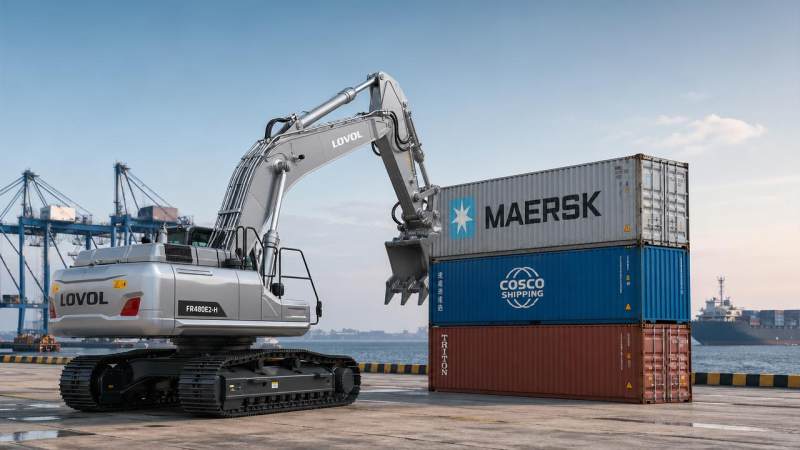
Red Sea shipping disruptions continue to exert upward pressure on Asia–Europe container freight rates, with the Far East–North Europe 40HQ spot rate exceeding $4,200—reaching $4,230 as of the week ending 30 April 2026. This development directly affects exporters of capital goods—including construction machinery—and signals growing strain on global maritime logistics networks. Stakeholders in heavy equipment manufacturing, international trade services, and multimodal supply chain management should monitor evolving carrier policies and port diversion strategies closely.
Event Overview
According to the Shanghai Shipping Exchange and Drewry’s weekly report published on 30 April 2026, the spot freight rate for a 40-foot high-cube (40HQ) container on the Far East–North Europe mainline route stood at $4,230—its highest level since October 2025. The increase is attributed to the常态化 (routine) rerouting of vessels away from the Red Sea, compounded by tightened Suez Canal transit quotas. Multiple global container carriers have responded by suspending new bookings or imposing war risk surcharges. Chinese construction machinery exporters report that delivery lead times to Germany, the Netherlands, and Saudi Arabia have extended by 2–3 weeks on average; some customers are preparing contingency plans, including shifting discharge ports (e.g., from Rotterdam to Hamburg).
Industries Affected
Direct Exporters (e.g., Construction Machinery Manufacturers)
These firms face direct cost and timing impacts: higher ocean freight costs erode export margins, while extended transit times delay revenue recognition and increase working capital requirements. Delivery schedule slippage also raises contractual risk—especially under Incoterms® such as DAP or DPU where sellers bear responsibility for timely arrival.
International Logistics & Freight Forwarding Providers
Forwarders must manage heightened volatility in capacity allocation, surcharge applicability, and port-specific operational constraints. The shift toward alternative European ports (e.g., Hamburg instead of Rotterdam) requires updated routing knowledge, inland transport coordination, and customs documentation alignment—adding complexity to service delivery.
Import-Dependent Distributors & Dealers (EU/Middle East Markets)
Distributors relying on just-in-time inventory models face increased stockout risk due to longer and less predictable lead times. Delayed arrivals may trigger customer dissatisfaction, order cancellations, or demand substitution—particularly in competitive markets like Germany’s rental and infrastructure sectors.
Supply Chain Finance & Risk Management Services
Extended shipment durations affect trade finance instruments (e.g., letters of credit validity periods) and insurance coverage windows. Providers must reassess exposure timelines, revise credit terms, and update force majeure clause interpretations in light of ongoing geopolitical risk premiums.
What Enterprises Should Monitor and Act On
Track carrier announcements and surcharge updates in real time
War risk surcharges and booking suspensions are being implemented on a per-carrier, per-route basis—not uniformly across the industry. Exporters and forwarders should subscribe to official carrier advisories and verify surcharge applicability before tendering shipments, especially for transshipment hubs (e.g., Jebel Ali, Singapore) en route to Europe.
Review Incoterms® usage and contract delivery clauses
With transit delays now structural rather than exceptional, contracts referencing fixed delivery dates—or those assigning arrival risk to sellers under DAP/DPU—may require renegotiation. Firms should audit active orders and assess whether shifting to FCA or CPT terms better aligns with current port and vessel reliability.
Validate alternative port and inland routing options
Port shifts (e.g., Hamburg over Rotterdam) involve differences in handling fees, rail/road connectivity, and customs clearance efficiency. Companies should obtain updated transit time estimates and cost comparisons from forwarders—not assume equivalence in service quality or total landed cost.
Update customer communications and delivery expectations proactively
Given the 2–3 week extension reported across multiple destinations, firms should adjust confirmed delivery commitments and notify key accounts in writing—documenting the Red Sea rerouting context as an external factor beyond reasonable control. This supports transparency and helps mitigate commercial disputes.
Editorial Perspective / Industry Observation
Observably, this freight surge is not a short-term spike but reflects an emerging baseline condition: Red Sea bypass has shifted from contingency to routine practice, and Suez Canal access is now subject to administrative rationing—not just physical security. Analysis shows the $4,230 rate signals sustained cost inflation rather than transient volatility; it reflects embedded adjustments in vessel deployment, fuel consumption, and crew risk allowances. From an industry perspective, this is less a ‘crisis event’ and more a structural recalibration of Asia–Europe maritime economics—one requiring long-term adaptation in pricing, contracting, and network design. Continued monitoring is warranted, particularly for further quota restrictions or carrier consolidation responses.
This development underscores that geopolitical friction is now a quantifiable, recurring input in global industrial logistics planning—not an outlier to be absorbed ad hoc. For affected enterprises, the priority is not forecasting when conditions will normalize, but embedding flexibility into procurement cycles, customer agreements, and transport mode selection. Current evidence suggests resilience—not reversal—is the dominant near-term theme.
Information Sources: Shanghai Shipping Exchange, Drewry Weekly Container Market Update (published 30 April 2026). Note: Ongoing developments—including potential Suez Canal policy revisions or new carrier surcharge frameworks—remain subject to official confirmation and require continued observation.
Send Your Inquiry
We welcome your cooperation and we will develop with you.
