


Red Sea Crisis Pushes Asia-Europe Freight Rates Up 18%
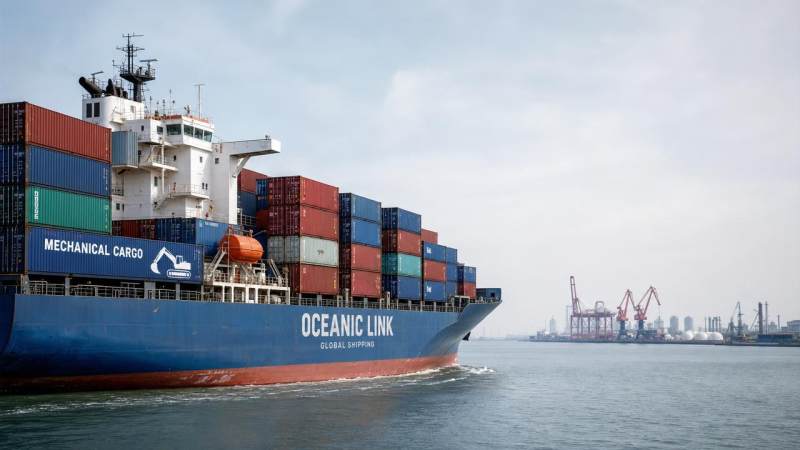
Freight costs on key Asia–Europe container routes surged 18.3% week-on-week to $4,958 for a 40HQ mechanical cargo container, per the Freightos Baltic Index (FBX) data released May 5, 2026. This development directly impacts exporters of large-scale machinery, components, and spare parts—and signals growing pressure on delivery timelines, procurement planning, and inventory management for global industrial buyers.
Event Overview
According to the Freightos Baltic Index (FBX), as of May 5, 2026, the spot rate for a 40HQ container on the Shanghai–Rotterdam route rose by 18.3% week-on-week to $4,958—its highest level since October 2025. The increase follows continued vessel rerouting around the Red Sea and ongoing restrictions on transit through the Suez Canal.
Industries Affected by Segment
Direct Exporters of Machinery & Equipment
These enterprises ship fully assembled machines or major subassemblies internationally. They face immediate cost inflation on ocean freight—especially for oversized or heavy-lift mechanical containers (40HQ). Since such shipments often operate on tight margin structures, the $4,950+ rate directly compresses landed-cost competitiveness in European markets.
Manufacturers of Mechanical Components & Spare Parts
Firms supplying precision-engineered parts or after-sales service kits are affected not only by higher per-container costs but also by extended lead times. With average delivery delays now at 5–7 days, just-in-time replenishment models risk stockouts—particularly where regional distribution centers rely on predictable weekly arrivals.
Global Procurement & Supply Chain Teams at Industrial Buyers
Overseas customers—especially those in Europe purchasing capital equipment or maintenance inventories—must reassess safety stock levels and order timing. The freight surge coincides with longer transit windows, increasing exposure to demand volatility and obsolescence risk for time-sensitive spares.
Freight Forwarders & NVOCCs Specializing in Heavy-Lift Cargo
Service providers handling mechanical freight face tighter capacity allocation, increased documentation complexity (e.g., over-dimensional permits), and heightened coordination needs with inland hauliers and terminal operators. Margins may narrow if surcharges cannot be passed through uniformly across client contracts.
What Relevant Enterprises or Practitioners Should Monitor and Do
Track official updates on Suez Canal access and Red Sea security advisories
Current rate pressure stems from operational constraints—not tariff changes. Monitoring statements from the Suez Canal Authority, IMO, and maritime security groups (e.g., UKMTO, MSCHOA) helps distinguish temporary disruptions from structural shifts in routing.
Review freight cost pass-through terms in active export contracts
Contracts without fuel or contingency surcharge clauses may expose exporters to unanticipated margin erosion. Now is the time to audit pricing mechanisms—especially for long-lead mechanical orders where freight represents >12% of total landed cost.
Assess alternative routing options—notably via West Coast North America + rail/intermodal to Europe
While trans-Pacific + land bridge routes add transit time, they avoid Red Sea and Suez bottlenecks entirely. Analysis shows such alternatives currently carry a ~$600–$900 premium over direct Asia–Europe sailings—but offer more schedule reliability for priority shipments.
Pre-validate inventory buffers with key European distribution partners
Given the 5–7 day average delay extension, jointly reviewing minimum order quantities (MOQs), safety stock triggers, and reorder point logic with EU-based logistics partners supports continuity—without requiring full buffer increases across all SKUs.
Editorial Perspective / Industry Observation
Observably, this freight spike is less a standalone event and more a stress-test indicator: it reveals how tightly coupled current Asia–Europe industrial logistics remain to a single maritime corridor. From an industry perspective, the $4,950 40HQ rate is better understood as a near-term signal of vulnerability—not yet a sustained new baseline. However, if Red Sea transits remain constrained beyond Q3 2026, shippers may begin re-evaluating port pairings, warehouse footprints, and even regionalized production sourcing. Current volatility underscores why freight cost modeling must now include geopolitical scenario planning—not just fuel and port congestion variables.
Concluding, this update reflects acute but localized pressure—not systemic breakdown—in Asia–Europe mechanical cargo logistics. It is best interpreted not as a trigger for emergency action, but as confirmation that freight cost and timeline assumptions require quarterly validation against real-time maritime intelligence. For most stakeholders, proactive recalibration—not reactive overhaul—is the appropriate response.
Source: Freightos Baltic Index (FBX), published May 5, 2026. Note: Ongoing monitoring is advised for updates on Suez Canal throughput volumes and Red Sea navigation advisories, which remain subject to change.
Send Your Inquiry
We welcome your cooperation and we will develop with you.
