


Redispersible Polymer Powder in Tile Adhesive vs Putty: What Changes in Performance?
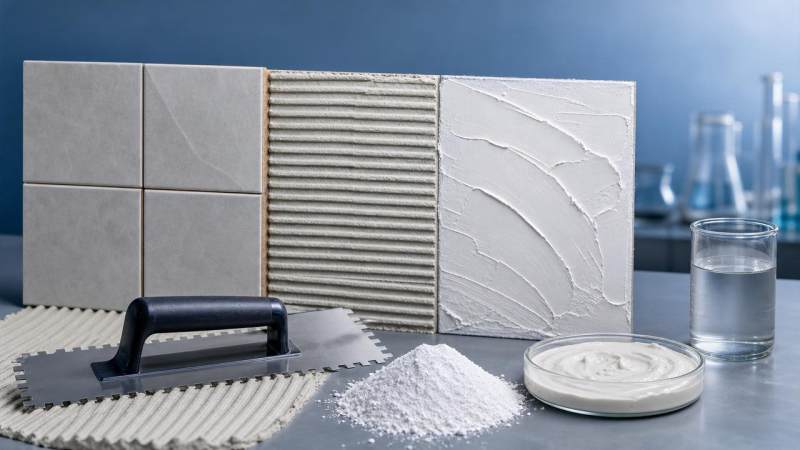
Redispersible Polymer Powder in Tile Adhesive vs Putty: What Changes in Performance?
Redispersible Polymer Powder changes how a dry-mix system behaves after water is added.
In tile adhesive, it mainly supports bonding, slip resistance, flexibility, and water durability.
In wall putty, it influences cohesion, surface toughness, crack resistance, and sanding balance.
That sounds similar on paper, but the on-site result is very different.
A formulation that performs well in tile adhesive may feel completely wrong in putty.
This is why understanding Redispersible Polymer Powder by application matters more than using a generic dosage rule.
From a practical angle, the right polymer choice improves stability, reduces callbacks, and keeps application more predictable.
Why Redispersible Polymer Powder behaves differently
Redispersible Polymer Powder forms a polymer film after dispersion and drying.
That film bridges cement particles, fillers, and the substrate interface.
However, tile adhesive and putty do not face the same stress.
Tile adhesive must carry tile weight and resist movement, moisture, and thermal change.
Putty must spread smoothly, stay workable, and leave a dense, even finishing layer.
So the same Redispersible Polymer Powder can deliver different value depending on the target performance.
More clearly, tile adhesive rewards bonding strength and deformation tolerance.
Putty rewards smooth handling, anti-cracking support, and a durable finish that is not too hard to polish.
What Redispersible Polymer Powder does in tile adhesive
1. It improves bond strength where it matters most
In tile adhesive, Redispersible Polymer Powder strengthens the bond between mortar, tile, and substrate.
This is especially important with low-absorption tiles and dense concrete surfaces.
Without enough polymer support, early adhesion may look acceptable but fail later under service conditions.
A well-selected Redispersible Polymer Powder helps maintain both dry and wet bonding performance.
2. It increases flexibility and absorbs movement
Tiles and substrates expand differently during temperature change.
Redispersible Polymer Powder gives the adhesive a more elastic internal structure.
That reduces brittle cracking and helps prevent debonding over time.
This becomes more critical with large-format tiles, heated floors, and outdoor applications.
3. It supports water resistance and aging stability
Tile adhesive often works in kitchens, bathrooms, facades, and wet maintenance zones.
Here, Redispersible Polymer Powder helps limit performance loss after water exposure.
It also improves the adhesive’s ability to stay reliable after repeated wet-dry cycles.
That means fewer hollow spots, fewer edge failures, and better long-term confidence.
4. It changes workability in a visible way
On site, handling matters as much as lab strength.
Redispersible Polymer Powder can improve creaminess, reduce dusting, and support trowel feel.
It also helps with open time and tile adjustment time when paired with cellulose ether.
In many formulations, Hydroxypropyl Methyl Cellulose works alongside polymer powder to stabilize water retention and application consistency.
What Redispersible Polymer Powder changes in putty
1. It improves cohesion and reduces powdering
Putty needs enough internal bonding to stay intact during drying and finishing.
Redispersible Polymer Powder helps hold fillers and cementitious components together.
As a result, the surface shows less chalking and better resistance to powder loss.
This is important before primer or decorative coating is applied.
2. It helps control micro-cracks
Putty layers are thin, but they still shrink during drying.
Redispersible Polymer Powder improves flexibility and distributes stress more evenly.
That lowers the chance of hairline cracking, edge lifting, or local flaking.
The benefit becomes more obvious on uneven walls or under fast drying conditions.
3. It affects sanding and surface feel
This is where putty differs sharply from tile adhesive.
Too little Redispersible Polymer Powder may cause weak surface strength.
Too much may make sanding difficult and increase labor time.
So the target is balance, not maximum addition.
A good putty formula feels smooth during spreading and stays firm after curing.
4. It supports water resistance, but with different priorities
In putty, water resistance helps prevent softening, blistering, and coating failure.
But the goal is usually surface durability rather than structural bonding under load.
That is the key distinction when comparing Redispersible Polymer Powder in both systems.
Side-by-side performance comparison
This comparison shows why one Redispersible Polymer Powder strategy does not fit both products.
The target property decides the best polymer type, dosage, and total additive package.
Practical selection tips for stable results
In actual production, performance should be judged by the whole formula, not one additive alone.
Still, several checks help narrow the right Redispersible Polymer Powder choice faster.
- Check the substrate and service environment before setting polymer dosage.
- Prioritize bond strength and flexibility for tile adhesive.
- Prioritize cohesion, anti-cracking, and sanding comfort for putty.
- Evaluate wet performance, not only dry lab strength.
- Test compatibility with cellulose ether and fillers before scale-up.
A balanced system often performs better than a formula pushed toward one extreme indicator.
That is especially true when weather, water demand, and labor habits vary from site to site.
Why formulation synergy matters
Redispersible Polymer Powder rarely works alone in a modern dry-mix recipe.
Its full effect depends on cement grade, filler shape, water ratio, and retention control.
This is why integrated raw material support becomes valuable.
Jinan Ludong Chemical Co., Ltd. focuses on cellulose ethers, Redispersible Polymer Powder, and related construction additives for coordinated formulation design.
Its large-scale production system and controllable viscosity range help support different dry-mix application targets.
When adjustment is needed, products such as Hydroxypropyl Methyl Cellulose can be combined with polymer systems to refine open time, anti-sag behavior, and water retention.
Final takeaway for application decisions
Redispersible Polymer Powder improves both tile adhesive and putty, but not in the same way.
In tile adhesive, its biggest value is stronger bonding, better flexibility, and improved wet durability.
In putty, its biggest value is better cohesion, crack resistance, and surface reliability.
The practical lesson is simple.
Do not ask whether Redispersible Polymer Powder is good or bad in general.
Ask what performance problem it needs to solve in that exact system.
Once that is clear, formulation choices become easier, jobsite behavior becomes more stable, and the final finish becomes more dependable.
Send Your Inquiry
We welcome your cooperation and we will develop with you.
