


SANY Electric Heavy-Duty Trucks Enter Vietnam Market
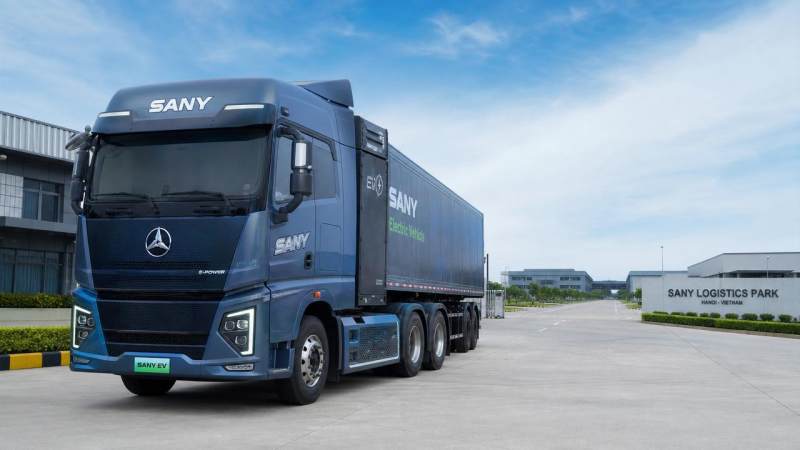
On April 25, 2026, SANY Group officially launched its electric heavy-duty trucks in Hanoi, Vietnam, completing a strategic order for 100 units and delivering the first 50 units. This development signals growing relevance for logistics infrastructure providers, EV component importers, and regional distribution networks operating across mainland Southeast Asia.
Event Overview
On April 25, 2026, SANY Group held an official launch event for its electric heavy-duty trucks in Hanoi, Vietnam. The company announced a strategic procurement agreement for 100 units and delivered 50 units to local partners on the same day. No further operational details—such as model specifications, battery suppliers, or service network rollout plans—have been publicly confirmed.
Industries Affected
Direct Trading Enterprises
Importers and distributors of commercial EVs in ASEAN markets may face intensified competition and shifting customer expectations. The successful market access and batch delivery indicate that Chinese-made electric heavy-duty trucks now meet Vietnamese regulatory and operational compliance requirements—potentially lowering entry barriers for other similar exporters.
Channel Distribution Enterprises
Regional logistics equipment distributors—especially those active in Cambodia, Laos, and Myanmar—may see increased demand for localized after-sales support, spare parts inventory, and driver training services. The Vietnam deployment serves as a de facto reference case for scalability across the Indochina Peninsula.
Supply Chain Service Providers
Firms offering customs brokerage, homologation support, or technical certification for heavy vehicles in Vietnam may observe higher inquiry volumes related to EV-specific documentation (e.g., battery safety certifications, charging interface standards). The event confirms that full-cycle regulatory clearance—including type approval—is operationally feasible for this vehicle class.
What Relevant Enterprises or Practitioners Should Focus On
Monitor official updates on Vietnam’s EV incentive framework
The timing of this launch coincides with ongoing policy consultations around Vietnam’s Decree 11/2024/ND-CP amendments. Stakeholders should track whether tax incentives or import duty reductions for zero-emission commercial vehicles are extended or clarified post-event.
Assess readiness for localized service infrastructure
For distributors and service partners, verifying availability of certified technicians, high-power charging compatibility, and battery maintenance protocols is more urgent than evaluating vehicle specs alone—since the event confirms deployability, not just product availability.
Distinguish between policy signal and commercial execution
This milestone reflects verification of market access and initial supply chain capability—not yet evidence of sustained production ramp-up or long-term service coverage. Buyers and partners should treat it as a validation point, not a trigger for large-scale procurement commitments without further due diligence.
Prepare for cross-border logistics coordination
Given the scale of the initial order (100 units), stakeholders involved in inland transport, port handling, or bonded warehousing in northern Vietnam should review capacity alignment—particularly for oversized EV truck shipments requiring specialized handling and storage conditions.
Editorial Perspective / Industry Observation
Observably, this event functions primarily as a market access signal—not a fully scaled commercial outcome. Analysis shows that the significance lies less in unit volume and more in the demonstrated ability to clear regulatory, logistical, and service-related thresholds simultaneously. From an industry perspective, it marks the first confirmed instance where a Chinese electric heavy-duty truck platform has passed end-to-end validation in a major ASEAN logistics hub. Current attention should focus on whether this becomes a replicable template—or remains an isolated pilot—across neighboring jurisdictions with comparable infrastructure constraints and regulatory frameworks.
Conclusion: This development is best understood as an early-stage inflection point in regional green freight adoption—not a completed market shift. It confirms feasibility, not inevitability. For industry participants, the priority remains monitoring follow-up activity in Vietnam over the next 6–12 months, rather than extrapolating immediate regional impact.
Source: Public announcement by SANY Group, April 25, 2026. No third-party verification or supplementary data sources have been cited. Ongoing observation is recommended regarding subsequent deliveries, service network expansion, and policy implementation timelines in Vietnam.
Send Your Inquiry
We welcome your cooperation and we will develop with you.
