


Synthetic Lubricants Cost More Up Front—Do They Save Money Later?
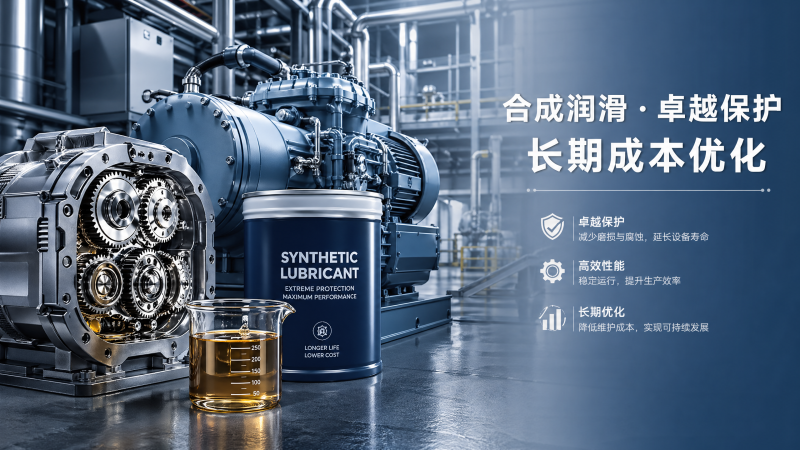
Synthetic lubricants often carry a higher purchase price, but for finance decision-makers, the real question is total lifecycle value. From reduced equipment wear and longer drain intervals to lower downtime and energy consumption, synthetic lubricants may deliver measurable long-term savings. This article examines whether the upfront premium can translate into stronger cost control, better asset protection, and a more predictable maintenance budget.
What Synthetic Lubricants Are and Why Cost Discussions Often Miss the Bigger Picture
In chemical manufacturing and related process industries, lubricants are not merely consumables. They influence equipment reliability, temperature control, maintenance intervals, and even production continuity. Synthetic lubricants are formulated from chemically engineered base stocks rather than conventional mineral oil alone, which generally gives them more stable viscosity behavior, stronger oxidation resistance, and better performance across wider temperature ranges such as -30°C to 200°C in many industrial operating environments.
For a finance approver, the important point is that lubricant cost should not be reviewed only as a line-item purchase price per liter or per drum. A plant may save 10% to 20% on procurement by choosing a lower-cost lubricant, yet lose far more through one unplanned shutdown, accelerated bearing wear, or shorter drain cycles. In continuous or semi-continuous production, where equipment may run 16 to 24 hours per day, cost visibility must extend beyond the storeroom.
This is especially relevant in the chemicals sector, where pumps, gearboxes, compressors, mixers, and thermal systems often operate under high loads, fluctuating temperatures, and contamination risk. In such conditions, synthetic lubricants are usually evaluated not because they are cheaper to buy, but because they may lower total cost of ownership over 12, 24, or 36 months.
Why the topic matters in process industries
Chemical plants frequently work with production windows that leave little room for avoidable maintenance. A failed gearbox or overheated compressor can disrupt batch timing, affect product consistency, and create knock-on losses across utilities, labor, and logistics. In this context, synthetic lubricants become part of an asset protection strategy rather than a simple maintenance consumable.
Companies like Jinan Ludong Chemical Co., Ltd., with large-scale production lines, integrated manufacturing systems, and annual capacity reaching 45,000 tons across cellulose ether products, illustrate why reliability matters. When production includes viscosity-controlled materials in ranges such as 400 to 200,000 CPS, process consistency and equipment uptime are commercially meaningful. Stable lubrication supports that operational discipline.
For finance teams, this shifts the discussion from “Why is the lubricant more expensive?” to “What hidden costs does the premium reduce?” That is the more relevant framing for industrial budget control.
Core cost elements that should be included
- Initial lubricant purchase cost per unit volume
- Drain interval length, such as 4,000 hours versus 8,000 hours
- Maintenance labor and shutdown hours required for oil changes
- Component life for bearings, seals, gears, and hydraulic systems
- Energy efficiency impact from lower friction or better viscosity stability
- Waste oil disposal, contamination control, and inventory complexity
Why Synthetic Lubricants Receive More Attention in the Chemical Industry
The chemical industry places unusual stress on machinery. Ambient heat, dust, moisture, process vapors, and long operating cycles all raise the technical demands on lubricants. In plants manufacturing cellulose ethers, polymer powders, or specialty additives, rotating equipment may run under highly scheduled conditions where stoppages have a direct impact on order fulfillment and material flow.
Synthetic lubricants are often favored because they maintain film strength more consistently at high temperature and resist oxidation longer than conventional mineral-based alternatives. In practical terms, that can mean fewer varnish deposits, less sludge formation, and more stable performance over service intervals that extend from a few months to a full year, depending on equipment type and contamination control.
This attention is not only technical. It is also financial. Plants pursuing more automated, integrated, and large-scale operations often seek fewer maintenance disruptions and tighter lifecycle forecasting. If a lubricant program can reduce emergency interventions from 6 events per year to 2, that improvement influences labor planning, spare parts consumption, and monthly budget variance.
Typical industrial conditions where synthetic lubricants are considered
Not every machine requires a premium formulation. However, the economics usually become more favorable when equipment operates under high heat, high load, variable speed, or around-the-clock duty cycles. These are common conditions in material handling systems, drying systems, mixers, and utility units found in chemical production.
The table below outlines where synthetic lubricants most often attract attention from maintenance and finance teams in process-oriented facilities.
The value proposition differs by asset class. On critical equipment, the premium may be justified even with modest performance gains because the cost of failure is high. On non-critical, lightly loaded systems, mineral lubricants may still remain the more economical choice. Good finance decisions depend on segmentation, not blanket adoption.
A related lesson from chemical materials management
The same lifecycle thinking applies across industrial inputs, not just lubricants. For example, when manufacturers evaluate specialty additives used in cleaning or formulation systems, consistent quality and process fit often outweigh the lowest visible purchase price. That is one reason buyers may review inputs such as Detergent-grade HPMC through a performance-and-stability lens instead of unit cost alone.
For finance approvers, this reinforces a broader principle: in chemical operations, materials that improve stability, reduce variation, or lower intervention frequency often produce savings that do not appear on the first quotation sheet.
Where the Long-Term Savings Usually Come From
The strongest economic argument for synthetic lubricants is rarely a single benefit. Savings usually come from several smaller improvements that accumulate over time. The main areas are drain interval extension, wear reduction, lower energy consumption, fewer maintenance stoppages, and better reliability in demanding conditions.
For example, if a mineral oil in a gearbox is changed every 4,000 operating hours and a synthetic lubricant can reliably support 8,000 hours under the same monitored conditions, the purchase price may double while the number of annual oil changes drops by 50%. Once labor, shutdown coordination, and disposal are added, the economics can shift in favor of the higher-cost fluid.
Similarly, even a small reduction in friction can matter when motors, pumps, and compressors operate at scale. A 1% to 3% improvement in efficiency is not transformational in a small workshop, but in a process plant with multiple running assets over 12 months, it can support meaningful utility savings and more stable thermal behavior.
Comparing visible cost and lifecycle cost
The following table provides a simplified framework for finance review. Actual results depend on contamination control, equipment condition, and lubricant selection, but it shows why unit price alone can be misleading.
The table does not suggest that synthetic lubricants always save money. It shows that the financial case improves when a plant has costly downtime, difficult maintenance access, or expensive rotating equipment. In those settings, the avoided secondary cost can be larger than the fluid premium.
Common savings categories finance teams should quantify
- Annual lubricant consumption volume before and after conversion
- Hours of labor required per drain event and associated line interruption
- Replacement frequency for bearings, seals, gears, and filters
- Energy use of high-duty compressors, pumps, and motors over 6 to 12 months
- Waste handling and disposal cost per service cycle
If these five categories are tracked, the decision becomes much more objective. Without them, the conversation tends to revert to purchase price alone, which understates both operational risk and maintenance burden.
How Finance Approvers Can Evaluate the Business Case More Reliably
A strong evaluation process begins with asset prioritization. It is usually unnecessary to convert every machine at once. Instead, companies can identify the top 10% to 20% of assets by failure cost, production criticality, and maintenance difficulty. Synthetic lubricants often produce the clearest financial result in these areas first.
Next, establish a baseline using the last 12 months of records where available. Review oil change frequency, spare part replacement, breakdown events, labor time, and downtime duration. Even approximate internal records are useful if applied consistently. The purpose is not academic precision; it is to compare before-and-after economics in a disciplined way.
Finally, coordinate maintenance, production, and procurement. A lubricant change that appears justified technically can still fail commercially if the wrong viscosity grade is selected, contamination controls are weak, or staff continue to service equipment on the old schedule without condition monitoring.
A practical review framework for decision-makers
The table below can be used as a practical checklist during internal approval. It is especially helpful in chemical manufacturing environments where cost savings must be balanced against continuity, process safety, and asset reliability.
This framework helps finance teams challenge assumptions without becoming trapped in technical detail. The goal is not to approve synthetic lubricants by default, but to identify where the premium aligns with measurable economic value.
Common pitfalls that weaken the expected return
- Applying synthetic lubricants to low-criticality assets with limited stress
- Ignoring contamination, filtration, or moisture ingress issues
- Changing lubricant type without reviewing seal compatibility and viscosity grade
- Assuming extended drain intervals without oil analysis or operating review
- Measuring only product cost, not downtime cost or labor savings
In many cases, synthetic lubricants save money only when paired with disciplined implementation. The fluid itself is not the whole program; storage control, application accuracy, and service interval verification all matter.
Practical Guidance for Chemical Manufacturers Planning a Lubrication Strategy
For chemical manufacturers, a balanced strategy is usually more effective than a full-site conversion. Start with critical rotating assets, compare one or two synthetic lubricant options against the current fluid, and monitor performance over a defined period such as 6 months or one production season. This creates a realistic basis for financial approval.
The strategy should also reflect the broader operational model. Enterprises with modern production lines, integrated solutions, and diverse customer requirements, such as those serving construction-grade and chemical-grade cellulose ether markets, often benefit from maintenance systems that support stable uptime and predictable intervention cycles. Lubrication policy is a small but meaningful part of that operating discipline.
It is also useful to align technical purchasing standards across multiple chemical inputs. Whether the discussion concerns lubricants, process additives, or auxiliary materials like Detergent-grade HPMC, the most durable savings often come from matching specification to process need, not from minimizing the quoted unit price in isolation.
Recommended implementation steps
- Identify critical assets with the highest downtime or repair cost exposure.
- Record current lubricant spend, maintenance frequency, and service hours.
- Select synthetic lubricants by operating temperature, load, speed, and compatibility.
- Use a trial period with inspection points at 30, 90, and 180 days where practical.
- Review results based on total cost, not purchase price alone.
This phased method reduces risk while giving finance teams real internal evidence. It also improves cross-functional trust, because the business case is based on operational results rather than supplier claims or assumptions.
Why Choosing the Right Industrial Partner Still Matters
A good financial decision depends on good operating information. That is why manufacturers often look for partners that understand large-scale production realities, specification control, and the relationship between material performance and process stability. In chemical manufacturing, the best outcomes usually come from suppliers that can support not only product delivery, but also technical communication and application understanding.
Jinan Ludong Chemical Co., Ltd. focuses on the production, trading, and integrated services of cellulose ethers, with products including HPMC, RDP, and HPS. With advanced production lines, a combination of traditional and intelligent automated manufacturing, and annual production capacity of 45,000 tons, the company is positioned to support global customers seeking consistency, flexible supply, and practical product matching across construction and chemical applications.
If you are reviewing industrial materials through a lifecycle cost lens, we can help you evaluate specification fit, application requirements, delivery cycles, and supply planning. Contact us to discuss parameter confirmation, product selection, sample support, lead time expectations, customized solutions, certification-related questions, or quotation details for your next project.
Send Your Inquiry
We welcome your cooperation and we will develop with you.
