


US Expands Export Controls on Critical Mechanical Components to China
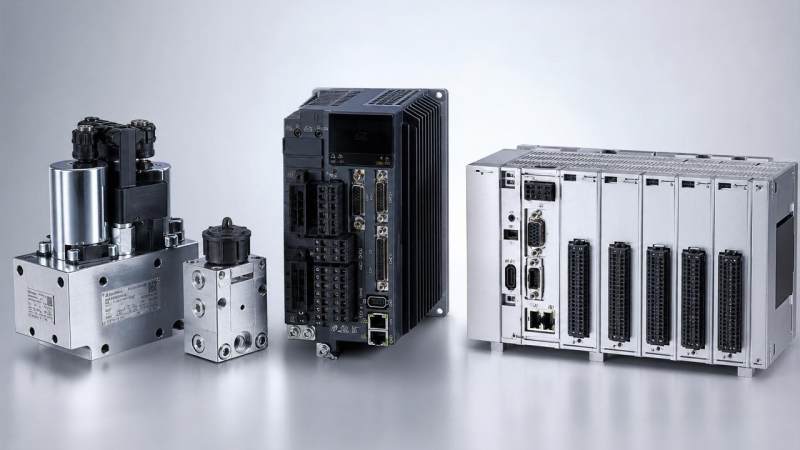
On May 1, 2026, the U.S. Department of Commerce’s Bureau of Industry and Security (BIS) updated the Commerce Control List (CCL), adding 12 categories of hydraulic valves, servo controllers, and industrial PLCs to the EAR99 licensing requirement for exports to China. This action directly affects suppliers and service providers supporting high-end construction and mining equipment — including tunnel boring machines and large electric-drive mining trucks — and warrants close attention from manufacturers, after-sales service networks, and industrial automation integrators.
Event Overview
On May 1, 2026, the U.S. Bureau of Industry and Security (BIS) amended the Commerce Control List (CCL) under the Export Administration Regulations (EAR). The update adds 12 specific categories of components — including hydraulic proportional valves, multi-axis servo drives, and industrial programmable logic controllers (PLCs) with domestic content below 30% — to the EAR99 classification, requiring a license for export, reexport, or transfer (in-country) to China. The rule took effect upon publication in the Federal Register.
Industries Affected by Sector
Original Equipment Manufacturers (OEMs) of High-End Construction & Mining Machinery
These firms rely on U.S.-origin hydraulic and motion control components for flagship products such as tunnel boring machines and electric-drive mining trucks. With newly licensed items required for replacement parts, OEMs may face delays or increased costs in fulfilling overseas warranty and after-sales support obligations — especially where local inventory or alternative sourcing is limited.
Industrial Automation Integrators & System Builders
Integrators deploying PLC- and servo-based control systems for heavy equipment often incorporate U.S.-designed or U.S.-branded components. The new controls affect procurement lead times, bill-of-materials validation, and compliance documentation for exported turnkey systems — particularly those containing subassemblies with less than 30% Chinese-sourced content.
After-Sales Service Providers & Spare Parts Distributors
Distributors maintaining regional spare parts warehouses for U.S.-designed machinery must now assess whether existing stock or planned shipments of the 12 listed item types fall under the new EAR99 license requirement. Unlicensed shipment of these components to China — even as replacements — may constitute a violation, impacting logistics planning and customs clearance.
Domestic Component Suppliers Supporting Localization Efforts
Chinese suppliers developing alternatives to U.S.-origin hydraulic valves, servo drivers, or PLCs may see accelerated demand — but only if their solutions meet functional equivalence and certification requirements for use in safety-critical or high-reliability applications. The 30% domestic content threshold cited in the rule signals heightened scrutiny of supply chain transparency, not just component origin.
What Relevant Companies and Practitioners Should Monitor and Do Now
Track official BIS guidance and potential license exceptions
The BIS announcement does not specify whether any License Exceptions (e.g., LVS, GBS) apply to these newly controlled items. Companies should monitor upcoming Federal Register notices and BIS FAQs for clarifications — particularly regarding servicing existing equipment already deployed in China.
Map current inventory and pending orders against the 12 listed categories
Exporters and distributors should cross-reference their part numbers and technical specifications against the official CCL amendment text. Focus should be on identifying exact matches — not functional equivalents — since EAR99 controls apply only to the enumerated items, not broader families.
Distinguish between policy intent and operational impact
This rule targets specific components used in strategic infrastructure equipment, not general-purpose industrial automation. Its immediate enforcement scope is narrow; however, it signals tightening oversight of dual-use mechanical subsystems. Companies should avoid overgeneralizing its reach while ensuring precise compliance for affected SKUs.
Review and document supply chain provenance for PLCs and controllers
For industrial PLCs subject to the <30% domestic content condition, companies must verify and retain evidence of manufacturing location, component sourcing, and assembly records. This documentation may be required during license application or post-shipment audit.
Editorial Perspective / Industry Observation
Observably, this update reflects a calibrated expansion of controls — focused on discrete, high-value mechanical control elements rather than broad technology categories. Analysis shows it is less a sweeping restriction and more a targeted reinforcement of existing supply chain oversight, particularly where U.S. components enable performance-critical functions in infrastructure-grade equipment. From an industry perspective, it functions primarily as a signal: one that underscores how export policy is increasingly applied to precision electro-hydraulic subsystems — not just semiconductors or software. Continued monitoring is warranted, as similar controls could extend to adjacent components (e.g., high-bandwidth position sensors, real-time motion firmware) in future updates.
Conclusion
This regulatory update does not broadly disrupt industrial automation trade, but it introduces tangible compliance requirements for a defined set of hydraulic, servo, and PLC components tied to strategic machinery. It is best understood not as an isolated action, but as part of an evolving framework for controlling dual-use mechanical subsystems — where performance, integration context, and supply chain transparency jointly determine regulatory treatment. Stakeholders should prioritize accurate item classification and documentation over broad assumptions about scope.
Information Sources
Main source: U.S. Bureau of Industry and Security (BIS), Amendment to the Commerce Control List, published May 1, 2026, in the Federal Register. Ongoing developments — including potential license exception clarifications or enforcement guidance — remain subject to observation.
Send Your Inquiry
We welcome your cooperation and we will develop with you.
