


Understanding HPMC Viscosity Grades in Tile Adhesive and Their Impact on Performance
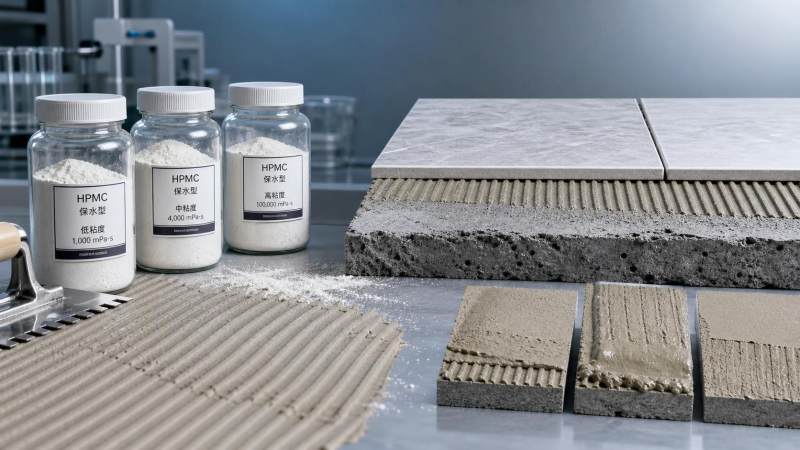
Understanding HPMC Viscosity Grades in Tile Adhesive and Their Impact on Performance
One of the most common mistakes in tile adhesive evaluation is to treat HPMC viscosity as a simple “higher is better” index. It is not. In practice, viscosity grade is a formulation tool that shifts the balance between water retention, trowel feel, slip resistance, open time, and hydration behavior. When technical teams compare one HPMC For Tile Adhesive grade with another, they are not only comparing a number in CPS. They are comparing how that cellulose ether will behave inside a cementitious system under mixing, standing, application, and curing conditions.
That distinction matters because tile adhesive performance is judged on site, not on paper. A product may look acceptable in a lab bucket yet fail to deliver stable combing, sufficient wetting, or workable open time once ambient temperature, substrate absorption, and installer habits begin to vary. Viscosity grade influences those outcomes directly, but only in relation to the rest of the formulation. This is why experienced formulators do not select HPMC by viscosity label alone.
In tile adhesive systems, HPMC mainly functions as a water-retention and rheology-modifying component. It helps keep water available for cement hydration, improves workability, and contributes to anti-sag behavior in vertical applications. Those are familiar statements, but the practical question is narrower: what changes when viscosity moves from a lower grade to a medium or high grade?
What the viscosity grade actually tells you
Viscosity grade refers to the flow behavior of an HPMC solution under specified test conditions. Different suppliers may present viscosity ranges based on their own product series and test methods, so a grade name should never be read without checking the corresponding technical data sheet. In broad industry use, however, lower-viscosity grades tend to give lighter consistency and faster wetting, while higher-viscosity grades usually generate stronger body, better shape retention, and stronger resistance to slump or sag.
That sounds straightforward until the adhesive is mixed with cement, fillers, polymer powder, and additives. In a real mortar system, viscosity does not act in isolation. A higher-viscosity HPMC may improve open time and anti-slip performance, but it can also change mixing feel, reduce spreadability if overdosed, or slow down the perception of wetting on some substrates. A lower-viscosity grade may make the mortar easier to spread and collapse under the trowel, yet it may not hold ridge definition as well, especially in wall tile applications.
For technical evaluators, the useful interpretation is this: viscosity grade is not a quality ranking. It is a control variable for application behavior.
How viscosity shifts adhesive behavior on site
In floor tile adhesives, the target is often smooth troweling, reliable wetting, and enough open time to maintain transfer without making the mortar feel overly heavy. Medium viscosity grades are frequently considered because they offer a workable compromise between water retention and application ease. In wall tile adhesives, sag resistance becomes more critical. Here, the rheological contribution of a higher-viscosity HPMC can be more valuable, provided the mortar still spreads properly and does not become difficult to bed.
Open time is another area where misunderstandings are common. HPMC supports water retention, which can help preserve workability and tile transfer over time, but open time is not determined by HPMC alone. Cement type, filler gradation, polymer content, ambient conditions, and substrate absorption all matter. A formulator who tries to solve open time only by moving to a much higher viscosity grade may gain one benefit and create two new problems: stickier handling and reduced application comfort.
The same applies to bond strength. HPMC contributes indirectly by managing water and improving contact conditions during application, but it is not the sole driver of adhesive strength classification. Evaluators looking at C1 or C2 cementitious adhesive performance under EN 12004, for example, need to judge the whole formulation. Water retention can support hydration and interface formation, yet excessive thickening can also interfere with optimal mortar structure if the balance is wrong.
A practical way to read grade selection
The most useful way to compare HPMC grades is by expected formulation behavior rather than by product label alone.
This table is intentionally broad. It is not a substitute for testing, because different HPMC products with similar nominal viscosities can still behave differently due to substitution profile, particle characteristics, dissolution behavior, and manufacturing consistency.
Why evaluators should not isolate viscosity from the rest of the system
A tile adhesive is a system, not an additive showcase. The chosen HPMC must match cement reactivity, calcium content, filler particle size distribution, redispersible polymer powder level, and target application class. If the formulation is designed for large-format wall tiles, anti-slip and non-sag behavior may deserve more weight than easy initial flow. If it is intended for fast-moving floor installation, installers may value clean troweling and transfer consistency more than a highly structured mortar body.
This is one reason large-scale cellulose ether producers with wide viscosity control ranges are useful to technical teams. A manufacturer able to supply HPMC across a broad controllable spectrum, such as 400 to 200,000 CPS, gives formulators more room to fine-tune mortar behavior rather than forcing the design into a narrow additive window. For companies like Jinan Ludong Chemical, which focus on cellulose ethers for construction applications, the technical value is not only production volume. It is the ability to align grade selection with different adhesive targets, from general-purpose mixes to more demanding application profiles.
Common misunderstandings that distort evaluation
One misunderstanding is to assume that two HPMC samples with the same declared viscosity will produce the same tile adhesive behavior. They may not. Viscosity is an important indicator, but it does not fully describe water-retention efficiency, thermal gel behavior, solution clarity, enzyme resistance, or the feel of the mortar during application. Experienced labs usually compare trial formulations instead of making a decision from viscosity alone.
Another is to treat poor anti-sag performance as proof that the HPMC viscosity is too low. Sometimes the real issue lies in filler grading, water demand, or polymer balance. Increasing viscosity may mask the symptom without solving the formulation weakness. The opposite mistake also appears often: a mortar that feels too sticky is blamed on “bad HPMC,” when the actual cause may be excessive dosage or a mismatch between cellulose ether and the rest of the dry-mix design.
A third misconception is that higher viscosity automatically means better bonding security. In reality, adhesive performance depends on proper wetting, tile back coverage, hydration, and cured matrix structure. If a mortar becomes difficult to spread or loses transfer efficiency because it is overly structured, the expected benefit from higher viscosity can be undermined during application.
What to look for during technical assessment
A useful evaluation process begins with the required adhesive behavior, not the additive grade. Define whether the priority is non-sag application, extended open time, smooth troweling, high water retention, or a balanced profile for standard ceramic installation. Then compare candidate HPMC grades under the same formulation and test conditions.
In most assessments, the critical observations include:
- mixing and lump-free dispersion behavior;
- slump or sag response after application;
- trowelability and ridge stability;
- open time and tile transfer under controlled conditions;
- water demand and consistency retention;
- compatibility with polymer powder and other rheology modifiers.
Where standards apply, the final decision should also remain tied to the adhesive class being targeted. Laboratory screening can identify which HPMC For Tile Adhesive grades give the right handling profile, but compliance-related properties still need to be confirmed through the relevant finished-product tests.
In other words, the right viscosity grade is the one that gives the intended mortar behavior with the least compromise. Technical evaluators usually get better results when they stop asking, “Which HPMC has the highest viscosity?” and start asking, “Which grade keeps this adhesive stable, workable, and fit for its installation method?” That shift in perspective leads to better formulations and fewer surprises once the material leaves the lab.
Send Your Inquiry
We welcome your cooperation and we will develop with you.
