


What Quality Tests Matter Most for HPMC Used in Tile Adhesive Production?
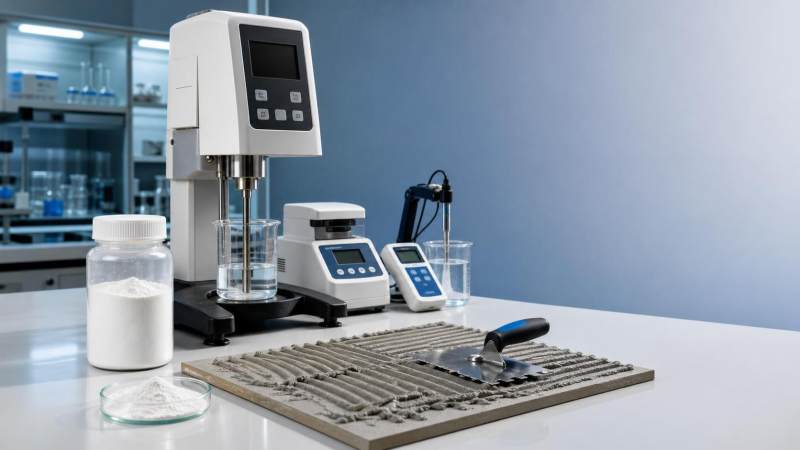
Which HPMC tests actually predict tile adhesive performance?
For quality teams, the real question is not whether an HPMC For Tile Adhesive batch passes a generic lab sheet. It is whether the tested values explain what will happen in the mixer, on the trowel, and under the tile. In practice, the most useful tests are the ones that connect directly to water retention, slip resistance, open time, consistency, and batch-to-batch stability.
That is why experienced QC and safety managers usually focus on a short list of high-impact checks: viscosity, moisture, ash, pH, particle size, substitution consistency, and application-level performance verification. Some of these are classic incoming inspection items. Others matter because a technically acceptable HPMC can still behave poorly in a tile adhesive formula if one key property drifts.
Is viscosity the most important test?
Usually, yes. If you only had room for one screening test, viscosity would be the first one to protect. It is one of the clearest indicators of whether the HPMC will deliver the expected thickening effect and handling profile in tile adhesive.
A viscosity shift can show up on the production floor as slower wetting, a different bucket feel, reduced anti-sag behavior, or a shorter workable window. The problem is that viscosity alone does not tell the whole story. Two lots with similar nominal viscosity can still behave differently if particle size, moisture, or substitution pattern changes.
What matters for QC is consistency of the test method as much as the number itself. You need the same solution concentration, temperature, spindle condition, and equilibration time every time. A viscosity result is only comparable when the method is controlled. If your supplier reports one method and your internal lab uses another, do not assume the values are directly interchangeable.
Why does water retention testing matter if viscosity already looks fine?
Because tile adhesive failure often starts with water management, not just thickness. HPMC is used in these systems largely to hold water inside the mortar long enough for cement hydration and workable application. If water retention is weak, installers may see poor spreadability, skinning that happens too fast, lower bond development, and more sensitivity to dry or absorbent substrates.
This is one of the tests that moves you from raw material screening to formulation relevance. A batch can sit inside a normal viscosity range and still underperform in water retention. That is why many plants treat retention behavior as a release-critical verification item, especially when changing lot, grade, or supplier.
If a batch triggers complaints about reduced open time or weak tile wetting, do not stop at the viscosity report. Check whether the adhesive formula still retains water under your actual test setup and substrate conditions.
What does moisture content tell you?
Moisture content is a simple test, but it protects more than storage quality. It affects active material content, flowability, weighing accuracy, and sometimes dispersion behavior. If moisture rises, the same bag weight may contain less effective polymer than your formula assumes.
For a QC manager, this matters in two places:
- Incoming inspection, where unusually high moisture may point to packaging, storage, or transport exposure.
- Complaint investigation, where the issue looks like “same formula, different result” even though the root cause is lower effective polymer solids.
It is also a safety and housekeeping concern. Damp powder is more likely to cake, bridge in feeding systems, and create inconsistent addition rates during batching.
Do ash content and purity checks matter in construction-grade HPMC?
They do, especially when you are trying to keep a tile adhesive formula stable over time. Ash content is commonly used as a practical indicator of inorganic residue. A drift here may suggest process variation, contamination, or differences in raw material handling. It will not tell you everything about performance, but it is useful for controlling material cleanliness and consistency.
In day-to-day work, ash becomes more valuable when it is trended rather than viewed as a one-off pass or fail. A lot that stays inside specification but moves sharply away from historical average deserves attention. That kind of shift is often where future application problems begin.
Should pH be part of routine incoming inspection?
Yes, because pH is a fast way to spot abnormal chemistry before the material enters production. HPMC itself is not being used as a strong pH control component in tile adhesive, but an unexpected pH result can point to residual processing chemicals, contamination, or lot inconsistency.
This test is especially useful when a batch shows unusual odor, color, wetting speed, or slurry appearance. On its own, pH is not enough to approve or reject a lot for performance use, but it is an efficient warning sign. For safety managers, it also supports basic chemical control discipline by helping identify material that may not match the approved incoming profile.
Why is particle size often overlooked, even though it affects mixing?
Because particle size does not always show up immediately on the certificate, yet it strongly affects how the powder behaves during addition and dispersion. A coarser material may dissolve more slowly. An overly fine material can change dusting behavior, wetting rate, or lump formation. Both situations can distort production consistency even when the chemistry is acceptable.
In a tile adhesive plant, that can lead to false troubleshooting. Operations may blame mixer time, operator technique, or even cement variation when the real difference is the HPMC particle distribution. If your process is sensitive to feeding speed or hydration time, particle size should be treated as a serious control point, not a secondary detail.
What performance checks belong beyond the raw material lab?
Raw material tests are necessary, but they do not fully replace application simulation. For HPMC For Tile Adhesive, a small-scale formulation check is often what separates a compliant lot from a production-safe lot.
The most practical checks usually include:
- Water demand at target consistency
- Open time behavior
- Sag or slip resistance on vertical application
- Trowelability and spread feel
- Early visual check for lumping or delayed hydration
These are the tests that catch the lots that look fine on paper but create trouble in use. They also help when switching among viscosity grades or when the plant uses multiple cellulose ether products across different adhesive types.
Which documents should QC ask for, besides the test report?
Start with the certificate of analysis for the actual batch, but do not stop there. For technical evaluation, the useful documents are the ones that help you compare declared values with your internal control method and purchasing requirements.
The key is matching each document to a decision. A file set is only useful if it helps you release, quarantine, investigate, or reject the lot with clear reasons.
When should a batch be held even if most results look acceptable?
Hold the batch when the numbers pass but the pattern does not make sense. That includes cases where one result sits near the edge of tolerance while another shifts away from normal history, or when the powder appearance, flow, or dissolution behavior differs from the approved reference.
A few common triggers:
- Viscosity fits the grade, but the application test shows shorter open time
- Moisture is elevated and the powder shows caking or poor flow
- pH or ash is still in range but clearly off the historical centerline
- Particle behavior during mixing does not match previous approved lots
This is where trend analysis matters more than one-time compliance. For tile adhesive production, consistency is often a stronger predictor of field reliability than a simple pass mark.
What is the most common mistake in evaluating HPMC for tile adhesive?
Treating HPMC as a single-number material. Many teams reduce evaluation to viscosity grade alone, then struggle to explain why the adhesive feels different from one batch to the next. In reality, HPMC performance comes from a combination of rheology, hydration behavior, water retention, and physical handling characteristics.
A better approach is to separate your controls into three layers: identity and documentation, raw material lab values, and formula-level application checks. If a lot passes all three, the risk of release is much lower. If it passes only the first two, you may still be missing the exact issue installers will notice first.
A practical release rule for QC and safety teams
Use viscosity as the anchor test, but never as the only decision point. Pair it with moisture, pH, ash, and particle-related control, then confirm performance in a reference tile adhesive mix whenever the lot is new, borderline, or process-sensitive. That sequence catches the two failures that matter most: material that is chemically off-profile, and material that looks normal in the lab but behaves differently in production.
For teams responsible for stable output, the best test program is the one that links incoming HPMC data to actual adhesive behavior. Once that link is built and trended, supplier discussions become clearer, batch release becomes faster, and production surprises become much less frequent.
Send Your Inquiry
We welcome your cooperation and we will develop with you.
