


Vietnam Enforces Dual Energy & Noise Certification for Imported Construction Machinery
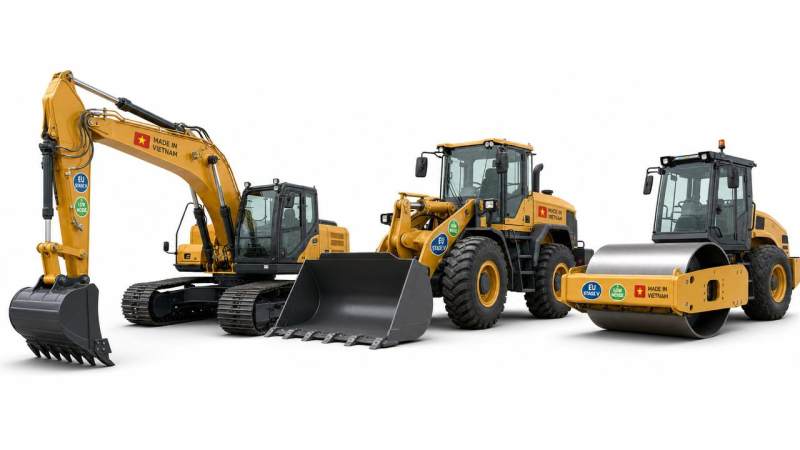
Vietnam has implemented Decree No. 32/2026/ND-CP effective 1 May 2026, mandating energy efficiency and noise emission certification for imported hydraulic excavators, wheel loaders, and road rollers. This regulatory shift directly impacts manufacturers, exporters, and importers engaged in Vietnam’s construction machinery trade—and signals a tightening of technical market access requirements in Southeast Asia.
Event Overview
On 1 May 2026, the Government of Vietnam formally enforced Decree No. 32/2026/ND-CP. Under this decree, all imported hydraulic excavators, wheel loaders, and rollers must be accompanied by dual certification reports issued by laboratories accredited by the General Department of Standards, Metrology and Quality (STAMEQ). These reports must verify compliance with two national technical regulations: QCVN 159:2026 (energy efficiency) and QCVN 160:2026 (noise limits). The decree entered into force without a transition period.
Which Subsectors Are Affected
Direct Exporting Enterprises
Enterprises exporting construction machinery from China—and other third countries—into Vietnam are directly affected because certification is now a mandatory customs clearance requirement. Non-compliant shipments may face rejection, delays, or re-export orders upon arrival.
Manufacturing Enterprises (OEMs & Tier-1 Suppliers)
Original equipment manufacturers and key component suppliers must ensure their product models meet both QCVN 159:2026 and QCVN 160:2026 before shipment. Retrofitting existing models for compliance may require design or control-system adjustments—not just documentation updates.
Supply Chain & Logistics Service Providers
Fulfillment and customs brokerage firms handling Vietnam-bound construction equipment must now verify the presence and validity of STAMEQ-recognized certification reports prior to cargo release. Absence or non-recognition of reports may trigger inspection holds at major ports including Cát Lái and Hải Phòng.
What Relevant Enterprises or Practitioners Should Focus On — And How to Respond Now
Confirm laboratory accreditation status with STAMEQ
Not all internationally accredited labs are recognized by STAMEQ for issuing QCVN 159:2026/QCVN 160:2026 reports. Exporters must verify that their testing lab appears on STAMEQ’s official list of authorized bodies—available via its public portal—before initiating tests.
Prioritize certification for high-volume and high-risk models
Given limited lab capacity and no grace period, enterprises should first submit models with the highest export volume to Vietnam (e.g., 20-ton hydraulic excavators, 5-ton wheel loaders) and those previously flagged for noise or fuel consumption concerns during local inspections.
Update commercial documentation proactively
Certification reports must be included in the full customs dossier—not submitted separately post-arrival. Exporters should revise pro forma invoices, packing lists, and certificates of origin to reference report numbers, issue dates, and STAMEQ-recognized lab IDs.
Monitor for potential enforcement clarifications
While the decree is in force, STAMEQ and the Ministry of Industry and Trade have not yet published detailed implementation guidelines (e.g., sampling rules, test cycle definitions, or grandfathering provisions for pre-2026 contracts). Enterprises should subscribe to official notifications and retain records of pre-1 May 2026 shipment bookings as potential evidence in case of dispute.
Editorial Perspective / Industry Observation
Observably, Decree No. 32/2026/ND-CP functions less as an isolated technical update and more as a structural signal: Vietnam is aligning its industrial import regime with broader ASEAN-wide sustainability and occupational health priorities. Analysis shows that QCVN 159:2026 references ISO 50002-based measurement protocols, while QCVN 160:2026 adopts EU-aligned A-weighted sound pressure level thresholds—suggesting deliberate convergence with international benchmarks. From an industry perspective, this is not merely a compliance checkpoint but an early indicator of how future technical barriers may scale across neighboring markets such as Indonesia and Thailand. Current enforcement rigor—especially the zero-transition-period approach—implies that policy intent is operational immediacy, not gradual adoption.
Consequently, the decree is better understood not as a one-off regulatory event, but as a threshold moment in Vietnam’s technical market access framework—one that prioritizes verifiable performance data over self-declaration or third-country equivalency claims.
Conclusion
This decree marks a formal escalation in Vietnam’s technical oversight of imported construction equipment. Its immediate effect is procedural—requiring verified, locally recognized certification—but its longer-term significance lies in raising the baseline for product conformity, testing transparency, and supply chain traceability. For stakeholders, it is more accurate to view this as the activation of a new gatekeeping layer rather than a temporary administrative hurdle. Current readiness depends less on reactive fixes and more on embedding certification planning into product development and export scheduling workflows.
Information Sources
Main source: Official Gazette of the Socialist Republic of Vietnam, Decree No. 32/2026/ND-CP (effective 1 May 2026); STAMEQ public notice on QCVN 159:2026 and QCVN 160:2026 implementation (published April 2026).
Note: Detailed testing procedures, lab application timelines, and possible exemptions for government procurement contracts remain under observation and are not yet publicly confirmed.
Send Your Inquiry
We welcome your cooperation and we will develop with you.
