


Vietnam Enforces Dual Energy Efficiency & Noise Certification for Construction Machinery
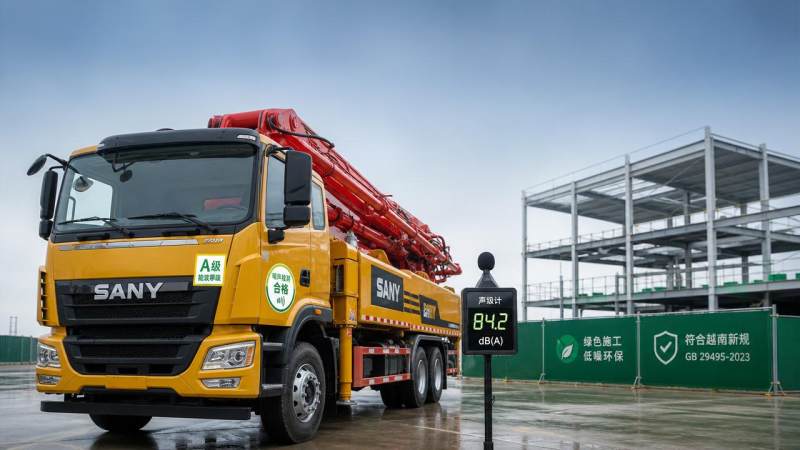
Vietnam’s Decree No. 32/2026/ND-CP entered into force on May 8, 2026, mandating dual mandatory certification — energy efficiency (per TCVN 8929:2026) and noise emission (≤85 dB(A)) — for all imported construction machinery, including forklifts, cranes, and concrete pump trucks. This regulatory shift directly affects Chinese exporters supplying to the Vietnamese market, requiring submission of test reports from locally recognized laboratories — or equivalent CNAS-accredited reports — starting June 2026. Exporters, compliance officers, and supply chain managers in heavy equipment manufacturing and international trade should closely monitor implementation timelines and documentation requirements.
Event Overview
The Vietnamese government officially enacted Decree No. 32/2026/ND-CP on May 8, 2026. The decree stipulates that all imported construction machinery must obtain certification verifying compliance with two technical requirements: (1) energy efficiency classification per national standard TCVN 8929:2026; and (2) sound pressure level not exceeding 85 dB(A) at specified measurement points. Certification must be issued by laboratories accredited by Vietnam’s national accreditation body. Products failing to meet both criteria will be denied customs clearance.
Industries Affected by Segment
Direct Exporters (China-based Machinery Manufacturers & Trading Companies)
These entities face immediate operational impact because their shipments to Vietnam will be held at port without valid dual certification. The requirement applies regardless of shipment date — meaning orders placed before May 2026 but cleared after June 2026 must still comply. Impact manifests in delayed deliveries, increased pre-shipment testing costs, and potential contract renegotiation due to extended lead times.
Supply Chain Service Providers (Certification Agencies, Testing Labs, Customs Brokers)
Service providers supporting China-Vietnam trade must adapt to new documentation workflows. Laboratories accredited under China’s CNAS system are permitted to issue equivalent reports only if they have formal recognition agreements with Vietnamese authorities — a status not yet publicly confirmed for all labs. Brokers now need to verify report validity prior to filing, adding scrutiny to document review processes.
Domestic Distributors & Aftermarket Operators (Vietnam-based)
Local distributors may experience inventory shortfalls if upstream suppliers fail to secure certification ahead of schedule. Since uncertified units cannot clear customs, stock replenishment cycles may extend unexpectedly. Additionally, warranty claims or service documentation may require alignment with certified specifications — introducing traceability requirements previously uncommon for non-safety-critical parameters like noise or energy class.
Key Focus Areas and Recommended Actions for Stakeholders
Monitor official guidance on CNAS report acceptance
While the decree permits use of reports from “equivalent” foreign labs, Vietnam’s Ministry of Science and Technology has not yet published a list of mutually recognized laboratories. Stakeholders should track updates from Vietnam’s National Accreditation Board (BOA) and the General Department of Vietnam Customs for formal confirmation of accepted CNAS lab equivalency.
Prioritize certification for high-volume, high-risk product categories
Forklifts and mobile cranes represent the largest share of Chinese construction equipment exports to Vietnam. These models often operate in confined urban worksites where noise limits are stringently enforced. Firms should prioritize testing for these categories first — especially variants with hydraulic systems or diesel engines known to exceed 85 dB(A) under load conditions.
Verify test protocol alignment between TCVN 8929:2026 and existing CNAS reports
TCVN 8929:2026 introduces updated test conditions (e.g., duty cycle definitions, ambient temperature ranges) compared to earlier versions or common international standards (e.g., ISO 9249). Existing CNAS test reports may not satisfy all methodological requirements. Exporters should request gap analyses from their labs before submission.
Adjust shipping schedules and commercial terms to reflect certification lead time
Certification processing — including sample submission, testing, and report issuance — typically requires 4–6 weeks. Contracts signed after May 2026 should explicitly allocate responsibility for certification, define acceptable report formats, and include buffer periods for customs release delays.
Editorial Perspective / Industry Observation
Observably, this decree signals Vietnam’s broader regulatory convergence with ASEAN harmonization goals — particularly around environmental performance metrics for industrial equipment. Analysis shows the dual-certification framework is less about immediate market restriction and more about institutionalizing technical oversight capacity within domestic agencies. It is currently more of a procedural signal than an enforcement outcome: while the legal mandate is active, full verification infrastructure (e.g., certified local labs for all machinery subtypes) remains under development. From an industry perspective, the timing — just over one year after Vietnam’s accession to the ASEAN Agreement on Energy Efficiency and Conservation — suggests coordinated policy sequencing rather than isolated action. Continued attention is warranted as enforcement rigor is expected to increase incrementally through 2027.
This regulation marks a structural shift in market access requirements for construction machinery entering Vietnam — moving beyond safety and EMC compliance toward measurable environmental performance. It does not represent an abrupt barrier, but rather a calibrated step toward standardized technical evaluation. For stakeholders, it is best understood not as a temporary hurdle, but as the formal onset of a new baseline for regulatory engagement in the Vietnamese construction equipment market.
Source: Official Gazette of the Socialist Republic of Vietnam (Decree No. 32/2026/ND-CP), effective May 8, 2026.
Note: Status of mutual recognition for specific CNAS-accredited laboratories remains pending official publication by Vietnam’s National Accreditation Board (BOA); ongoing observation recommended.
Send Your Inquiry
We welcome your cooperation and we will develop with you.
