


What Is HPMC Powder and Why Is It Used in Mortar, Coatings, and Daily Chemicals?
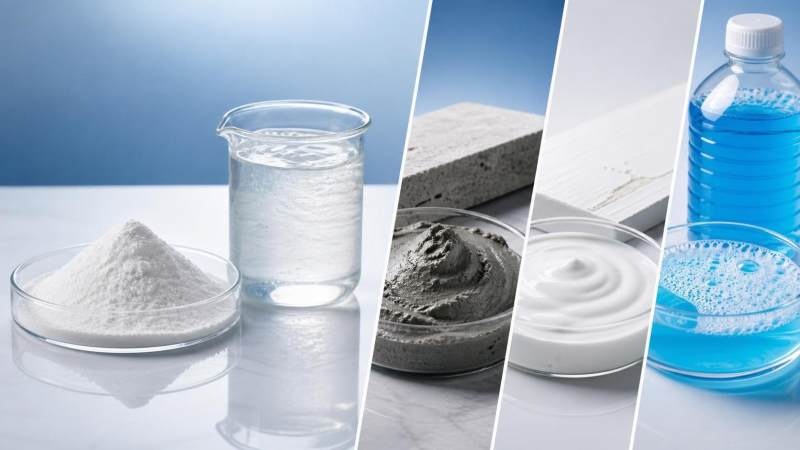
What HPMC Powder Actually Is
HPMC powder is not a filler, not a simple thickener, and not a generic “performance improver.” In practical formulation work, it is a cellulose ether used to control how water behaves inside a system and how that system responds during mixing, application, and drying. That is why the same material shows up in dry-mix mortar, architectural coatings, tile adhesives, putties, shampoos, detergents, and other daily chemical products. The chemistry is the same in principle, but the grade selection and performance target are very different from one industry to another.
Hydroxypropyl methylcellulose is derived from cellulose and modified so it can dissolve or disperse in water in a controlled way. Once hydrated, it builds viscosity, stabilizes the formulation, and slows the loss or migration of water. That sounds simple until you look at what actually happens on a jobsite or in a production line. In cement mortar, water disappears quickly into the substrate or is consumed by cement hydration. In a wall coating, poor rheology leads to sagging, spattering, or roller marks. In a liquid detergent or personal care base, the challenge is often suspension, flow feel, and storage stability. HPMC powder is used because it helps manage these problems through one core mechanism: water-phase control.
Why So Many Industries Use the Same Material
People new to cellulose ethers often assume that if HPMC powder is used across different products, it must behave like a universal additive with identical effects everywhere. That is one of the most common misunderstandings. The broader truth is that HPMC is versatile because its substitution level, particle characteristics, surface treatment, and especially viscosity grade can be adjusted to fit very different process windows.
A manufacturer with a wide production range can therefore supply HPMC for both construction and chemical applications without claiming that one grade fits all. Jinan Ludong Chemical, for example, produces construction-grade and chemical-grade HPMC, including type 75 and type 60 series, with viscosity control from 400 to 200,000 CPS. That range matters because the practical difference between a low-viscosity and a high-viscosity product is not academic. It changes mixing feel, open time, anti-sag behavior, film build, and often whether a formulation remains stable during storage or application.
In other words, HPMC powder is less a single product than a family of performance tools built around the same polymer backbone.
In Mortar, Water Retention Is Usually the First Reason
If you ask a dry-mix mortar formulator why HPMC powder is in the recipe, the first answer is usually water retention. Cement-based systems need enough available water for hydration and for workable application time. If water is lost too fast, the mortar becomes hard to spread, bond development suffers, and the surface may dry before the underlying structure has developed properly.
This is especially important in tile adhesive, plaster, skim coat, masonry mortar, and self-leveling related systems, although the target behavior differs by product type. In tile adhesive, applicators care about open time, slip resistance, and trowelability. In skim coat, they often focus more on smooth spreading, knife feel, and reduced drag. In plaster, consistency and anti-sag performance become more sensitive. HPMC helps hold water inside the mix, but it also affects entrained air, build, and working texture, so grade selection is a balancing act.
This is where people sometimes overestimate a high-viscosity grade. Higher viscosity does not automatically mean better overall mortar performance. A product that retains water well may still create poor workability or undesirable air content if it is not matched to the cement system, filler package, and application method. Contractors notice this immediately even if the lab formula looked acceptable on paper.
Coatings Use HPMC Differently Than Cement Systems
In water-based coatings, HPMC powder is usually valued less for hydration control and more for rheology, consistency, and storage behavior. A coating has to behave differently under different forces: it should stay stable in the bucket, move smoothly under brush or roller shear, and then recover enough structure on the wall to resist sagging and leveling defects. That flow profile is where cellulose ethers become useful.
HPMC can contribute to thickening and suspension, and it can support pigment and filler distribution in some formulations. But coatings formulators are usually careful here, because not every cellulose ether is ideal for every paint system. The final result depends on emulsion compatibility, defoaming strategy, desired finish, and production process. If the wrong grade is selected, the coating may feel too stringy, build viscosity too slowly, or show poor application response.
So when people say HPMC improves coatings, that statement needs context. It may improve brushability in one system and become a drag problem in another. The correct question is not whether HPMC is “good for paint,” but what rheology profile the formula needs and whether HPMC is the right way to achieve it.
Daily Chemicals Care About Texture, Stability, and User Feel
In daily chemicals, HPMC powder is often chosen for thickening, stabilizing, suspension, and texture adjustment. The performance language changes here. Instead of open time or slip resistance, formulators may talk about clarity, flow feel, pumpability, foam behavior, or whether insoluble particles stay evenly dispersed during shelf life.
That does not mean HPMC behaves like a cosmetic active ingredient. It is still a functional additive, but now the benchmark is consumer use rather than construction application. A household cleaner that separates in the bottle or a personal care base that feels uneven in viscosity is immediately judged as low quality. In those systems, the value of HPMC often lies in helping the product stay physically coherent from factory filling to end use.
Chemical-grade HPMC is therefore not just construction-grade material used elsewhere. The purity expectations, application environment, and formulation interactions can differ enough that grade distinction matters.
What Buyers and Researchers Usually Need to Check
When evaluating HPMC powder, viscosity is important, but it is not the only useful parameter. Buyers often focus on one number because it is easy to compare across quotations. In actual application work, several questions matter more:
- How quickly does the powder disperse and hydrate in the chosen process?
- How stable is the viscosity from batch to batch?
- What water retention or rheology profile does it produce in the real formulation, not just in water?
- Does it introduce side effects such as excessive air entrainment, stringiness, or poor flow recovery?
- Is the grade designed for construction use or chemical use?
These are not minor details. Two HPMC products with similar nominal viscosity can perform differently because substitution pattern, particle fineness, production control, and application targeting all influence behavior. This is why experienced formulators ask for application data and trial results, not just a specification sheet.
A Short Reality Check on “Better” HPMC
There is no universally best HPMC powder. The right grade is the one that solves the formulation problem without creating a second one. In mortar, that may mean balancing water retention with workable consistency and acceptable setting behavior. In coatings, it may mean finding the right compromise between sag resistance and application smoothness. In daily chemicals, it may be about viscosity stability and user feel rather than maximum thickening power.
That is also why manufacturing capability matters. A supplier with broad viscosity control and integrated production lines is in a better position to support grade matching and batch consistency than a supplier handling only a narrow catalog. Ludong Chemical’s stated annual capacity of 45,000 tons and its coverage of both construction and chemical HPMC grades suggest the kind of scale typically associated with stable supply and broader formulation support, though suitability still has to be verified in the intended end use.
Why the Concept Matters More Than the Name
For an information-stage reader, the most useful way to understand HPMC powder is not to memorize its full chemical name, but to recognize what problem it is hired to solve. It is a water-phase control polymer used where consistency, retention, application behavior, and stability are difficult to hold together at the same time. That explains why it appears in products that seem unrelated on the surface.
If you are comparing materials, start with the application environment rather than the label. Ask what must be controlled: water loss, viscosity build, anti-sag behavior, suspension, spreadability, or storage stability. Then look at whether the HPMC grade, viscosity range, and intended use category actually match that target. That is the point at which HPMC powder stops being a generic additive term and becomes a practical formulation decision.
Send Your Inquiry
We welcome your cooperation and we will develop with you.
