


How HPMC Powder Controls Water Retention, Open Time, and Workability in Dry Mix
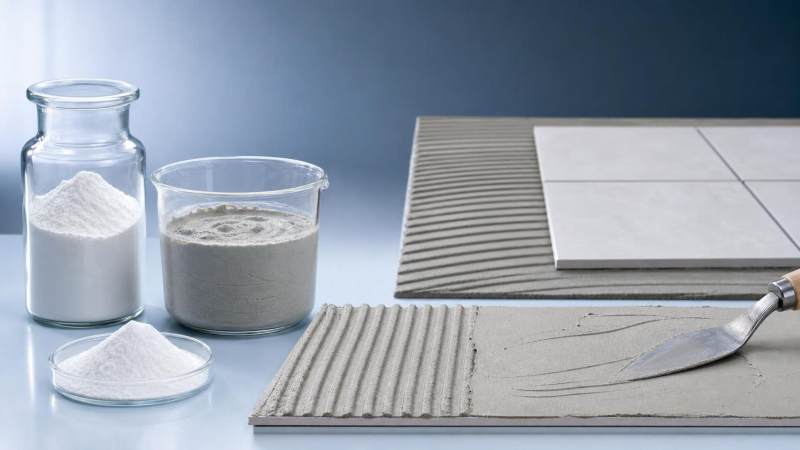
What to check before you choose an HPMC grade
In dry mix, the grade matters as much as the dosage. Two powders that look similar on paper can behave very differently once water hits the batch. If the mortar feels too stiff, dries too fast, or refuses to hold water on a hot wall, the problem is often not the formula name alone. It is the way the HPMC powder fits the rest of the system.
For tile adhesive, plaster, mortar, and wall putty, the practical question is simple: does the powder help the mix stay open long enough, spread without drag, and keep water available for hydration and adhesion? That is the real check. Everything else is only useful if it supports those three points.
Start with water retention, not viscosity alone
Water retention is the first thing to verify because it shapes nearly every other field result. A mix that loses water too quickly will skin over, pull too hard on the trowel, and leave weak contact at the interface. On porous substrates, that can turn into dusting, poor bond, or uneven curing.
- Check whether the mix still feels workable after a few minutes on the board, not just right after mixing.
- Watch for rapid stiffening on hot, dry, or windy sites; these conditions expose weak water retention fast.
- Compare spreadability on absorbent and non-absorbent surfaces, because the same formulation can behave differently on each.
A common mistake is chasing higher viscosity and assuming that will solve water loss. It sometimes helps, but not always. The better test is whether the powder keeps enough moisture in the system for the cement or other binders to do their job. If the mix stays wet but feels gummy or sluggish, you may have moved too far in the other direction.
Use open time as the field reality check
Open time is where the product either helps the installer or creates rework. In practice, it means the window between spreading and placing still needs to be long enough for the job rhythm on site. Short open time leads to early skinning, poor transfer, and rushed corrections that damage the finish.
Do not judge open time only by the laboratory clock. A formulation can look fine in a controlled test and still fail when ambient temperature rises, air movement increases, or the substrate pulls moisture faster than expected. What matters is whether the installer can comb, place, adjust, and still get full contact without fighting a dry surface.
- If the surface skins before placement, open time is too short for that job condition.
- If the mortar remains workable but slumps or loses edge definition, the issue may be balance, not just duration.
- If re-tempering is needed to keep the batch alive, the system is already outside a comfortable working window.
For site users, the useful question is whether the batch stays usable long enough for the actual crew pace. A slower team, a larger area, or a warmer floor can all demand a different grade than the one that worked in another project.
Workability is not just “feels smooth”
Workability is the part operators notice first, but it needs to be judged carefully. A mix can feel creamy and still be wrong if it drags under the trowel, slumps after application, or traps air during application. Good workability means the material spreads evenly, holds shape when needed, and releases cleanly from the tool.
A useful field check is to look at the whole handling sequence: batching, wetting out, mixing time, standing time, remix, application, and final surface behavior. If one of those steps feels off, the problem may be dosage, grade selection, or the interaction with sand, cement, RDP, starch ether, or other additives.
Match the grade to the job, not the label
People often ask for a “stronger” HPMC powder, but stronger is not a clean technical target. A grade that helps a heavy mortar can be too slow or too sticky for a finer finish coat. A grade that feels excellent in wall putty may not give enough body in tile adhesive. The right choice depends on what the mix has to do on site.
Use this simple check before you lock the formulation:
- Define the substrate: absorbent, dense, warm, or exposed to air movement.
- Define the application pace: fast crew, slow crew, large area, or detailed repair.
- Define the finish requirement: flat build-up, thin skim, smooth trowel, or strong anti-sag behavior.
- Check compatibility with the rest of the dry mix, especially any other cellulose ether or polymer system in the formula.
That sequence prevents a lot of avoidable trial-and-error. It also keeps the discussion focused on performance rather than on vague powder descriptions.
Watch how the mix behaves after standing
A dry mix can look perfect immediately after mixing and still fail after a short rest. That is why standing time should be part of every practical check. If the material thickens too quickly, loses creaminess, or needs too much remixing to recover, the installer will feel it long before a lab report explains it.
This is where HPMC powder shows its balance. Too little water retention and the mix dries out. Too much structure without enough release and the mix becomes sticky. The useful range is the one that keeps the mortar open, stable, and easy to move without turning it into paste.
Do not ignore processing and storage
Even a good formulation can drift if handling is poor. Powder that absorbs moisture in storage, blends unevenly, or is added in the wrong sequence can give inconsistent site results. When users report batch-to-batch variation, the problem is sometimes in the process rather than the grade itself.
- Keep the blend uniform so the additive does not segregate during transport or bagging.
- Use a mixing sequence that allows the powder to wet out cleanly.
- Protect bags from damp storage, because moisture pickup can change flow and handling before the product ever reaches the mixer.
A practical way to review a batch
When a batch is being evaluated, the most useful approach is to check the same questions in the same order every time: does it retain water long enough, does it stay open long enough, and does it remain easy to place without losing body? That sequence keeps the review tied to job performance instead of isolated test numbers.
If one of those points fails, trace it back before changing several ingredients at once. Start with dosage, then grade choice, then interaction with the other solids in the formula. That order usually saves time and avoids masking the real cause.
For operators and applicators, the best result is not the most impressive powder on paper. It is the one that gives a predictable batch, a workable open window, and a finish that holds up under the actual site conditions.
Send Your Inquiry
We welcome your cooperation and we will develop with you.
