


Choosing the Right HPMC Powder Viscosity for Tile Adhesive and Wall Putty
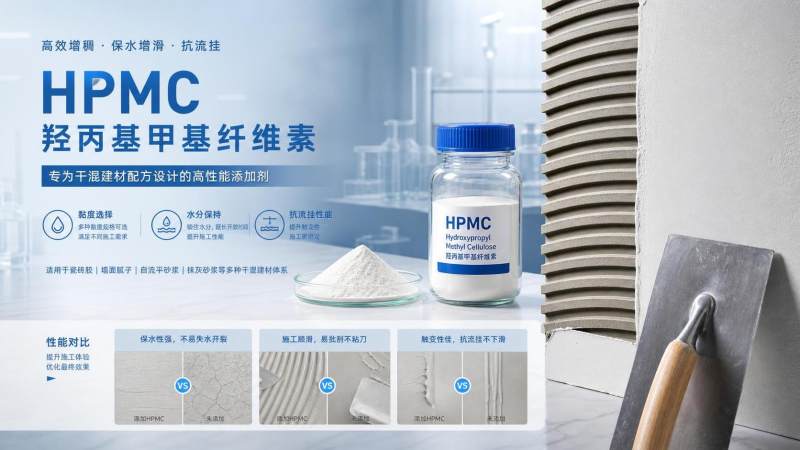
Choosing the Right HPMC Powder Viscosity for Tile Adhesive and Wall Putty
The most common mistake in selecting HPMC powder for drymix mortar is treating viscosity as a simple “higher is better” indicator. It is not. In tile adhesive and wall putty, viscosity is one of the key control points, but it only becomes meaningful when read together with water retention, open time, anti-sag behavior, workability, mixing response, and the substrate or tile system involved. A grade that performs well in one formula can create avoidable problems in another, even when the dosage looks reasonable on paper.
That is why technical evaluation usually starts with application behavior rather than with a single CPS number. HPMC powder is expected to do several things at once: retain water so cement or gypsum can hydrate properly, improve spreadability, stabilize the wet mix, and help the material stay where it is placed. In tile adhesive, this affects troweling feel, slip resistance, and bonding consistency. In wall putty, it influences knife smoothness, leveling, edge drag, and whether the applicator feels the material is “full” or “empty” under the blade.
Viscosity matters because it changes how the cellulose ether builds the rheology of the system. But the usable result on site is not determined by viscosity alone. The same nominal viscosity grade can behave differently depending on raw material selection, surface treatment, dissolution profile, particle distribution, and formulation balance with cement, fillers, RDP, starch ether, and retarders. This is one reason experienced buyers do not reduce selection to one brochure line.
What the viscosity number really helps you predict
In practical terms, lower-to-mid viscosity HPMC grades are often considered when a formulation needs easier flow, faster wetting, and a lighter application feel. Higher viscosity grades are usually brought in when stronger water retention, more body, and improved anti-sag performance are required. That sounds straightforward, but there is a tradeoff curve behind it.
If the viscosity is too low for the system, tile adhesive may feel weak under the trowel, lose water too quickly on absorbent substrates, or show poor vertical hold. Wall putty may become too loose, with reduced fullness and less forgiving application. If the viscosity is too high, the mortar can become sticky, harder to spread, slower to dissolve cleanly during mixing, or overly resistant during manual application. In putty, excessive viscosity may create a “dragging” feel that workers dislike even if laboratory retention values look good.
So the viscosity number is best understood as a predictor of rheological direction, not a guarantee of field performance. It tells the evaluator where the formulation is likely to move, but not whether it has reached the right balance.
Tile adhesive: viscosity selection is tied to tile type and construction method
In tile adhesive, HPMC powder is often judged by three visible outcomes: whether the mix holds water long enough, whether the ridges stay stable after troweling, and whether the tile stays in position without noticeable slip. These points become more critical as tiles become larger, less absorbent, or heavier.
For standard wall and floor tile adhesives, a mid-range viscosity grade is often a starting point because it gives room to balance open time and workability. Once the system shifts toward large-format tiles, vertical application, or more demanding open-time expectations, the evaluator may need a higher viscosity contribution or a different combination of HPMC and auxiliary additives. The reason is simple: larger and denser tiles give the adhesive less margin. Water retention must stay under control, and the wet matrix needs enough structure to resist slump before the cement network develops.
Another point often missed is that high viscosity alone does not automatically solve anti-slip issues. If the cement, filler gradation, polymer powder, or starch ether are mismatched, the formula may still show poor comb stability or difficult troweling. Evaluators who have worked with vertical tile installation know that the best result usually comes from coordinated rheology, not from pushing one cellulose ether parameter to the top.
This is where supplier capability starts to matter. A manufacturer with broad viscosity coverage gives more room for precise adjustment rather than forcing the formulator into oversized dosage changes. Jinan Ludong Chemical, for example, produces construction-grade HPMC with viscosities controllable from 400 to 200,000 CPS, which is relevant not as a marketing claim but as a formulation advantage: evaluators can move more deliberately between grades instead of redesigning around a narrow product window.
Wall putty: the “best” viscosity is the one that makes application stable, not heavy
Wall putty creates a different selection logic. The operator is highly sensitive to touch, blade response, and leveling. A viscosity grade that looks attractive because it gives strong water retention may still be rejected if it produces obvious drag marks, poor feathering, or uneven smoothing on the wall.
In interior wall putty, the HPMC powder usually needs to provide enough lubricity and water control for a smooth finish while keeping the mix stable during the application window. If the grade is too thin, the putty can feel weak, watery, or short in open handling. If it is too thick, the applicator may feel that the material “locks up” under the blade. That kind of feedback is not trivial; in real production, applicator acceptance often determines whether a formula survives scale-up.
There is also a difference between formulas aimed at easy hand application and those optimized for machine-assisted or higher-throughput production. A technical evaluator should be careful not to assume that one viscosity target fits both. Putty systems often need a narrower comfort zone than tile adhesive because tactile performance is judged more directly and more critically.
A practical way to compare viscosity options
When selecting among HPMC powder grades, it helps to compare them through formulation behavior rather than through isolated product descriptions. The table below is not a substitute for testing, but it reflects the kind of distinctions technical teams usually look for.
The useful question is not “Which side is better?” but “Which side supports the target construction behavior with the least compromise?”
Common misunderstandings in HPMC powder selection
One misunderstanding is assuming that a high CPS grade always means better bonding. Bond strength depends on the complete adhesive system and the curing condition, not on cellulose ether viscosity by itself. HPMC mainly shapes water management and application rheology; it does not replace polymer contribution where flexibility or improved adhesion is required.
Another is reading lab viscosity as if it were a direct on-site performance value. Viscosity is measured under defined conditions, but jobsite behavior includes water quality, ambient temperature, sand gradation, mixing energy, and operator habit. This is why bench comparison should include application simulation, not just solution data sheets.
A third mistake is changing dosage when the problem is actually grade mismatch. Increasing dosage can sometimes correct a weak system, but it can also make the mix too sticky, slow, or costly. In many cases, switching to a more suitable viscosity range or adjusting the cellulose ether package with other ingredients is the cleaner solution.
What technical evaluators should ask before locking a grade
A sound selection process usually comes down to a few discipline-specific questions:
- Is the application focused on general interior use, vertical tile installation, large-format tile, or high-smoothness putty finishing?
- What is the acceptable balance between easy spreading and structural hold?
- How sensitive is the formula to water demand, filler changes, and mixing conditions?
- Does the supplier offer enough viscosity range and batch consistency to support scale-up?
- Are the tests reflecting the actual construction method rather than only laboratory convenience?
Those questions matter because HPMC powder is rarely selected in isolation. A global producer with integrated cellulose ether manufacturing, established process control, and a wide product window can reduce formulation risk simply by making grade-to-grade behavior more predictable. Ludong Chemical’s production setup, including large-scale capacity and construction-grade series coverage, is relevant here because consistency and selectable range are often as important as nominal viscosity itself.
For tile adhesive and wall putty, the right viscosity is the one that delivers stable construction behavior under the real conditions where the material will be mixed and applied. That usually means resisting the temptation to choose by CPS number alone. Start with the job requirement, verify how the mix behaves in use, and treat viscosity as a formulation lever rather than a standalone quality verdict. That is where better selection decisions usually come from.
Send Your Inquiry
We welcome your cooperation and we will develop with you.
