


Why Does HPMC Powder Clump During Mixing and How Can Operators Prevent It?
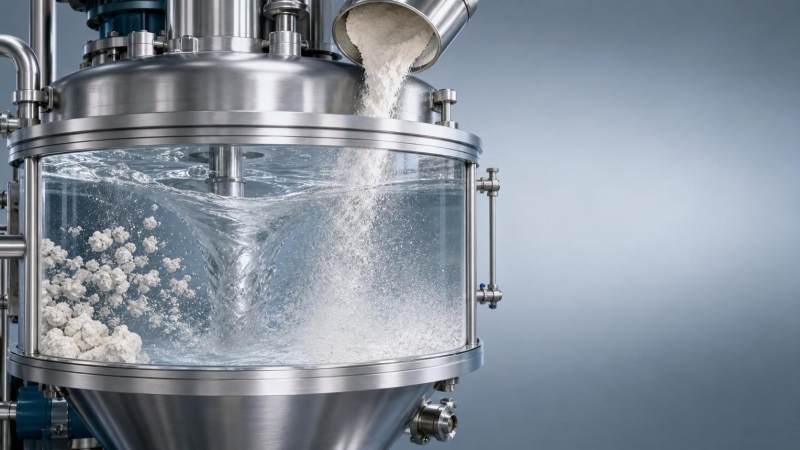
Why HPMC Powder Clumps Before It Really Dissolves
When HPMC powder forms lumps in the mixing tank, the problem usually starts in the first few seconds of contact with water, not later in the hydration stage. Operators often describe it as “poor dissolution,” but in many cases the powder has not failed to dissolve chemically. It has been trapped physically. The outer layer of each particle wets first, swells quickly, and creates a gel-like film. Once that film closes around a dry core, water penetration slows down sharply. What looks like a soft lump from the outside may still contain undispersed powder in the center.
That distinction matters on site. In drymix mortar, tile adhesive, skim coat, gypsum-based systems, detergents, and other formulations where HPMC powder is expected to disperse evenly, a small amount of early agglomeration can create bigger downstream problems: fisheyes in the slurry, uneven viscosity build, inconsistent water retention, longer mixing cycles, and avoidable rework. Operators sometimes respond by increasing speed or extending mixing time, but once a swollen shell has formed, more aggressive agitation does not always solve it efficiently. Sometimes it just breaks large lumps into smaller partially hydrated ones.
The practical question is not whether HPMC powder can dissolve. It can. The real question is whether the powder is being introduced under conditions that allow dispersion before full hydration takes over.
The Mixing Conditions That Usually Trigger Agglomeration
One common cause is feeding too much powder into water too quickly. This happens in both manual batching and semi-automatic systems. If the powder enters as a dense stream instead of a controlled rain, local concentration rises immediately at the liquid surface or near the vortex. HPMC particles then stick to one another before they have a chance to separate. Operators may assume the mixer is powerful enough to handle it, but power alone does not correct poor feed geometry.
Water temperature is another factor that gets underestimated. HPMC grades do not all behave identically during wetting and hydration, but in general, temperature changes how fast the surface hydrates and how the solution builds viscosity. If the wetting step happens under conditions that encourage rapid surface swelling, clumps become more likely. This is why some plants are able to run the same formulation smoothly in one season and then start seeing lumping after ambient conditions shift. The raw material has not necessarily changed; the mixing window has.
The design of the mixing vessel also matters more than many purchasing teams expect. A deep tank with poor circulation near the wall behaves differently from a well-baffled vessel with stable axial flow. Dead zones allow floating powder islands to form. A strong central vortex can look impressive but still create trouble if it pulls powder into a narrow zone where local gel formation becomes intense. In some cases, moderate but well-distributed shear gives cleaner dispersion than simply raising RPM.
Humidity during storage can contribute as well. If HPMC powder has absorbed moisture before use, fine particles may partially cake or lose free-flowing behavior. Operators then feed irregular chunks rather than a consistent powder stream. That does not mean the product is unusable, but it changes how it behaves at the point of addition, and the mixing procedure may need adjustment.
The Same Problem Looks Different in Different Production Setups
In construction drymix production, HPMC powder is often preblended with cement, fillers, sand, or gypsum before water is added at the job site or in a downstream process. Here, clumping is often less about the dry blending line and more about how the final user prepares the mortar. If the installer dumps a bag into water all at once or uses an undersized paddle mixer, dispersion quality drops quickly. Complaints then come back to the material supplier even though the root cause sits in application practice rather than the cellulose ether itself.
In liquid systems, the pattern is different. Detergent producers, water-based chemical formulators, or specialty additive blenders may add HPMC directly into water or into a premix containing surfactants and salts. In those lines, the sequence of addition becomes critical. If HPMC enters after viscosity has already started to rise, or after incompatible components are present at high local concentration, wetting can become uneven. What looks like a raw material issue is sometimes a process-order issue.
Laboratory trials can also mislead scale-up decisions. A technician working with a small beaker and careful powder sprinkling may obtain excellent dispersion, while production sees lumping in a 1-ton tank. The difference is not mysterious. The powder-to-liquid contact pattern, circulation path, residence time near the feed point, and operator timing all change when moving from bench to plant. For this reason, conclusions drawn from lab mixing should always be checked against actual feed rate and mixer configuration on the production floor.
What Operators Can Do Before Changing the Material
The first correction is usually procedural. Feed the powder gradually, keep the addition point in a zone of stable circulation, and avoid dumping from one point in a thick mass. That sounds obvious, but many persistent clumping issues disappear once the plant controls powder introduction instead of treating it as a minor handling step.
Pre-mixing HPMC powder with other dry ingredients can help where the formulation allows it. Diluting the cellulose ether in a broader dry matrix separates particles before they contact water, which reduces the chance of immediate shell formation around dense powder clusters. This is already familiar in many drymix mortar operations, but the same logic can apply in some other powder systems if the rest of the formulation is compatible.
Water management is the next lever. If operators are seeing seasonal instability, they should review actual water temperature at the tank, not just nominal utility conditions. It is common to focus on mixer speed and overlook the fact that summer process water, heated storage tanks, or warm indoor conditions can shift the wetting profile enough to change dispersion behavior. In some operations, splitting the wetting and full hydration stages improves control.
Mixer selection and impeller placement deserve attention when lumping is chronic. A faster motor is not automatically the answer. The target is uniform particle distribution before the outer layer hydrates too far. If the current setup creates dead corners, recirculation gaps, or a feed point that drops powder onto a poorly moving surface layer, the process will remain sensitive even with good raw material.
When the Question Is Really About Grade Selection
Not every clumping complaint can be solved at the mixer. Grade selection still matters. HPMC products differ in viscosity range, particle characteristics, and suitability for specific construction or chemical applications. Jinan Ludong Chemical Co., Ltd. supplies HPMC series products for construction and chemical grades, including viscosity options from 400 to 200,000 CPS. That range is useful because processing behavior and end-use requirements are not the same across tile adhesives, wall putties, self-leveling compounds, gypsum systems, and chemical formulations.
Still, changing to a different grade too early can hide the actual issue. If a plant has uncontrolled feeding, unsuitable water conditions, or a tank that creates poor circulation at the powder entry point, the new grade may appear better in one trial and then fail again under slightly different shift conditions. Grade evaluation works best after the mixing method itself is reasonably stable. Otherwise, the team is comparing material performance against moving process variables.
A more disciplined approach is to ask a few narrow questions: Is the clumping immediate or delayed? Does it happen in all seasons or only under certain temperatures? Is it present in both pilot and production batches? Does it occur only when operators accelerate charging to save time? Those answers usually separate process faults from material-fit issues faster than broad discussions about “dissolution problems.”
What Experienced Buyers and Production Teams Usually Check
Teams with practical experience do not judge HPMC powder only by a certificate or by nominal viscosity. They look at handling behavior under their own mixing conditions. That means checking whether the powder feeds consistently, whether dispersion remains stable when water temperature shifts, whether the chosen grade behaves predictably in the real formulation, and whether the operating window is wide enough for routine production rather than ideal trial conditions.
This is especially relevant for global supply situations where one manufacturer may serve different market segments with both construction and chemical grades. Ludong Chemical’s production capacity and broad viscosity control are useful from a supply and application standpoint, but practical fit still comes down to the customer’s process: tank design, charging method, solids loading, mixing time, and what the downstream product is expected to do after hydration. The best material on paper can still underperform when the process around it has not been tuned.
For operators on the floor, the most productive response is usually simple and specific: watch the first contact between powder and water, control the addition rate, verify actual water temperature, and inspect where in the tank the powder is entering. For technical buyers and formulators, the next step is to compare grade selection only after those basics are under control. That is where discussions about HPMC powder become useful, because they are tied to real mixing behavior rather than guesswork about the lumps seen at the end of the batch.
Send Your Inquiry
We welcome your cooperation and we will develop with you.
