


HPMC Powder Storage Guide: How Humidity and Packaging Affect Shelf Life
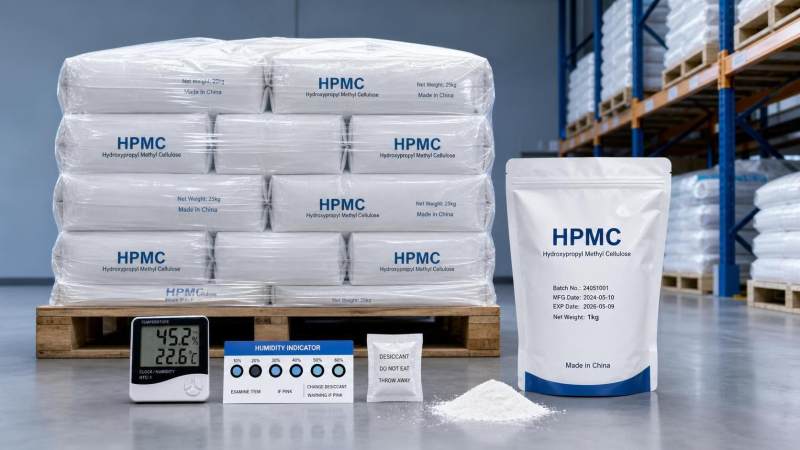
Why storage problems with HPMC powder show up in after-sales work so often
If you handle after-sales support, you usually see HPMC powder storage issues only after they become application problems: poor flow, lumping, unstable mixing, or customer complaints that a familiar formula suddenly behaves differently. In many cases, the root cause is not the formulation itself. It is moisture pickup during storage, weak packaging control, or handling conditions that were treated as “good enough” until performance started to drift.
That is why storage needs to be managed as part of product performance, not as a warehouse housekeeping detail. Humidity, packaging integrity, stack condition, opening practices, and turnover speed all affect whether HPMC powder reaches the end user in the same condition it left the supplier. The questions below focus on the issues maintenance and service teams actually need to judge on site or during complaint handling.
Does humidity really shorten the shelf life of HPMC powder?
Yes. Humidity is one of the fastest ways to reduce storage stability, especially once packaging has been opened or damaged. HPMC powder is usually expected to remain free-flowing and consistent during normal storage, but exposure to moisture can change that long before the material looks obviously spoiled.
The first signs are often practical rather than chemical. Powder may start forming soft or hard agglomerates, the discharge rate changes, dusting behavior becomes inconsistent, and dispersion in water may take longer or become less uniform. For an after-sales team, that matters because customers rarely describe the problem as “moisture exposure.” They describe it as mixing trouble, viscosity variation, or poor job-site consistency.
A useful field judgment is simple: if the product has been stored in a damp warehouse, near doors, near wet walls, or in an area with repeated temperature swings, humidity should be treated as a likely cause even before lab work begins.
What packaging issues usually lead to trouble?
Most storage failures do not start with a dramatic tear in the bag. They start with smaller packaging weaknesses that go unnoticed during receiving, internal transfer, or partial use. A pinhole, poor sealing line, puncture from pallet movement, crushed corners, or repeated rehandling can be enough to let moisture in over time.
When you inspect a complaint batch, check the packaging in this order:
- Look at the outer bag condition: tears, abrasion, softened paper, or warped shape.
- Check the seal area closely: broken seams, incomplete sealing, or tape-based resealing after opening.
- Review pallet condition: overstacking, leaning loads, edge compression, or bottom-layer deformation.
- Ask whether the bag was ever opened and closed again during use.
If the material was stored correctly but the packaging barrier was compromised, the shelf life you expected on paper may no longer reflect the actual condition of the powder in the bag.
How can you tell whether HPMC powder has absorbed too much moisture?
Start with the physical condition. You do not need to wait for full analytical testing to make a first judgment. In service work, the following signs are often enough to separate a storage issue from a normal process complaint:
- Free-flowing powder has become packed, caked, or uneven in texture.
- Lumps break apart with pressure but return after short exposure.
- There is visible hardening near the bag opening or at the bottom corners.
- Mixing time on site has increased compared with previous batches stored under better conditions.
- Operators report different wetting or dispersion behavior using the same process.
One caution: not every lump means the material is unusable, and not every bag that looks acceptable is still in ideal condition. What matters is whether the physical change has started to affect handling and application. If the customer reports process instability along with visible caking, storage exposure should move to the top of the investigation list.
What storage conditions are worth checking first on site?
After-sales teams can lose time by asking broad questions like “Was it stored properly?” That usually gets a vague yes. Better results come from checking a few specific points that directly affect HPMC powder condition.
This kind of check gives you usable evidence. It also helps separate supplier-related concerns from storage and handling issues at the user end.
Is an unopened bag automatically safe until the full shelf life ends?
No. “Unopened” is not the same as “protected.” Shelf life depends on storage conditions being maintained, and packaging remaining intact throughout transport, warehousing, and internal movement. A sealed bag that sat for months in a humid, poorly ventilated area can still become a problem bag.
This is especially relevant when stock sits too long in low-turnover warehouses or service depots. Teams often rely on the production date alone, but the better approach is to look at three factors together: bag age, packaging condition, and storage history. If one of those is weak, the date code alone does not tell the full story.
What should be done once a bag has been opened?
Opened bags deserve special handling because the original moisture barrier has already been interrupted. The safest practice is to use the remaining HPMC powder as quickly as practical under controlled storage, instead of treating it like unopened stock.
For after-sales guidance, the most useful advice is operational:
- Reseal immediately after partial use with a closure that actually limits air and moisture ingress.
- Mark the opening date on the bag or internal stock label.
- Store the remainder off the floor, away from doors and wet-process areas.
- Use opened material ahead of unopened inventory.
A common mistake is leaving partial bags in production areas for convenience. That is where moisture exposure, contamination, and identification errors tend to happen together.
Can caked HPMC powder still be used?
Sometimes, but it should not be cleared based on appearance alone. Soft caking from mild compaction is very different from moisture-driven hard agglomeration. If the powder breaks down easily and the application behavior remains consistent, the risk may be lower. If the lumping is hard, uneven, or linked to slower dispersion and processing changes, using it without evaluation can create repeated complaints downstream.
A practical service rule is this: once caking is accompanied by process change, do not treat it as a cosmetic issue. Isolate the lot, compare it with well-stored reference material if available, and review the storage chain before approving further use.
Which documents help when investigating a shelf-life complaint?
Good complaint handling depends on traceability. When HPMC powder performance is questioned, the most useful records are usually not long reports. They are basic control documents that show where the material has been, how long it stayed there, and whether the packaging was preserved.
- Batch or lot identification
- Production or delivery date
- Warehouse receiving record
- Internal transfer history
- Opened-bag usage log, if partial use occurred
- Photos of the bag condition and storage area
These records help answer the real question: did the HPMC powder remain within controlled storage conditions, or did the complaint develop after preventable exposure? Without that trail, teams end up arguing from memory.
What storage mistakes cause the most repeat complaints?
A few patterns show up again and again. One is storing bags directly on the floor, especially in warehouses with seasonal humidity or cleaning water exposure. Another is mixing old and newly received stock without clear rotation. Partial bags are also a recurring problem, particularly when they are folded over and left in production zones.
There is also a less obvious issue: assuming all dry-looking warehouses are suitable. A space can look clean and still have repeated condensation near entrances, roofs, or exterior walls. That is enough to affect packaging over time. If your team keeps seeing isolated complaint lots rather than a full-batch issue, local storage conditions are often the missing piece.
How should after-sales teams give storage guidance without overcomplicating it?
Keep the message tied to decisions people actually make in warehouses and on site. The goal is not to give a chemistry lecture. It is to prevent avoidable moisture exposure and protect packaging from the moment the material arrives until the bag is fully used.
A practical instruction set usually fits on one page: store in a dry indoor area, keep bags off the floor and away from walls, avoid long exposure in high-humidity zones, inspect seals before use, mark opened bags, and rotate stock so older material is used first. When complaints do occur, inspect the bag and the storage environment before assuming the product itself is at fault.
If you need one working principle to close the loop, use this one: treat HPMC powder shelf life as a combination of time, barrier condition, and environment. When any one of those slips, performance risk goes up fast.
Send Your Inquiry
We welcome your cooperation and we will develop with you.
