


Can HPMC Powder Reduce Formula Cost Without Sacrificing Performance?
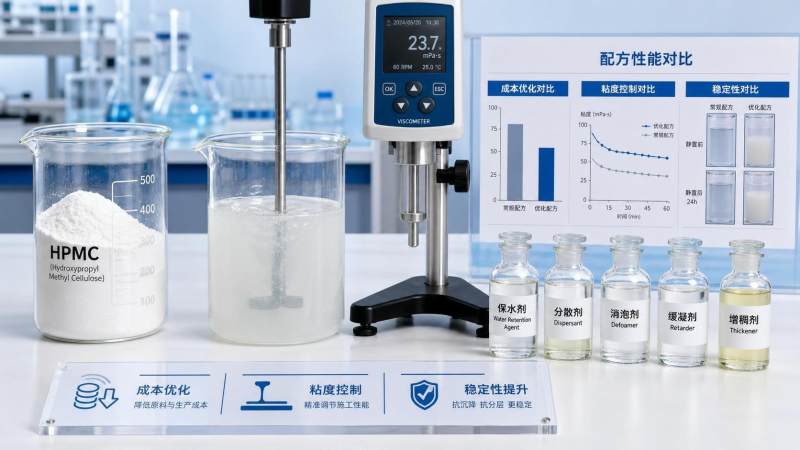
Where does HPMC powder actually save money in a formulation?
For most buyers, the wrong starting point is price per kilogram. The real question is cost per usable formula. HPMC powder can reduce overall formulation cost when it helps you use materials more efficiently, improve consistency in production, and avoid performance failures that trigger rework, complaints, or waste.
In construction and chemical additive applications, HPMC is often selected for water retention, workability, open time, thickening control, and stability. If those functions are handled well, a formulator may be able to optimize the loading of other ingredients, reduce application issues on site, or stabilize quality enough to lower hidden operating cost. That is usually where the financial gain comes from, not from simply buying the cheapest grade available.
So yes, HPMC powder can reduce formula cost without sacrificing performance, but only when the grade, viscosity range, and dosage are matched to the end use. A low purchase price paired with poor batch behavior is not a saving. It is just delayed cost.
Is lower-cost HPMC always a smart procurement move?
Usually not. Lower unit price can be helpful, but only if the material performs at a similar dosage and gives stable processing behavior. If a cheaper HPMC requires a higher addition rate, slower mixing, tighter process control, or causes more batch variation, the apparent saving disappears quickly.
Decision-makers should compare suppliers on a delivered-cost basis, not just invoice price. That means looking at:
- effective dosage in the target formula
- viscosity consistency from batch to batch
- mixing behavior and dispersion time
- risk of field complaints linked to sagging, poor workability, or weak water retention
- supply reliability and specification clarity
A procurement team that ignores those points may buy a cheaper raw material and still end up with a more expensive finished product.
What performance should not be traded away just to cut cost?
That depends on the formula, but some performance areas are usually non-negotiable. If HPMC powder is part of the functional backbone of the system, weakening it can damage the product in ways that are expensive to fix later.
If your product competes on application feel, consistency, or site efficiency, these are not side issues. They are commercial issues.
How do you tell whether a higher-viscosity or lower-viscosity HPMC powder will be more economical?
More viscosity does not automatically mean better value. A higher-viscosity grade may allow lower dosage in some systems, but it can also change mixing behavior, application feel, and production tolerance. A lower-viscosity grade may be more economical when the formula already has enough body and only needs support on water retention or stability.
This is where specification range matters. Ludong Chemical, for example, offers HPMC viscosities from 400 to 200,000 CPS, which reflects how wide the decision window can be. For a buyer, that means the conversation should not be limited to “send your best price.” The useful question is which viscosity range reaches the target performance at the lowest total formula cost.
A practical approach is to compare two or three grades under the same test conditions and measure performance at equivalent use levels. You are looking for the lowest dosage that still protects the product’s critical behavior, not the strongest thickening effect on paper.
What should a procurement team ask a supplier before approving HPMC powder?
The fastest way to make a weak buying decision is to request a quote without defining the technical checkpoint list. Even if purchasing and formulation are separate teams, HPMC approval should be based on a short set of commercial and technical questions.
- What grade is being proposed for the intended application?
- What is the nominal viscosity range, and how tightly is it controlled?
- What dosage window is typically evaluated for similar formulations?
- Is the material positioned for construction grade or chemical grade use?
- What documents define the product consistently: technical data sheet, specification sheet, and certificate of analysis?
- What annual production capacity and supply continuity can support long-term contracts?
Those questions matter because cost control is not only about negotiating price. It is also about reducing the chance that you switch material, re-qualify it, and then discover supply inconsistency three purchase orders later.
Can HPMC powder lower the use of other additives?
In some formulations, yes. That is one of the strongest arguments for reviewing HPMC powder strategically rather than treating it as a simple commodity input. When HPMC is well matched to the system, it may help rebalance the formula so that other supporting materials do not need to be pushed as hard.
But this only works when the role of each additive is clear. If a team substitutes grades without understanding which ingredient is carrying water retention, flow behavior, or stability, they can end up increasing total additive cost while chasing the original performance back into the formula.
The sound method is to test HPMC in the full formulation, then review whether any companion additives are now oversized for the target result. That step is where cost reduction becomes real.
What are the most common mistakes when companies try to save money with HPMC powder?
A few mistakes show up again and again in procurement-driven reformulation work.
- Comparing products by price only, without matching viscosity and intended grade.
- Running a lab check on appearance and viscosity, but not on application behavior.
- Assuming one successful sample batch proves long-term production stability.
- Ignoring interaction with RDP, HPS, or other additives already in the system.
- Switching supply without defining what counts as pass or fail before trials begin.
These are avoidable errors. The pattern is simple: when the buying process gets ahead of the technical evaluation, the company often pays for it later through inconsistency, longer troubleshooting cycles, and a second supplier search.
How should decision-makers test whether a new HPMC option really reduces cost?
Use a controlled comparison, not a broad reformulation. Keep the rest of the formula stable and test one HPMC change at a time. That makes it possible to separate genuine savings from noise.
A useful internal trial usually includes:
- Set a target: lower raw material cost, lower dosage, or better process stability.
- Define pass/fail criteria before testing begins.
- Compare current HPMC against one or two alternatives at realistic dosage points.
- Measure processing behavior, not only final viscosity.
- Review total cost impact after dosage adjustment, yield, and production handling are included.
That last point is where many evaluations go wrong. A material that looks cheaper in a spreadsheet may become more expensive once extra dosage, extra mixing time, or quality variation is counted.
Does supplier scale make a difference in the cost equation?
Yes, especially for buyers managing recurring volume, multiple SKUs, or export-oriented production. Supplier scale affects more than lead time. It can influence consistency, specification discipline, and the ability to support grade matching over time.
A producer with broad cellulose ether capability and meaningful capacity may be better positioned to support ongoing sourcing programs, including different HPMC types for construction and chemical applications. Ludong Chemical states annual capacity of 45,000 tons and offers multiple HPMC series, which matters because buyers often need room to optimize across grade, viscosity, and long-term supply, not just a one-off sample.
That does not mean the largest supplier is automatically the best choice. It means supply capability should be evaluated alongside technical fit, especially when a cost-saving reformulation may become a standard product specification.
When does switching HPMC powder become too risky?
It becomes risky when the product has tight application tolerances, when customer acceptance depends on feel and consistency, or when your internal process cannot absorb raw material variation easily. In those situations, even a modest change in HPMC behavior can show up as a field problem rather than a lab problem.
Be cautious if:
- your current product is already near the lower edge of acceptable performance
- operators frequently adjust water or mixing conditions during production
- end users are sensitive to spreadability, open time, or finish consistency
- the supplier cannot clearly define the proposed grade and test basis
In other words, HPMC powder is a good place to pursue savings, but not a good place to gamble.
What is the clearest buying rule for balancing cost and performance?
Buy the grade that delivers your required performance at the lowest stable formula cost, backed by clear specifications and repeatable supply. That sounds obvious, but it changes the decision process in a useful way. Instead of asking, “Which HPMC powder is cheapest?” the better question is, “Which option keeps the formula inside target at the lowest fully loaded cost?”
For a decision-maker, the practical sequence is straightforward: define the non-negotiable performance points, screen the right viscosity range, test dosage efficiency in the full formula, and only then compare commercial terms. That is how HPMC powder becomes a cost-control tool rather than a source of avoidable variation.
Send Your Inquiry
We welcome your cooperation and we will develop with you.
