


CAS 9004-65-3 Explained: Chemical Identity, Properties, and Common Industrial Uses
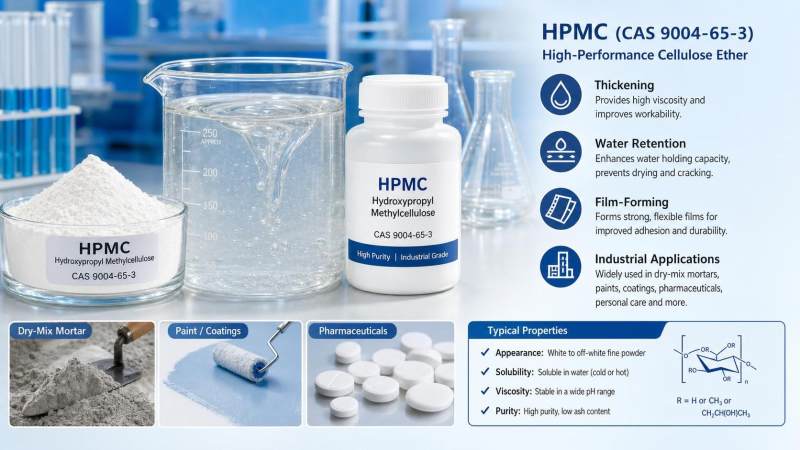
What does CAS 9004-65-3 actually refer to?
CAS 9004-65-3 is the Chemical Abstracts Service number for hydroxypropyl methylcellulose, usually shortened to HPMC. If you are researching raw materials for additives, formulations, or industrial processing, that number is the cleanest way to identify the substance without getting lost in trade names or regional naming differences.
In practical terms, HPMC is a non-ionic cellulose ether made by chemically modifying cellulose. That matters because the modification gives the material a useful mix of behaviors: it can thicken water-based systems, help hold moisture, improve consistency, form films, and stabilize suspensions. Those functions explain why CAS 9004-65-3 shows up in construction chemicals, coatings, adhesives, detergents, ceramics, pharmaceuticals, and some specialty chemical formulations.
For an information-stage buyer or researcher, the key point is simple: this CAS number identifies a broad material family, but not a single identical product grade. Different HPMC grades can behave very differently in use.
Why is CAS 9004-65-3 used so widely in industrial formulations?
Because it solves several formulation problems at once.
A lot of additives do one job well and little else. HPMC is different. In many water-based systems, it can improve application feel, reduce separation, slow down water loss, and make the final mixture more stable during handling or curing. That combination is especially valuable in products that need predictable workability on site or in production.
In construction drymix materials, for example, water retention is often one of the main reasons it is chosen. In coatings or cleaners, thickening and flow control may be more important. In tablets or films, the film-forming and binding behavior may take priority. Same CAS number, different technical reason for use.
Is CAS 9004-65-3 the same as HPMC in every document?
Usually yes, but you should still read the document beyond the CAS line.
On safety data sheets, technical data sheets, and purchasing documents, CAS 9004-65-3 commonly appears alongside names such as hydroxypropyl methylcellulose, hypromellose, or HPMC. Those names generally point to the same chemical identity. What they do not tell you by themselves is the substitution pattern, viscosity range, particle size, surface treatment, or intended application grade.
This is a common sourcing mistake: someone matches the CAS number and assumes the product is interchangeable. It may not be. For real comparison, you need the grade-level information from the supplier’s technical data sheet.
Which properties matter most when evaluating HPMC?
That depends on the application, but a few properties come up again and again:
- Viscosity: Often one of the first screening parameters. It strongly affects thickening, sag resistance, flow, and handling.
- Water retention: Critical in cement-based and gypsum-based systems where moisture control affects open time and performance.
- Solubility and dissolution behavior: Some grades disperse more easily or hydrate differently, which changes mixing behavior.
- Film-forming ability: Relevant when surface continuity, cohesion, or binding performance matters.
- Thermal gelation behavior: Important in processes exposed to elevated temperatures.
- Compatibility with the rest of the formulation: A grade that looks fine on paper can still behave poorly with salts, pigments, binders, fillers, or surfactants.
If you are only collecting baseline information, viscosity and intended application grade are usually the fastest starting points. After that, the real test is formulation fit.
What are the most common industrial uses of CAS 9004-65-3?
The broad answer is “as a multifunctional additive in water-based and powder-based systems,” but that is too vague to be useful. A more practical view looks like this:
For companies focused on cellulose ethers, the construction segment is often the most visible because HPMC performance there is closely tied to application quality and batch consistency.
If the CAS number is the same, why do different HPMC grades perform differently?
Because CAS identity tells you what the substance is, not how a specific grade behaves in your formula.
Performance can shift with viscosity level, substitution degree, particle size distribution, moisture content, surface treatment, and manufacturing control. In real production, those details affect mixing speed, lump formation, final texture, water demand, and even whether a system stays stable during storage.
That is why suppliers often offer multiple HPMC grades under the same chemical family. For example, manufacturers may provide construction and chemical grades across a wide viscosity range. A low-viscosity option and a high-viscosity option can both be CAS 9004-65-3, yet behave nothing alike in the same formula.
What should you check before selecting a grade for a project?
Start with the application, then narrow down the grade using documents and bench testing.
- Define the system: cement-based, gypsum-based, coating, cleaner, ceramic slurry, or something else.
- Identify the main job the additive must do: thicken, retain water, stabilize, improve workability, form film, or balance several of these.
- Review the technical data sheet for viscosity range, recommended use, and handling notes.
- Check whether the grade is described for your target industry or process conditions.
- Run a lab-scale trial with your actual formulation, not a simplified one.
The last step matters more than people expect. A grade can look correct on paper and still fail because another ingredient changes hydration rate or viscosity build.
What documents are useful when researching or buying CAS 9004-65-3?
At minimum, ask for the technical data sheet and safety data sheet. Those two documents answer different questions.
- Technical data sheet: Helps you judge whether the grade fits the application. Look for viscosity, recommended use, appearance, and any grade-specific handling information.
- Safety data sheet: Confirms identity, handling precautions, storage guidance, and transport-related information.
- Certificate of analysis, if available for the purchase lot: Useful when you need batch-level quality checks rather than general product claims.
If you are comparing offers from multiple suppliers, match the grade data line by line. Comparing only CAS number and price is a fast way to create avoidable reformulation work.
Are there common mistakes people make when evaluating HPMC for industrial use?
Several, and most of them happen early.
One is assuming that “higher viscosity means better performance.” Sometimes it does, sometimes it creates mixing difficulty, poor flow, or a finish that feels wrong in application. Another is treating all cellulose ethers as interchangeable. They are not. HPMC, HPS, and other etherified cellulose products may overlap in function, but they do not behave identically.
A third mistake is ignoring process conditions. Water temperature, mixing order, shear, and dwell time can all change how the product disperses and builds viscosity. When users say a material is “inconsistent,” the cause is sometimes the process, not the raw material itself.
Does CAS 9004-65-3 tell you anything about suitability for catalyst or chemical additive applications?
Only at a very general level. The CAS number tells you the chemical family, which is useful for screening. It does not prove suitability for a specific catalyst support system, reaction environment, or additive package.
If you are considering HPMC in a chemical additive context, focus on the role it needs to play. Is it there as a binder, rheology modifier, stabilizer, or processing aid? Once that role is clear, review the grade data and test the formulation under realistic conditions such as shear, solids loading, pH exposure, and drying profile. That gives you a usable answer; the CAS number alone does not.
How should this material be approached from a sourcing perspective?
Treat CAS 9004-65-3 as the starting filter, not the final buying decision.
A capable supplier in this field should be able to provide multiple HPMC grades, clear viscosity ranges, and application-oriented technical support. In the cellulose ether market, that usually matters more than broad marketing language. What you want is traceable product identity, grade clarity, and consistent documentation. If a supplier can only confirm the CAS number but cannot explain grade selection, that is a weak signal.
A practical rule: match CAS number + grade + application + trial result. Leaving out any one of those four makes the selection much less reliable.
Send Your Inquiry
We welcome your cooperation and we will develop with you.
