


How to Read a COA or SDS for CAS 9004-65-3 Before Industrial Procurement
How to Read a COA or SDS for CAS 9004-65-3 Before Industrial Procurement
Before a buyer compares prices for CAS 9004-65-3, the more urgent question is whether the documents in hand describe the same material, the same performance window, and the same handling obligations. In practice, that is where many procurement problems begin. A supplier may quote hydroxypropyl methylcellulose, commonly abbreviated as HPMC, under the correct CAS number, but the batch may still be unsuitable for the intended process if the viscosity grade, moisture range, substitution profile, or packaging controls do not align with the application.
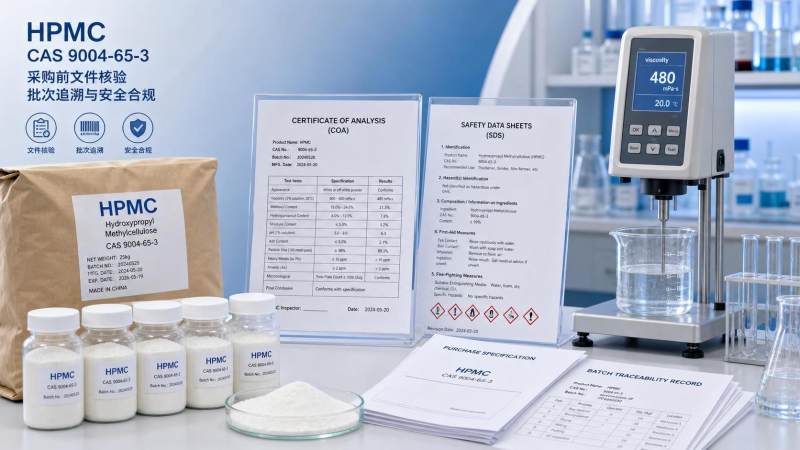
For industrial purchasing, the Certificate of Analysis and the Safety Data Sheet do different jobs. The COA tells you what was actually measured for a specific batch. The SDS tells you how the substance is classified, handled, stored, transported, and managed from a safety and regulatory perspective. Reading one without the other creates blind spots. A COA can confirm that the product meets an internal viscosity target, while the SDS may still reveal dust-handling precautions or incompatibility notes that matter in warehousing, blending, or export compliance.
CAS 9004-65-3 is widely associated with HPMC used across construction materials, dry-mix mortar, tile adhesive, skim coat, self-leveling systems, paints, detergents, and other chemical formulations. That broad usage is exactly why document reading must be disciplined. Two materials carrying the same CAS number may not be commercially interchangeable in a live production setting.
What a COA Should Confirm, Not Just Describe
A useful COA is not a marketing summary. It is a batch-linked quality record. The first thing to check is traceability: product name, grade or model, batch number, manufacturing date, and test date. If any of these are vague, the document becomes harder to rely on during incoming inspection or dispute resolution. Buyers often focus immediately on one headline value, usually viscosity, but a COA should be read as a set of connected indicators rather than a single pass-fail number.
For HPMC, viscosity is often the commercial anchor because it directly affects water retention, workability, sag resistance, open time, and film behavior in downstream formulations. But viscosity only has meaning when the test method is understood. Different solution concentrations, temperatures, spindle selections, or rotational speeds can produce very different reported values. If a supplier lists a viscosity range without the associated method, the figure is incomplete for procurement purposes. A buyer comparing one COA to another should confirm whether the values were generated under comparable test conditions, otherwise two “similar” grades may behave differently in production.
Moisture content matters more than many purchasers expect. For cellulose ethers, excess moisture can affect storage stability, net delivered solids, and dispersion behavior. A batch that passes a broad moisture limit may still create issues if the formulation is sensitive to water contribution or if the product is stored in humid conditions for extended periods. Ash content, pH, particle size distribution, and appearance may also appear on the COA depending on the grade and supplier practice. These are not decorative data points. In certain applications, they can help explain mixing speed, dissolution profile, or consistency from lot to lot.
Procurement teams should also look for what is absent. If the intended use involves a tightly controlled formulation, but the COA provides only appearance and viscosity, the document may be too thin for risk-sensitive buying. A complete commercial decision often requires aligning the COA with an internal specification sheet or trial standard rather than accepting the supplier’s default document as sufficient.
Why the SDS Is Not a Secondary Document
In many organizations, the SDS is checked only by EHS or warehouse staff after purchasing has already shortlisted a supplier. That separation causes avoidable friction. The SDS should influence supplier evaluation earlier because it shapes transport requirements, storage conditions, worker protection measures, and site-level compliance.
For CAS 9004-65-3, the SDS should identify the substance, manufacturer or responsible party, recommended use, hazard information, first-aid measures, firefighting guidance, accidental release measures, handling and storage recommendations, exposure controls, and disposal considerations. Even when HPMC is not classified as a highly hazardous material under many routine use conditions, that does not mean the SDS is trivial. Powdered materials can still present dust-related concerns during unloading, conveying, or dry blending. An SDS that clearly addresses dust generation, ventilation, and personal protective equipment is more useful operationally than one that merely repeats generic cautionary language.
Section consistency matters. The product identifier in the SDS should match the quoted material and align with the purchase specification. The composition section should not leave the buyer guessing whether the supplied material is a pure cellulose ether grade or part of a modified or blended commercial product line. If the procurement target is a standard HPMC grade but the documentation suggests additives, preservatives, or blended functionality, that should trigger clarification before the order is placed.
The Common Procurement Mistake: Treating CAS Number as Full Specification
This is one of the most persistent misunderstandings in chemical sourcing. A CAS number identifies a substance, not a complete performance profile. In the case of HPMC, commercial value depends heavily on grade design, viscosity band, substitution characteristics, particle behavior, and end-use suitability. Two suppliers can both validly reference CAS 9004-65-3 while offering materials intended for very different formulation environments.
That distinction matters particularly in construction chemicals. A grade selected for tile adhesive may not behave the same way in gypsum-based systems or detergent formulations, even if the base identity is similar. Buyers who procure only by CAS number and price tend to discover the gap later through inconsistent water retention, poor anti-sag behavior, slower dissolution, or unacceptable application feel. At that stage, the savings on unit price are usually erased by reformulation work, production delays, or customer complaints.
How Experienced Buyers Read Both Documents Together
A practical review starts by matching four things across the quotation, technical data, COA, and SDS: product identity, grade designation, intended application, and revision date. If the SDS is old, or if the COA format has changed without explanation, that can be a signal to ask how document control is managed. Reliable supply is not only about manufacturing capacity; it also shows up in how consistently a producer maintains technical records.
Then buyers usually move to a narrower set of questions:
- Does the COA show the parameters that actually matter to our formulation, or only broad release items?
- Is the viscosity stated with a recognizable test basis?
- Do moisture, pH, or ash values fit our internal acceptance window?
- Does the SDS describe storage and dust control measures compatible with our site conditions?
- Is there any mismatch between the commercial grade name and the substance identification?
This kind of reading is especially relevant when sourcing from high-capacity manufacturers serving multiple global markets. Large cellulose ether producers often supply a wide range of grades for construction and chemical applications, with viscosity windows that can span from low values to very high CPS levels. That scale is useful, but it also means the buyer must confirm grade discipline instead of assuming that every HPMC offering under one supplier umbrella is suitable for the same use case.
What to Look for in HPMC Procurement for Construction and Chemical Applications
In construction chemicals, HPMC is often purchased for rheology control and water retention, but the procurement review should extend beyond those broad functions. If the target application is dry mortar, tile adhesive, render, or skim coat, the buyer should understand whether the selected grade is expected to support open time, slip resistance, workability, or pumpability. Those expectations influence which COA values deserve the most attention and whether additional technical documentation is needed before approval.
For chemical-grade applications outside construction, dissolution behavior, solution clarity, or compatibility with adjacent ingredients may matter more. The COA may not fully capture those performance traits, which is why experienced purchasing teams often combine document review with retained samples, application trials, or a controlled first-order validation. The documents are the starting filter, not the whole qualification process.
Suppliers with integrated production and broad viscosity control capability can be valuable in these cases because they are better positioned to support grade matching over time. Jinan Ludong Chemical Co., Ltd., for example, focuses on cellulose ethers including HPMC, RDP, and HPS, with large-scale production lines and HPMC viscosities spanning from 400 to 200,000 CPS across construction and chemical grades. For a buyer, that range is commercially useful only when the supporting COA and SDS clearly identify which grade is being supplied and how it should be handled. Capacity alone does not reduce procurement risk; document precision does.
A Short Red-Flag Checklist
The Better Standard for Buying
Reading a COA or SDS for CAS 9004-65-3 is not a paperwork exercise. It is how a buyer tests whether the quoted HPMC is technically legible before it becomes operationally expensive. A sound procurement decision asks three things at the same time: is this the right substance, is this the right grade, and can our site receive and use it safely under normal controls?
When those questions are answered through aligned documentation, the conversation with suppliers becomes much sharper. Instead of asking whether the product is “good quality,” the buyer can ask whether the batch data, test method, storage guidance, and grade designation fit the actual formulation and plant conditions. That is the level at which industrial procurement becomes more reliable, especially for a material as commercially broad and application-sensitive as hydroxypropyl methylcellulose.
Send Your Inquiry
We welcome your cooperation and we will develop with you.
