


What Is Hydroxyethyl Methyl Cellulose (HEMC)? A Practical Guide for Formulators
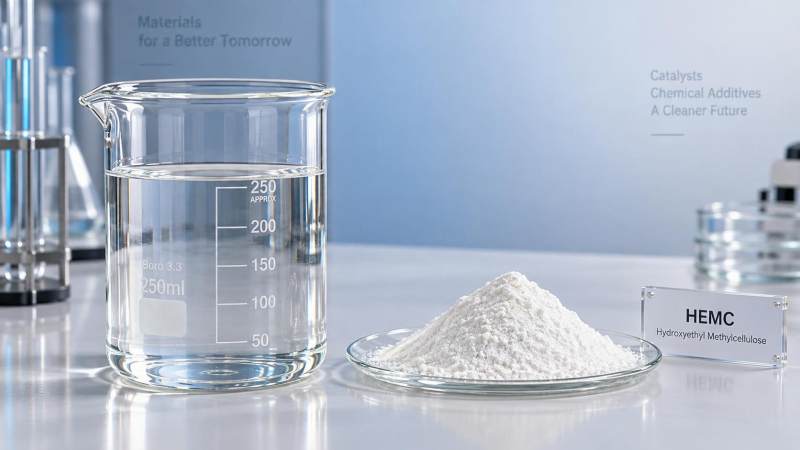
Hydroxyethyl Methyl Cellulose (HEMC) is a water-soluble, non-ionic cellulose ether derived from natural cellulose through controlled etherification with ethylene oxide and methyl chloride. Its molecular backbone consists of anhydroglucose units, each bearing hydroxyethyl (–CH2CH2OH) and methyl (–CH3) substituents at varying degrees of substitution (DS) and molar substitution (MS). Unlike hydroxypropyl methylcellulose (HPMC), where the hydrophobic propyl group imparts distinct thermal gelation behavior, HEMC’s hydroxyethyl group offers greater hydrophilicity and reduced steric hindrance—resulting in faster dissolution, higher clarity in solution, and markedly improved compatibility with ionic surfactants, acrylic monomers, and polar solvents commonly used in specialty coatings, adhesives, and chemical synthesis media.
Structural Features That Define Performance
The functional profile of HEMC is governed not only by average DS/MS values but critically by the *distribution* of substituents along the cellulose chain. A narrow distribution—achieved through precise reaction control—yields more uniform hydration kinetics and predictable viscosity build-up. In contrast, broad substitution heterogeneity can lead to inconsistent thickening, delayed water retention onset, or premature phase separation when blended with latexes or crosslinkers. For example, under high-shear mixing conditions typical in industrial dispersion preparation, HEMC with uneven substitution may exhibit transient viscosity spikes followed by rapid breakdown—a phenomenon rarely observed with tightly controlled batches. This sensitivity makes analytical characterization—such as 13C NMR for DS/MS mapping and size-exclusion chromatography for molecular weight distribution—essential for formulation reproducibility, especially when scaling from lab trials to production.
Water Retention vs. Rheology: Two Interdependent Functions
While often discussed separately, water retention and rheological control in HEMC are mechanistically linked through polymer chain hydration and network formation. At low concentrations (<0.3 wt%), HEMC primarily functions as a water binder via hydrogen bonding with free water molecules—slowing evaporation without significantly increasing viscosity. As concentration rises above 0.5 wt%, intermolecular entanglement begins, forming a transient hydrogel network that resists flow under static conditions but yields readily under shear. Crucially, this network’s stability depends on ambient temperature and pH: unlike HPMC, which gels irreversibly above its cloud point (~60–75°C depending on grade), HEMC remains fully soluble up to ~90°C and shows minimal viscosity loss even after prolonged exposure to 80°C. However, this thermal robustness comes with a trade-off—its lower hydrophobic character reduces film-forming capability in drying systems, making it less effective than HPMC in cementitious mortars requiring extended open time.
Compatibility Considerations in Complex Matrices
HEMC excels where formulation complexity demands neutrality toward charged species. In emulsion polymerization systems, for instance, its non-ionic nature avoids destabilizing anionic surfactants like sodium dodecyl sulfate or cationic initiators such as ammonium persulfate. Similarly, in pigment dispersions containing polyphosphate dispersants, HEMC maintains colloidal stability without competing for adsorption sites on particle surfaces—a limitation frequently encountered with carboxymethyl cellulose (CMC). Yet compatibility is not absolute: strong chelating agents (e.g., EDTA at >0.1%) can sequester trace metal ions that otherwise moderate HEMC chain expansion, leading to unexpected viscosity surges. Likewise, high concentrations of glycols (e.g., propylene glycol >15%) may partially dehydrate the polymer, reducing effective molecular volume and thinning the system unpredictably.
Practical Handling and Dispersion Protocol
HEMC’s rapid wetting tendency makes it prone to agglomeration if added directly to cold water. The recommended method involves dry-blending with 5–10× its weight in inert carrier (e.g., fumed silica or spray-dried glucose) before gradual incorporation into the aqueous phase under moderate agitation (300–600 rpm). Avoid high-shear pre-mixing unless the final formulation contains ≥2% co-solvent (e.g., ethanol or glycerol), as excessive mechanical energy can fragment polymer chains and reduce thickening efficiency by up to 40%. Once dispersed, full viscosity development typically requires 30–90 minutes at 20–25°C; accelerating this with heat (>35°C) risks localized dehydration and irreversible lump formation. For pH-sensitive applications, maintain pH between 4.5 and 10.5—outside this range, hydrolytic cleavage of ether linkages accelerates, particularly above pH 11.5 or below pH 3.0.
Comparative Context Within the Cellulose Ether Family
HEMC occupies a distinct niche between methylcellulose (MC) and HPMC. Compared to MC, it offers superior cold-water solubility and reduced thermogelling interference. Against HPMC, it trades some film strength and air-entrainment capacity for enhanced electrolyte tolerance and broader thermal operating range. Notably, while Hydroxypropyl Methyl Cellulose remains the benchmark for construction-grade water retention, HEMC gains traction where process flexibility and compatibility outweigh absolute thickening power—such as in solvent-borne architectural coatings, pharmaceutical suspensions requiring sterile filtration, or catalyst support matrices where residual chloride must be minimized. Its lower gelation propensity also simplifies pumpable slurry formulations destined for extrusion or spray-drying processes.
Key Selection Parameters for Formulators
When evaluating HEMC grades, prioritize three interrelated parameters over nominal viscosity alone: (1) the ratio of hydroxyethyl-to-methyl substitution (typically 1.2–2.5:1), which governs solubility kinetics; (2) the viscosity profile across shear rates (e.g., 1 s−1 vs. 100 s−1), indicating pseudoplasticity suitable for application methods like rolling or spraying; and (3) ash content (<0.5%), critical for electronic-grade slurries or battery electrode binders where metallic residues impair conductivity. Viscosity specifications (e.g., 4000–15,000 mPa·s at 2% in 20°C water) should always be referenced against standardized test conditions—not manufacturer-specific protocols—to ensure cross-grade comparability.
Ultimately, HEMC is not a drop-in replacement for other cellulose ethers but a purpose-built tool for specific formulation challenges. Its value emerges not from universal superiority, but from precise alignment with constraints: high ionic strength, elevated processing temperatures, demanding compatibility requirements, or need for rapid, lump-free hydration. Recognizing these boundaries—rather than treating it as a generic thickener—is what enables formulators to leverage its unique architecture effectively.
Send Your Inquiry
We welcome your cooperation and we will develop with you.
