


How HEMC Enhances Thickening and Suspension in High-pH Detergent Systems
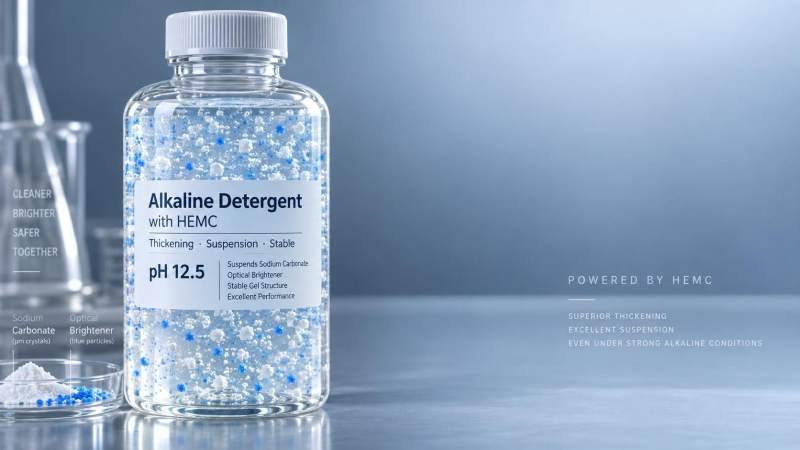
In high-pH detergent systems—especially those with pH values above 11—formulators and production operators routinely face two interrelated challenges: inconsistent thickening performance and poor suspension stability of insoluble particles (e.g., abrasives, enzymes, or optical brighteners). Unlike neutral or mildly alkaline formulations, highly alkaline environments accelerate the degradation of many conventional rheology modifiers. This leads to rapid viscosity loss, phase separation, sedimentation within hours, or even gelation upon storage. The result isn’t just cosmetic—it directly impacts dosing accuracy, cleaning efficacy, shelf life, and batch-to-batch reproducibility on the production line.
The root cause lies in molecular instability. Most cellulose ethers, including standard hydroxypropyl methylcellulose (HPMC), undergo alkaline hydrolysis under sustained high-pH conditions. Their ether linkages cleave, reducing molecular weight and collapsing the hydrated polymer network responsible for viscosity build-up and particle lift. Temperature fluctuations during storage or transport further accelerate this breakdown. Operators often misattribute the issue to incorrect dosage, inadequate mixing, or raw material variability—delaying resolution while yield losses accumulate and customer complaints rise.
Why Standard Cellulose Ethers Fail Above pH 11
Standard HPMC grades rely on methoxy and hydroxypropoxy substituents for water solubility and thickening. In strong alkali, hydroxide ions attack the glycosidic bonds between glucose units and hydrolyze ether side chains. This degradation is not linear—it accelerates exponentially above pH 10.5. At pH 12, typical HPMC solutions can lose 30–50% of initial viscosity within 72 hours at room temperature. Worse, the degraded fragments act as impurities that interfere with surfactant micelle formation, reducing detergency and foaming consistency.
Other alternatives—such as xanthan gum or carboxymethyl cellulose (CMC)—also falter. Xanthan suffers from shear-thinning hysteresis and sensitivity to divalent cations commonly present in hard-water-based detergent concentrates. CMC, while more alkali-tolerant than HPMC, lacks sufficient suspension capacity for dense particulates and exhibits pronounced syneresis over time. Neither delivers reliable, long-term rheological control across the full operating range of industrial liquid detergents.
Molecular Design Enables Alkali Resistance
The key differentiator lies in substitution pattern and backbone stability. Methyl Hydroxyethyl Cellulose (HEMC) features a dual-substitution architecture: methyl groups provide hydrophobic anchoring and thermal stability, while hydroxyethyl groups enhance hydration and steric hindrance around the glycosidic bond. Crucially, the hydroxyethyl ether linkage is significantly more resistant to nucleophilic attack by OH⁻ than hydroxypropyl or carboxymethyl groups. This structural advantage translates directly into retained molecular weight and consistent chain entanglement—even after 30 days at pH 12.5 and 40°C.
Unlike conventional cellulose ethers, HEMC does not require pre-neutralization or pH buffering to function. Its dissolution profile remains stable across pH 9–13.5, eliminating the need for tight pH control during manufacturing—a major simplification for continuous blending lines where pH drift is common. Moreover, its rheology is less sensitive to ionic strength shifts caused by salt buildup from sodium carbonate or silicate builders.
Practical Formulation Adjustments
Integrating HEMC doesn’t require overhauling existing processes—but it does demand attention to three operational parameters:
- Dissolution sequence: Add HEMC to the aqueous phase *before* introducing strong alkalis (e.g., NaOH, sodium silicate). Premixing with a small portion of non-ionic surfactant improves wetting and prevents surface lumping.
- Hydration temperature: Unlike HPMC, HEMC achieves full hydration at ambient temperatures (20–25°C) without requiring hot-water pre-dissolution. However, brief heating to 45°C for 10 minutes post-addition can accelerate dispersion completeness in high-solids systems.
- Shear history: HEMC solutions recover viscosity rapidly after high-shear pumping or homogenization. Avoid prolonged high-shear mixing (>5,000 rpm for >15 min), which can induce localized chain scission even in alkali-stable grades.
Typical dosage ranges fall between 0.3–0.8 wt% depending on target viscosity (2,000–12,000 mPa·s at 25°C, 1/s) and particulate loading. For suspending 15–25% abrasive solids (e.g., sodium carbonate crystals or silica granules), 0.6–0.7% HEMC consistently maintains ≤5% sedimentation after 6 months at 45°C—outperforming equivalent HPMC doses by a factor of 3–4 in accelerated stability testing.
Process and Quality Control Implications
From a manufacturing standpoint, HEMC reduces reliance on real-time viscosity monitoring during filling. Because its rheology remains stable across pH and temperature swings, operators can set fixed pump speeds and fill times without recalibration per batch. This cuts line changeover time by ~12% in facilities running multi-formula detergent lines.
For quality assurance teams, the reduced variability means fewer out-of-spec viscosity readings during release testing. Batch acceptance criteria can shift from ±25% tolerance (common with HPMC) to ±12%—tightening process control without increasing rejection rates. Importantly, no additional analytical methods are required; standard Brookfield viscometry and sedimentation assays remain fully applicable.
When to Reconsider Your Rheology Modifier
If your current formulation shows any of the following, HEMC warrants immediate technical evaluation:
- Viscosity drops >20% within 48 hours of final pH adjustment;
- Sediment forms within 7 days despite adequate surfactant package;
- Batch viscosity varies by >35% between production runs using identical raw material lots;
- Product separates during winter transport (≤5°C) or summer warehouse storage (≥40°C);
- Final product requires pH buffering agents solely to stabilize thickener performance.
These are not isolated symptoms—they signal underlying molecular instability. Switching to an alkali-resistant backbone like HEMC addresses the mechanism, not just the symptom. It eliminates reactive compensation steps (e.g., over-dosing thickeners, adding secondary stabilizers) and reduces formulation complexity without sacrificing performance.
HEMC’s value becomes most visible when scaling up from lab to plant. Pilot batches formulated with HEMC typically require zero viscosity rework during scale-up validation—whereas HPMC-based counterparts average 2–3 iterations to match target flow behavior. That consistency directly supports faster time-to-market for new eco-concentrates and heavy-duty industrial cleaners where pH-driven instability has historically limited formulation flexibility.
Send Your Inquiry
We welcome your cooperation and we will develop with you.
