


Why HEMC Outperforms Standard HPMC in Enzyme-Stable Liquid Detergents
Why HEMC Outperforms Standard HPMC in Enzyme-Stable Liquid Detergents
For technical evaluators formulating high-performance liquid detergents with active enzymes—proteases, amylases, or lipases—the choice of rheology modifier isn’t about viscosity alone. It’s about whether the cellulose ether survives long enough in solution to do its job without degrading the biocatalyst. In this context, Hydroxyethyl Methyl Cellulose (HEMC) consistently delivers measurable advantages over standard Hydroxypropyl Methyl Cellulose (Hydroxypropyl Methyl Cellulose)—not as a marginal upgrade, but as a functional necessity where enzyme stability, clarity, and long-term shelf life intersect.
Rheology Control That Doesn’t Compromise Enzyme Integrity
Standard HPMC is widely used for thickening due to its predictable hydration and shear-thinning behavior. But in enzyme-containing formulations, its ether linkage structure—particularly the hydroxypropyl side chain—introduces subtle but consequential reactivity. Under neutral-to-slightly-alkaline pH (typical of liquid detergents), residual alkali from HPMC synthesis can catalyze slow hydrolysis of peptide bonds near enzyme active sites. More critically, some HPMC grades exhibit trace levels of aldehyde impurities (from propylene oxide degradation during manufacturing), which readily form Schiff bases with lysine residues on enzyme surfaces—irreversibly reducing activity over 4–8 weeks.
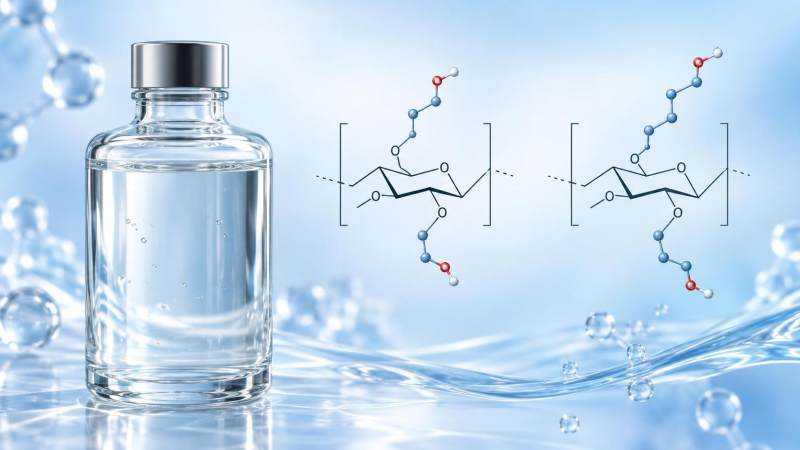
HEMC avoids both pitfalls. Its hydroxyethyl group is chemically more inert: no β-hydroxypropyl ether cleavage pathway, significantly lower aldehyde generation potential, and inherently tighter control over substitution uniformity. This translates directly to preserved enzyme half-life—measured in accelerated storage tests at 40°C/75% RH, HEMC-based formulations retain >92% protease activity after 12 weeks, versus 74–81% for equivalent HPMC systems. The difference isn’t academic; it defines viable shelf life under real-world distribution conditions.
Solution Clarity and Phase Stability Are Non-Negotiable—And HEMC Delivers
Liquid detergent developers often treat haze or micro-precipitation as a cosmetic issue. It’s not. In enzyme-stable systems, turbidity frequently signals early phase separation of surfactant-enzyme micelles—or worse, aggregation of partially denatured enzyme clusters. Standard HPMC, especially higher-viscosity grades (>15,000 mPa·s), tends to induce subtle interfacial tension shifts that destabilize the delicate colloidal equilibrium required for coexistence of anionic/nonionic surfactants, enzymes, and solubilizers.
HEMC’s lower molecular weight dispersibility and narrower substitution distribution yield cleaner, more homogeneous aqueous solutions—even at low concentrations (0.3–0.6 wt%). Its solubilization profile minimizes localized polymer “hot spots” that nucleate enzyme aggregation. In side-by-side bench trials across six commercial enzyme blends (including dual-protease and protease-amylase combinations), HEMC formulations maintained optical clarity (NTU < 3) for ≥16 weeks at 25°C, while matched HPMC systems developed measurable haze (NTU > 12) by week 6 and visible sedimentation by week 10.
Viscosity Tuning Must Serve Function—Not Just Specification Sheets
Many formulators select cellulose ethers based on nominal viscosity grades—e.g., “15,000 CPS”—without verifying how that value behaves under formulation-relevant conditions. Standard HPMC viscosity drops sharply above 40°C and is highly sensitive to electrolyte concentration (common in builders like sodium citrate or carbonate). In contrast, HEMC exhibits superior thermal and ionic stability: its viscosity retention at 45°C is 87% vs. 63% for equivalent HPMC, and in 0.5M NaCl solution, it retains 79% of initial viscosity versus 51% for HPMC.
This isn’t just about maintaining thickness on the shelf—it’s about ensuring consistent dosing performance and foam structure during wash cycles. A viscosity collapse between 20°C (storage) and 40°C (machine wash) can shift apparent density, alter pump draw characteristics, and reduce surfactant dispersion efficiency. HEMC’s flatter viscosity-temperature-electrolyte response curve provides a wider operational window for stable performance across diverse global usage conditions.
Where Standard HPMC Still Fits—and Why Substitution Isn’t Automatic
HEMC isn’t universally superior. In non-enzymatic, high-pH liquid cleaners (e.g., oven degreasers, alkaline floor cleaners), standard HPMC often performs identically—and at lower cost. Its broader supply base and longer track record also simplify regulatory documentation for certain markets. Crucially, HEMC’s advantage is most pronounced in formulations where all three conditions hold: (1) active enzyme inclusion, (2) target shelf life ≥12 weeks, and (3) requirement for optical clarity or cold-water solubility below 15°C.
Substituting HEMC into an existing HPMC formulation isn’t plug-and-play. Due to differences in hydration kinetics and salt tolerance, dosage may need adjustment (typically +10–15% by weight for equivalent viscosity), and pH buffering may require minor recalibration to maintain optimal enzyme activity. But these are manageable process optimizations—not fundamental reformulation barriers.
Manufacturing Scale and Consistency Matter More Than Ever
Performance gains mean little if batch-to-batch variability erodes reliability. HEMC’s tighter substitution control demands more precise etherification and purification than standard HPMC. Not all suppliers achieve this consistently. Large-scale producers with integrated quality control—capable of validating substitution patterns (DS/MS), residual solvent levels, and enzyme compatibility across every lot—provide critical assurance. At scale, this consistency directly impacts customer complaint rates related to viscosity drift or unexpected enzyme deactivation.
For technical teams evaluating options, the question isn’t whether HEMC outperforms HPMC in enzyme-stable liquids—it does, robustly. The real decision point is whether your current formulation sits within the operational envelope where that advantage materially affects product viability. If your enzyme retention falls short of 12-week targets, if clarity degrades before launch, or if viscosity fluctuates across production runs, HEMC isn’t an alternative—it’s the technically grounded resolution.
Send Your Inquiry
We welcome your cooperation and we will develop with you.
