


HEMC vs. HPMC: Key Rheological Differences for Industrial Cleaner Development
Time:Oct 04, 2026
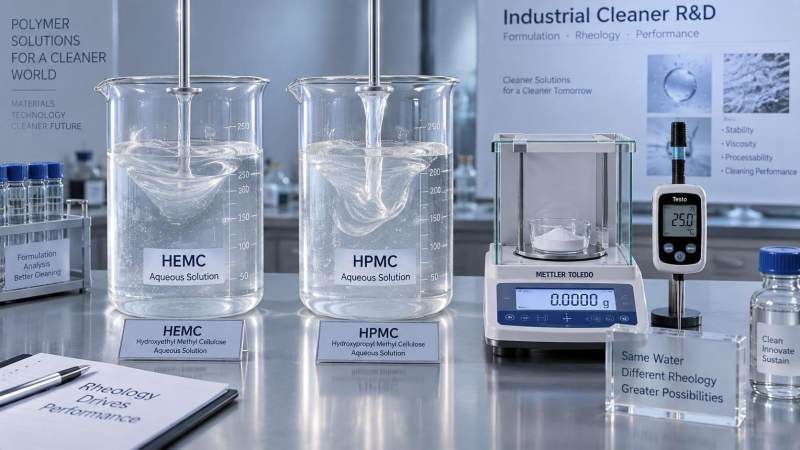
Selecting the right cellulose ether isn’t just about ticking a box on a formulation sheet—it’s about anticipating how your cleaner behaves *before*, *during*, and *after* use. When technical evaluators at industrial detergent labs weigh Hydroxyethyl Methyl Cellulose (HEMC) against Hydroxypropyl Methyl Cellulose (HPMC), they’re not comparing two similar thickeners. They’re choosing between two distinct rheological personalities—each with its own response to shear, temperature shifts, ionic environments, and surfactant interactions. And in high-stakes applications—like alkaline degreasers, CIP formulations, or concentrated liquid cleaners—getting this choice wrong can mean batch instability, inconsistent dispensing, or even phase separation during storage.
HEMC and HPMC share a common backbone—cellulose—but their side-chain chemistry creates divergent hydration kinetics and molecular entanglement patterns. HEMC carries hydroxyethyl groups, which are smaller and more flexible than the bulkier hydroxypropyl moieties in HPMC. That subtle difference ripples through every functional property: solubility onset, viscosity build rate, pseudoplasticity profile, and—critically—resilience under electrolyte stress. In real-world cleaner development, these aren’t academic distinctions. They’re the difference between a gel that holds suspended abrasives evenly for 12 months on shelf—and one that synereses after three weeks in a warehouse where ambient humidity fluctuates daily.
Take viscosity development under low-shear conditions: HPMC typically delivers faster, more robust initial thickening in aqueous systems, especially above 40°C. Its hydroxypropyl groups promote stronger intra- and intermolecular hydrogen bonding once hydrated, leading to tighter polymer networks. HEMC, by contrast, hydrates more gradually and forms looser, more fluid-sensitive networks. This makes HPMC particularly effective in sprayable or pump-dispensed cleaners where suspension stability matters more than instant pourability. But that same strength becomes a liability when high-shear mixing is unavoidable—say, during inline homogenization or high-speed filling. HPMC’s pronounced shear-thinning behavior can cause sudden viscosity drops mid-process, risking inadequate dispersion of actives or inconsistent fill weights. HEMC responds more linearly to shear, offering smoother processing control—especially in continuous manufacturing lines where reproducibility trumps peak viscosity.
Then there’s the electrolyte challenge. Most industrial cleaners contain significant levels of sodium carbonate, sodium metasilicate, or sodium tripolyphosphate—ingredients that destabilize many thickeners. Here, HPMC’s performance is highly grade-dependent. Standard construction-grade HPMC (e.g., Ludong’s Type 75 series) often shows measurable viscosity loss above 0.8% Na₂CO₃. Yet specially modified HPMC variants—designed with balanced methoxy/hydroxypropyl ratios and tighter molecular weight distributions—maintain >85% of baseline viscosity even at 2.5% electrolyte concentration. HEMC, while inherently more salt-tolerant due to its lower crystallinity and weaker hydrophobic associations, sacrifices some thermal gelation control. It won’t “set” as sharply upon heating—a trait useful in hot-process formulations—but also means less resistance to cold-chain viscosity drift during winter transport.
Surfactant compatibility adds another layer. Nonionic surfactants like alcohol ethoxylates generally pair well with both polymers—but anionic types (LAS, AES) interact differently. HPMC tends to form looser, more reversible complexes with anionics, preserving viscosity across wider pH ranges (9–12.5). HEMC, however, can exhibit transient viscosity spikes during early surfactant addition—followed by gradual decay—as its ethyl side chains partially co-solubilize with micellar structures. For evaluators building multi-surfactant blends, this means HPMC offers more predictable rheology scaling; HEMC demands careful sequencing and controlled addition rates.
Temperature cycling is where the distinction becomes visceral. A cleaner formulated with standard HPMC may hold viscosity well at 25°C—but begin gelling irreversibly above 60°C, then separate upon cooling. That’s not always undesirable: some oven-cleaner gels *rely* on thermal reversibility. But for general-purpose alkaline cleaners stored in non-climate-controlled facilities? That behavior risks customer complaints and returns. HEMC’s gelation onset is broader and more gradual, making it preferable where ambient fluctuations are unavoidable—though it rarely achieves the same high-end viscosity ceiling as premium HPMC grades.
Which brings us to precision engineering—not just chemistry. At Jinan Ludong Chemical, rheological tailoring starts long before the lab bench. With annual production capacity of 45,000 tons and viscosity control spanning 400–200,000 CPS, their HPMC portfolio includes variants engineered specifically for electrolyte-rich, high-pH cleaner systems—such as low-substitution, narrow-MWD grades optimized for rapid rehydration and minimal surfactant interference. Their HEMC offerings, meanwhile, emphasize batch-to-batch consistency in hydration lag time and shear recovery—critical for automated dosing systems where dwell time in static tanks varies across production runs.
None of this means one polymer is “better.” It means selection hinges on *what the formulation must endure*. If your cleaner undergoes high-shear filling, contains >1.5% builder salts, and ships globally across climates—HPMC’s tunable thermal response and strong suspension lift may justify the extra process calibration. If it’s a low-pH, enzyme-stabilized cleaner requiring gentle mixing and extended shelf life under variable storage—HEMC’s forgiving rheogram and lower electrolyte sensitivity could save formulation headaches downstream.
And sometimes, synergy beats substitution. Some advanced cleaners blend both—using HPMC as the primary thickener for suspension power, and HEMC as a secondary rheology modifier to buffer shear shock or temper gelation peaks. In those cases, understanding *how* each polymer contributes—not just what it does—is what separates robust design from reactive troubleshooting.
One final note: while cellulose ethers dominate thickener selection, certain niche cleaner systems benefit from complementary binders. For instance, Polyvinyl Alcohol offers exceptional film-forming and particle-binding properties in low-foam, rinse-free formulations—particularly where residue control and surface adhesion matter more than bulk viscosity. It’s not a direct substitute, but a strategic partner when cellulose ethers alone can’t meet all functional targets.
There’s no universal rheology chart. There’s only context—the equipment, the chemistry, the supply chain, the end-user expectation. Every viscosity curve tells a story. The skill lies not in reading it, but in knowing which polymer will write the next chapter—without rewriting the entire formula.
Send Your Inquiry
We welcome your cooperation and we will develop with you.
