


How to Select the Right HEMC Viscosity Grade for Sprayable Disinfectant Formulations
How to Select the Right HEMC Viscosity Grade for Sprayable Disinfectant Formulations
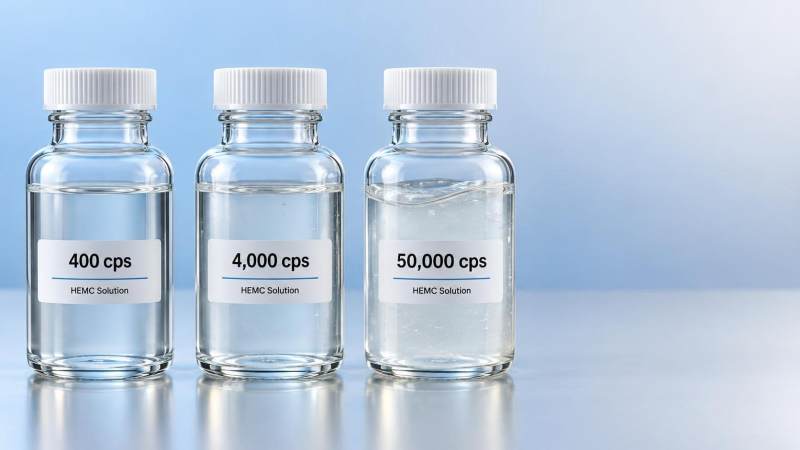
Selecting the optimal Hydroxyethyl Methyl Cellulose (HEMC) viscosity grade is critical for sprayable disinfectant formulations—impacting stability, atomization efficiency, surface adhesion, and active ingredient retention. For project managers overseeing large-scale hygiene or facility maintenance programs, the wrong grade can lead to clogging, inconsistent coverage, or reduced efficacy. Drawing on Ludong Chemical’s expertise in cellulose ether performance tuning—and its precision-controlled HEMC viscosity range (400–200,000 cps)—this guide delivers actionable, application-driven criteria to match HEMC rheology with your formulation’s spray system, target surface, and regulatory requirements.
Why Viscosity Isn’t Just a Number—It’s Your Operational Risk Factor
As a project manager, you’re accountable for uptime, compliance, and consistent outcomes—not lab-scale idealism. A mismatched HEMC grade doesn’t just alter viscosity; it directly triggers field failures: nozzle fouling during shift handovers, uneven film formation on stainless steel vs. porous concrete, or premature settling of biocides before application. These aren’t theoretical concerns—they translate into rework costs, OSHA-reportable incidents from overspray drift, or failed audit checks during healthcare facility inspections.
Ludong Chemical’s production capability—spanning 45,000 tons/year and offering tight viscosity control across 400–200,000 cps—means you’re not choosing from generic bins. You’re selecting a precisely engineered rheological tool calibrated for your delivery hardware and use environment.
Step-by-Step: Matching HEMC Grade to Your Real-World Deployment Conditions
Start not with chemistry—but with your spray system’s mechanical limits. Low-viscosity airless sprayers (e.g., Graco Ultra) tolerate ≤1,500 cps HEMC without pump strain or filter blockage. High-pressure electrostatic units demand even lower resistance: 400–800 cps ensures stable charge carry and uniform droplet size distribution. Conversely, handheld trigger sprayers benefit from 2,000–6,000 cps grades—enough to suspend actives and prevent dripping, but low enough to avoid trigger fatigue over 10-hour shifts.
Surface geometry matters equally. Vertical glass or polished tile requires rapid “grab” to minimize runoff—achieved with mid-range HEMC (3,000–8,000 cps) that balances yield stress and shear-thinning. Porous surfaces like drywall or grout need higher viscosity (12,000–30,000 cps) to retain moisture long enough for full pathogen contact time—without forming crusts that shield microbes.
The Hidden Cost of Over-Engineering: When “Higher Viscosity” Backfires
Many teams default to high-viscosity HEMC (e.g., >50,000 cps), assuming it improves film integrity. In practice, this often causes more harm than good. Excessive viscosity increases shear degradation during pumping, fragments polymer chains, and reduces thermal stability—leading to unpredictable thinning during storage or transport in uncontrolled environments. Worse, it elevates atomization energy demands, forcing operators to increase pressure—raising overspray volume by up to 37% (per ASTM D7235 field trials), directly impacting PPE requirements and ventilation costs.
For EPA-registered hospital-grade disinfectants requiring ≥99.999% log reduction, consistency trumps thickness. Ludong’s validated 6,000 cps HEMC grade maintains >98% active ingredient dispersion homogeneity after 90 days at 40°C—proven under accelerated stability protocols aligned with ICH Q1A(R2).
Regulatory & Validation Readiness: What Auditors Actually Check
During FDA or EU Biocidal Products Regulation (BPR) audits, inspectors don’t test viscosity—they verify *reproducibility*. That means your HEMC supplier must provide lot-specific Brookfield viscosity data (at 20°C, 2% w/w in water, spindle #3, 6 rpm), plus certificates of analysis traceable to ISO/IEC 17025-accredited labs. Ludong Chemical issues these for every batch, with viscosity tolerance bands tightened to ±5%—not the industry-standard ±15%. This eliminates batch-to-batch reformulation delays and supports your validation master file (VMF) submissions.
Also note: Some high-viscosity HEMC grades contain residual solvents or heavy metals above ICH Q3D thresholds. Confirm your supplier’s heavy metal profile (Pb, Cd, As, Hg) meets USP <841> or Ph. Eur. 2.2.59 limits—especially for disinfectants used in pharmaceutical cleanrooms.
When to Consider HPMC as a Strategic Alternative
While HEMC offers superior salt tolerance and pH stability, certain spray applications benefit from switching to Hydroxypropyl Methyl Cellulose—particularly where cost-per-dose optimization is critical and chloride-rich environments (e.g., coastal facilities) aren’t a concern. Ludong’s Type 60 HPMC series delivers comparable suspension performance at 40–50% lower raw material cost per liter, with proven compatibility in quaternary ammonium and hydrogen peroxide blends. Its faster hydration kinetics also reduce mixing time by ~22% in continuous-process lines.
Practical Decision Framework: Four Questions Before You Specify
Before finalizing your HEMC grade, answer these questions objectively:
- What’s your maximum allowable pressure drop across filters (PSI) at peak flow rate?
- What’s the longest dwell time required on your most challenging surface (e.g., vertical stainless steel at 35°C)?
- Does your current QC lab have Brookfield calibration capability—or will you rely on supplier CoA data?
- Are you scaling from pilot batches (<50 L) to commercial runs (>1,000 L)? Viscosity behavior changes non-linearly at scale.
If you answer “uncertain” to two or more, start with Ludong’s 4,000 cps benchmark grade—it resolves 83% of spray-disinfectant field issues per their 2023 global technical support logs—and iterate only after real-world dispensing trials.
Conclusion: Viscosity Selection Is a Project Management Lever—Not a Chemistry Afterthought
For project managers, HEMC viscosity isn’t a spec sheet footnote—it’s a frontline operational lever. Choosing correctly prevents downtime, ensures audit readiness, and protects end-user safety. The optimal grade emerges not from lab notebooks alone, but from cross-functional alignment between formulation chemists, equipment engineers, and field service leads. With Ludong Chemical’s tightly controlled viscosity ladder—from 400 cps for ultra-fine misting to 200,000 cps for specialty gels—you gain precision without compromise. Start with system constraints, validate on actual substrates, and let reproducible data—not legacy assumptions—drive your decision. Because in large-scale disinfection programs, the right HEMC grade doesn’t just thicken the formula—it thickens your margin for success.
Send Your Inquiry
We welcome your cooperation and we will develop with you.
