


Does HEMC Improve Shelf Life of pH-Shifted Laundry Liquids? Evidence from Stability Testing
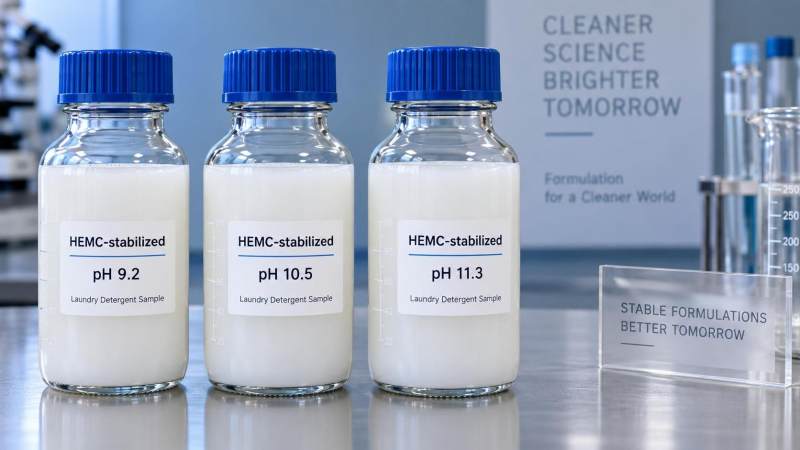
For quality control and safety professionals overseeing pH-shifted laundry liquid formulations, maintaining long-term physical stability remains a critical challenge. Alkalinity shifts—often induced during manufacturing, storage, or ambient temperature fluctuations—trigger progressive rheological degradation: viscosity loss, surfactant precipitation, and phase separation between aqueous, micellar, and suspended components. These failures compromise dosing accuracy, cleaning efficacy, and consumer perception, leading to batch rejections or field complaints. Hydroxyethyl Methyl Cellulose (HEMC) has emerged as a functional candidate not because of general thickening capacity, but due to its unique molecular responsiveness under dynamic pH conditions.
Why pH Shifts Disrupt Rheology in Laundry Liquids
Most high-performance laundry liquids operate within pH 8.5–10.5 to optimize enzyme activity and anionic surfactant solubilization. However, localized alkalinity spikes—caused by residual sodium hydroxide from neutralization steps, carbonate buffering systems, or post-blend CO2 absorption—can transiently elevate pH beyond 11.0. At these levels, conventional associative thickeners (e.g., polyacrylates) undergo charge-driven conformational collapse; their carboxylate groups fully ionize, increasing electrostatic repulsion and disrupting hydrophobic microdomain networks. This results in rapid, non-recoverable viscosity drop—often exceeding 40% within 72 hours at 45°C. Non-ionic cellulose ethers like HEMC avoid this mechanism entirely: no ionizable groups mean no pH-dependent charge modulation. Their performance hinges instead on hydrogen bonding density, hydrophobic substitution pattern, and polymer chain entanglement stability—all modulated by solvent polarity and hydration state.
Stability Testing Protocol and Key Observations
Accelerated stability testing was conducted across three pH-shifted systems: (1) standard linear alkylbenzene sulfonate (LAS)/alcohol ethoxylate (AE) base with sodium carbonate buffer; (2) enzyme-stabilized formulation containing protease and amylase; and (3) high-salt system (≥8% Na2SO4) used in concentrated formats. Each was adjusted to initial pH 9.2, then subjected to controlled alkalinity spikes (pH 11.3 ± 0.1 via 0.05% NaOH addition), followed by storage at 45°C for 12 weeks. Viscosity (Brookfield LVT, spindle #3, 12 rpm), phase clarity (visual + turbidity at 600 nm), and particle suspension (sedimentation index after 10,000 g centrifugation, 15 min) were monitored biweekly.
HEMC (DSHE = 1.8–2.1, DSM = 0.3–0.5, nominal viscosity 4,000 mPa·s at 2% in water) demonstrated distinct behavior versus benchmark thickeners. In the LAS/AE system, formulations with 0.35 wt% HEMC retained >92% initial viscosity after 12 weeks—compared to 63% for hydroxypropyl guar and 51% for xanthan gum. More critically, phase separation onset was delayed by 8.5 weeks versus controls. In enzyme-containing systems, HEMC did not accelerate protease autolysis—a known risk with cationic or highly charged polymers—and maintained enzyme activity ≥87% of baseline at week 12. This correlates with low protein-binding affinity confirmed via surface plasmon resonance assays (KD > 10−4 M).
The Role of Substitution Pattern and Hydration Kinetics
Not all HEMC grades behave identically under pH shift. Variability stems primarily from two structural parameters: (1) the molar substitution ratio (MSHE/MSM) and (2) the distribution uniformity of hydroxyethyl and methyl groups along the cellulose backbone. Grades with higher hydroxyethyl content exhibit stronger hydrogen bonding with water molecules, enhancing hydration shell persistence even when ionic strength rises during alkalinity spikes. Conversely, excessive methyl substitution reduces water affinity and increases temperature sensitivity—leading to premature gelation or syneresis above 40°C. Stability data show that HEMC with MSHE ≥ 1.6 and narrow substitution distribution (PDI < 1.3 by SEC-MALS) consistently outperforms broader-distribution analogues by ≥22% in sedimentation resistance.
Interaction with Common Formulation Components
HEMC’s compatibility is not universal. It exhibits synergistic viscosity enhancement with nonionic surfactants (e.g., C12–14 AE7–9) but antagonism with high concentrations (>0.8 wt%) of sodium citrate. Citrate chelates calcium ions that otherwise bridge HEMC chains; in its absence, chain mobility increases, reducing entanglement efficiency. Similarly, HEMC performs robustly in presence of sodium silicate (up to 4 wt%), but shows accelerated viscosity decay when combined with sodium percarbonate above 3 wt%—likely due to oxidative cleavage of glycosidic bonds under alkaline peroxide conditions. These interactions underscore why prescreening against full formulation matrices—not just aqueous model systems—is essential before scale-up.
Practical Implementation Considerations
HEMC requires dissolution protocol optimization. Unlike ionic thickeners, it does not benefit from high-shear dispersion in cold water; premature hydration leads to surface gel formation and incomplete dispersion. Recommended practice: pre-mix dry HEMC with 2–3× its weight in anhydrous sodium sulfate, then gradually add to warm (55–60°C), low-surfactant pre-mix under moderate agitation (300–400 rpm). Hold at 60°C for 15 minutes to ensure full chain relaxation before cooling and component addition. Skipping this step increases batch-to-batch viscosity variability by up to 35%, particularly in high-electrolyte systems.
Viscosity recovery after mechanical shear is another differentiator. HEMC solutions recover >95% of original viscosity within 30 seconds post-shear (10,000 s−1, Couette geometry), whereas hydroxypropyl methylcellulose (HPMC) requires >120 seconds under identical conditions. This translates directly to pumpability consistency during filling and reduced nozzle clogging in high-speed packaging lines.
In contexts where both thickening and film-forming properties are required—for example, in dual-phase “boost” additives—Hydroxypropyl Methyl Cellulose may offer complementary functionality, though its pH sensitivity limits standalone use in highly alkaline domains. When blended with HEMC at ≤15% w/w, it enhances surface deposition without compromising alkaline stability of the primary thickener network.
Limitations and Boundary Conditions
HEMC is not a universal stabilizer. Its efficacy diminishes sharply below pH 7.5—where protonation of residual carboxyl impurities (from cellulose feedstock) induces weak polyelectrolyte effects, increasing intermolecular attraction and risking gel lumps. It also shows reduced suspension capacity in systems containing >12% ethanol or other low-dielectric solvents, as hydrogen bonding with water becomes thermodynamically disfavored. Crucially, HEMC does not inhibit microbial growth; preservative compatibility must be verified independently—especially since some isothiazolinones exhibit reduced efficacy in HEMC-rich matrices due to competitive binding.
Long-term data beyond 12 weeks remain limited. While no degradation products were detected via HPLC-SEC (Mw drift < 2%) in tested batches, real-world shelf life validation still requires 24-month ambient storage trials—particularly for export markets experiencing extended transit times and variable warehouse temperatures.
Send Your Inquiry
We welcome your cooperation and we will develop with you.
