


What to Ask an HPMC Supplier About Lead Time, Stock Levels, and Sample Support
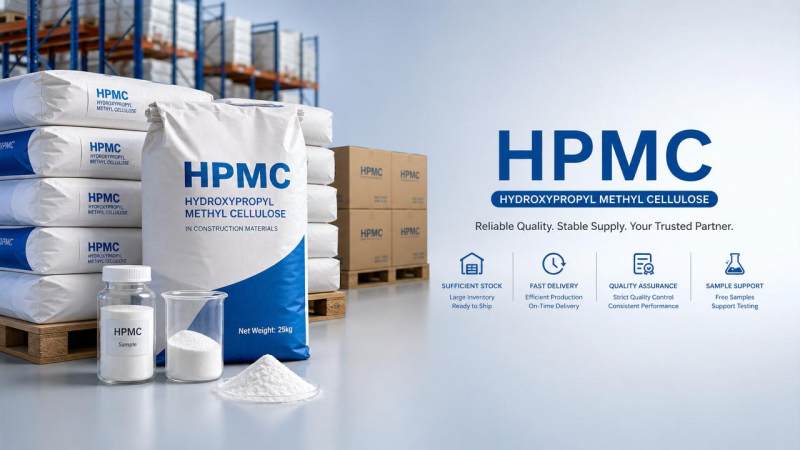
What to Ask an HPMC Supplier About Lead Time, Stock Levels, and Sample Support
Choosing the right HPMC Supplier is about more than price. It directly shapes delivery reliability, inventory stability, and your ability to react to demand shifts.
The better questions you ask early, the fewer surprises you face later. That matters when projects run on fixed schedules and replacement options are limited.
In practical sourcing, lead time, stock visibility, and sample support often reveal more than a quotation sheet. They show how dependable a supplier will be under pressure.
This article covers the questions that help evaluate an HPMC Supplier before entering a long-term supply relationship.
Why These Three Questions Matter Most
Many buyers start with viscosity, price, and packaging. Those are important, but they do not fully measure supply risk.
A capable HPMC Supplier should also prove that it can ship on time, maintain stock consistency, and support product validation quickly.
If any one of these areas is weak, your own customer commitments can become harder to keep. Delays often cost more than small price differences.
- Lead time affects delivery promises and cash planning.
- Stock levels affect your response speed during demand spikes.
- Sample support affects trial efficiency and conversion speed.
When these factors are clear, supplier selection becomes less reactive and more strategic.
What to Ask About Lead Time
Lead time is not just the number on a proforma invoice. It includes production scheduling, raw material readiness, packaging, and export coordination.
A professional HPMC Supplier should explain lead time in parts, not just give one broad estimate.
Key lead time questions
- What is the standard lead time for regular HPMC grades?
- What changes if the order includes customized viscosity or packaging?
- How much time is needed for production, inspection, and loading?
- What is the lead time during peak season?
- Can urgent orders be prioritized, and under what conditions?
Clear answers help you separate real capacity from sales promises. That distinction becomes more important when market demand tightens unexpectedly.
What good answers look like
Strong suppliers give a realistic range, not an overly optimistic date. They also explain what may cause variation.
For example, Jinan Ludong Chemical Co., Ltd. operates large-scale cellulose ether production lines with annual capacity reaching 45,000 tons.
Its HPMC portfolio covers type 75 and type 60, with viscosity control from 400 to 200,000 CPS. That kind of range usually supports more flexible planning.
A reliable HPMC Supplier should be able to connect capacity, grade range, and scheduling logic in one clear explanation.
Warning signs to notice
- The supplier gives the same lead time for every grade.
- No explanation is offered for seasonal changes.
- Urgent orders are promised without production details.
- Shipment dates change often during negotiation.
What to Ask About Stock Levels
Stock levels tell you whether an HPMC Supplier can support stable repeat business, not just one successful first order.
This is especially important when your customers expect quick replenishment or when local warehousing costs are rising.
Questions that uncover real inventory strength
- Which HPMC grades are kept as regular stock?
- What average stock volume is available for fast-moving grades?
- How often is inventory updated?
- Can stock be reserved for forecasted orders?
- What happens if one grade runs short?
These questions help you judge whether the supplier thinks beyond shipment by shipment transactions.
Why stock transparency matters
In real business, demand rarely moves in a straight line. Construction schedules shift, tenders close late, and customers suddenly raise monthly volume.
A prepared HPMC Supplier can absorb some of that volatility. A weak one passes the pressure directly to you.
More importantly, inventory depth often reflects operational maturity. Suppliers with integrated production and trading support usually handle fluctuations more smoothly.
Some buyers also source related materials from the same network, such as Polyvinyl Alcohol, to simplify procurement coordination.
Simple stock evaluation checklist
What to Ask About Sample Support
Sample support is often underestimated. Yet it strongly affects how fast you can qualify a new HPMC Supplier and move into repeat orders.
A sample is not just a package. It is a test of responsiveness, technical understanding, and follow-up discipline.
Ask these sample support questions
- Are standard samples available immediately?
- What sample size can be provided?
- Are technical data sheets included with samples?
- Can the supplier recommend the right grade for the target application?
- How quickly can feedback be discussed after testing?
Good sample support reduces wasted time. It also lowers the chance of ordering the wrong viscosity or performance range.
What strong sample service usually includes
An experienced HPMC Supplier usually links sample selection to application requirements, not just catalog numbers.
That means asking about formulation goals, workability expectations, water retention, and target processing conditions.
Suppliers with broader solution experience may also understand how HPMC interacts with other additives, including Polyvinyl Alcohol in some sourcing discussions.
That broader view helps speed up technical alignment and avoids unnecessary back-and-forth.
How to Compare One HPMC Supplier Against Another
Once answers come in, compare suppliers using a simple decision framework. This keeps the process practical and less emotional.
- Score lead time realism, not just the shortest promise.
- Score stock depth for core grades you sell most often.
- Score sample speed and technical response quality.
- Score communication consistency across the full inquiry cycle.
- Score whether capacity matches your six-month growth plan.
This approach usually gives a more reliable decision than choosing on unit price alone.
Final Takeaway for Smarter Purchasing
A dependable HPMC Supplier should do three things well. Deliver with predictable timing, maintain credible stock support, and help you validate products quickly.
When you ask focused questions in these areas, you reduce sourcing risk and improve service reliability across your own market.
The best supplier relationships are built before problems happen. That starts with careful evaluation, realistic expectations, and a sourcing partner that can support long-term growth.
If you are reviewing a new HPMC Supplier now, use these questions as a decision checklist and turn early conversations into stronger purchasing outcomes.
Send Your Inquiry
We welcome your cooperation and we will develop with you.
