


Why Cellulose Ether Can Cause Lumps During Mortar Mixing and How to Avoid Them
Why Cellulose Ether Can Cause Lumps During Mortar Mixing and How to Avoid Them
Cellulose Ether is one of the ingredients that makes modern dry-mix mortar easier to spread, more stable on the wall, and less likely to lose water too quickly. In tile adhesive, wall putty, skim coat, plaster, and cement-based repair mortar, it helps create the “right feel” that operators notice immediately: smoother troweling, better open time, more even consistency, and reduced drag.
Yet the same additive can become the source of one of the most frustrating mixing problems: stubborn soft or rubbery lumps that do not break down even after extended mixing. Operators often blame the raw material first. Sometimes that is justified, but in many cases the issue begins with how the powder meets water, how quickly it hydrates, and whether the mixer creates enough movement to disperse it before a gel layer forms.
A lumped mortar batch is not merely unattractive. It can create weak spots, uneven water retention, variable setting behavior, visible streaks during application, and repeated reworking at the jobsite. Understanding the mechanism makes troubleshooting much faster.
The Main Mechanism: Fast Surface Hydration Traps Dry Powder Inside
Most construction-grade cellulose ethers, including hydroxypropyl methylcellulose (HPMC), are designed to interact strongly with water. Once a dry particle contacts water, its outer surface begins to hydrate and swell. This is useful in the finished mortar because the hydrated polymer helps hold water within the cementitious system.
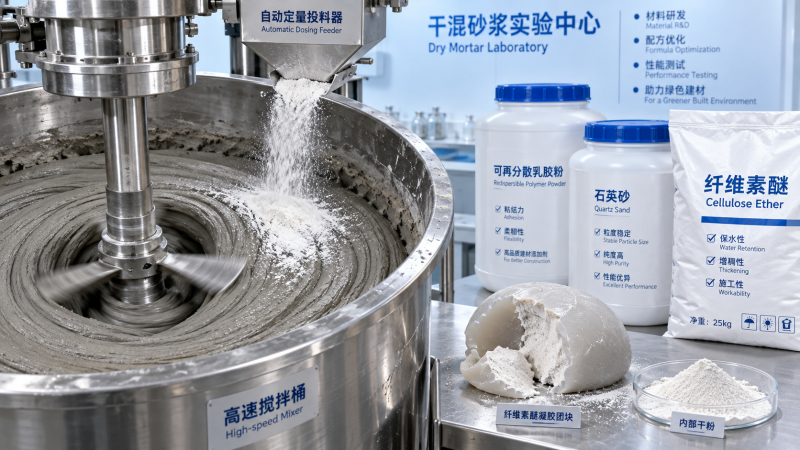
The problem appears when too much powder reaches water in one spot. The outside of the particle or powder cluster hydrates quickly and creates a sticky gel-like shell. That shell slows further water penetration into the center. What remains is a partially wet agglomerate with dry or poorly dispersed cellulose ether inside. From the outside, it looks like a small gel ball; when squeezed or spread with a trowel, it may reveal dry powder at the core.
This is why simply increasing mixing time is not always the answer. Once a thick skin has formed, a low-shear mixer may keep rolling the lump around rather than opening it. Excessive mixing can also introduce air, alter mortar temperature, or begin to affect workability in ways the operator did not intend.
The issue is especially common when cellulose ether is added directly into a small volume of water, poured rapidly into a stationary mixer, or sprinkled onto the same wet location repeatedly. A good additive can behave badly when the addition point is wrong.
Where Lumping Usually Starts in Real Mixing Conditions
On a dry-mortar production line, the most common risk is poor pre-dispersion. Cellulose ether is used at a comparatively low dosage compared with sand, cement, and fillers. If it is added as a small concentrated portion and the mixer does not distribute it evenly before water is introduced, localized polymer-rich pockets can remain in the powder blend. Those pockets hydrate differently from the rest of the mortar.
At the jobsite, the pattern is usually different. An operator may add water first, pour a substantial amount of dry mortar into one area of the bucket, and then wait before starting the mixer. During those few seconds, fine powder components settle into a dense wet mass. If the mix contains a high-water-retention HPMC, surface hydration can begin before the paddle has had a chance to distribute the material.
Mixing equipment matters more than people expect. A paddle that is too small for the bucket, a mixer run at an unsuitable speed, worn blades, or a large dead zone at the bottom of the vessel can all leave poorly wetted areas. Large horizontal industrial mixers have their own version of the problem: material can accumulate around corners, discharge gates, or low-energy zones if fill level and mixing time are not matched to the equipment design.
Water quality and temperature can complicate the picture. Very cold water may slow dissolution and make operators think the product has failed to disperse. Very warm water can change hydration behavior for some cellulose ether grades and may shorten the practical working window of the mix. The correct approach is not to assume one water temperature suits every formulation; it is to keep water conditions reasonably consistent and verify the mixing procedure with the specific mortar system.
A Simple Way to Identify the Type of Lump
Not every lump in mortar is caused by cellulose ether. Cement that has absorbed moisture in storage, wet sand, poorly dispersed redispersible polymer powder, foreign particles, or unmixed filler can produce a similar visual complaint. Before changing the formula, cut several lumps open and look at their internal structure.
This quick inspection prevents a common mistake: lowering cellulose ether dosage when the real cause is water-damaged cement or a mixing process that is too weak for the batch size.
How to Prevent Lumps During Jobsite Mortar Preparation
For bagged tile adhesive, plaster, or putty, the most reliable procedure is generally to measure the required water first, start the mixer, and add dry mortar gradually into the moving water. The word “gradually” matters. It does not mean adding one scoop every several minutes; it means maintaining a controlled feed so the paddle can pull fresh powder into the wet zone without allowing a dense floating layer to build up.
Avoid dumping the full bag into a bucket of water and expecting a handheld paddle to solve the problem afterward. That method can work with very forgiving formulations, but it leaves little margin when the mortar contains a higher-viscosity cellulose ether or when the operator is working in cold weather.
Use the water ratio recommended for the specific product rather than adjusting by appearance too early. A mix that looks dry during the first minute may become more workable as the cellulose ether hydrates. Adding extra water immediately can make the mortar seem easier to mix, but it may later cause sagging, reduced body, or inconsistent application thickness.
A short rest period after initial mixing is often helpful when the product instructions allow it. This gives polymeric additives and fine mineral particles time to wet out more evenly. The mortar should then be remixed briefly before use. Resting is not a cure for large agglomerates, however. If the initial dispersion was poor, the rest period may simply allow the outer gel layer to become stronger.
Keep the bucket and paddle clean between batches. Dried residue is easy to overlook, especially around the paddle hub and bucket base. Those residues can break loose and be mistaken for fresh lumps caused by the current batch.
For Dry-Mortar Producers, Dispersion Begins Before Water Is Added
Manufacturers have more control points, but they also handle larger volumes, where a minor segregation issue can affect an entire production run. The cellulose ether should be distributed through a suitable carrier fraction before the complete formula is blended. Depending on the mixer and formulation, this may mean pre-mixing it with a portion of dry sand, calcium carbonate, or another compatible powder fraction. The objective is straightforward: prevent a low-dose functional additive from entering the main mixer as a concentrated island.
Particle-size differences deserve attention. Fine powders can segregate during conveying or vibration, even when the blend looked uniform immediately after mixing. Long transfer routes, repeated hopper drops, and poorly controlled pneumatic conveying can all change distribution. If lumping appears only after packaging or only in certain bag positions, the problem may be segregation rather than the cellulose ether itself.
The choice of HPMC grade should match the mortar and the intended mixing conditions. Viscosity, substitution pattern, particle form, dissolution behavior, and dosage all influence how the product behaves in the formulation. There is no universal “best” grade. A high-viscosity product may provide valuable water retention in one cement-based plaster but require more careful balance in a thin-bed adhesive or a rapid-mixing system.
This is one reason suppliers with a broad controllable viscosity range can support more targeted formulation work. Jinan Ludong Chemical Co., Ltd. produces construction and chemical grades of HPMC, including type 75 and type 60 series, with stated viscosity control from 400 to 200,000 CPS. In practice, the useful question is not simply “Which viscosity is higher?” but “Which grade gives stable water retention and application behavior without creating unnecessary sensitivity in our actual mixing process?”
Do Not Treat Every Additive as an Isolated Ingredient
Mortar performance comes from interactions. Redispersible polymer powder, starch ether, mineral fillers, retarders, accelerators, and cellulose ether all influence water demand and rheology. A formula that mixes smoothly without polymer may behave differently after RDP is introduced. Likewise, hydroxypropyl starch ether can change anti-sag behavior and the feel of the wet mortar, which may alter the operator’s judgment about whether more water is needed.
In specialty formulations, a binder such as Polyvinyl Alcohol may also be considered alongside other functional components. Its use should be evaluated as part of the full formulation and mixing sequence, not added casually to solve a lumping complaint. Changing one additive can improve one property while introducing a different issue in redispersion, water demand, film formation, or application feel.
When a formulation suddenly begins to lump, compare more than the cellulose ether batch. Check whether the sand moisture changed, whether a filler source changed, whether the operator altered water addition, whether the mixing time was shortened, or whether a new packaging and storage condition exposed the dry mortar to humidity. Experienced troubleshooting is usually a process of eliminating these variables one by one.
What Not to Do When Lumps Appear
Do not solve the problem by adding water blindly. It may temporarily make a thick mix easier to move, but it does not reliably break polymer-gel agglomerates. It can also move the mortar outside its intended water range.
Do not assume higher mixer speed is always safer. Adequate shear is necessary, but aggressive mixing can entrain air and change the final texture. The better target is efficient circulation with no dead zones, not maximum speed for maximum time.
And do not judge a cellulose ether only by its behavior in a beaker. A laboratory dispersion test can be useful, but a real mortar includes cement hydration, fillers, sand grading, polymer powders, equipment differences, and operator habits. The final evaluation should include the actual mixing method used in production or on site.
A Better Routine Produces More Consistent Mortar
Cellulose Ether lumps are usually preventable. The central rule is simple: do not allow a concentrated mass of cellulose ether-containing powder to sit in water long enough to form a hydrated outer shell before it has been dispersed. Controlled powder addition, correct water measurement, appropriate mixer action, clean equipment, and a formulation matched to the process will resolve most recurring problems.
If lumps continue after the mixing procedure has been corrected, examine the dry-mix homogeneity, storage exposure, raw-material condition, and grade selection together. That is a more productive path than treating every gel particle as proof that the cellulose ether is defective.
Send Your Inquiry
We welcome your cooperation and we will develop with you.
