


Cellulose Ether Grades Compared for Tile Adhesive, Skim Coat, and EIFS
Cellulose Ether Grades Compared for Tile Adhesive, Skim Coat, and EIFS
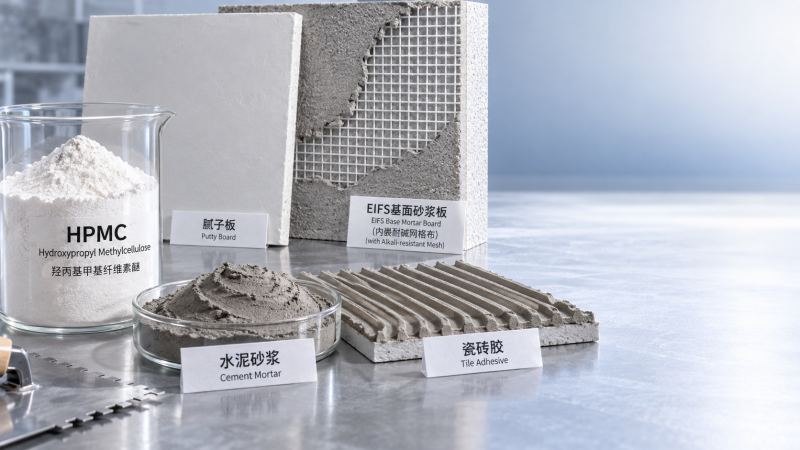
Selecting the right Cellulose Ether grade is critical for technical evaluators comparing tile adhesive, skim coat, and EIFS formulations. Viscosity, water retention, workability, open time, and sag resistance can vary significantly by application. This guide examines how HPMC grades and complementary additives influence performance, helping formulators identify reliable options for balanced processing efficiency, application quality, and finished-system durability.
The key point is often missed during early screening: a cellulose ether is not simply a thickener. In dry-mix construction materials, it controls how water is distributed through the mortar, how the formulation wets during mixing, how long the surface remains workable, and how the material behaves under its own weight. A grade that makes a tile adhesive feel smooth may still be unsuitable if it causes excessive air entrainment, delays strength development, or produces poor combing. The same grade can be even less appropriate in a thin skim coat or an EIFS base coat, where the balance of rheology and water management is different.
For that reason, grade selection should begin with the application mechanism rather than a target viscosity number alone. Viscosity is useful, but it is only one part of the decision.
What Technical Evaluators Should Compare Beyond Viscosity
Hydroxypropyl methylcellulose (HPMC) is commonly evaluated through nominal viscosity, but two products with similar viscosity can perform differently in mortar. Their substitution pattern, particle-size profile, dissolution behavior, water-retention efficiency, gel characteristics, and interaction with cement, fillers, starch ether, and polymer modifiers all matter. The effect becomes more visible when a formulation must work across changing sand moisture, cement batches, ambient temperatures, or mixing equipment.
A useful technical review normally considers five connected questions:
- Does the grade retain enough water for cement hydration and practical open time?
- Does it create the right consistency at the intended water-to-powder ratio?
- How does it influence slip, sag, trowel response, and surface finish?
- Does it introduce an air profile that is acceptable for density, strength, and adhesion?
- Can the same performance be reproduced at plant scale, not only in a laboratory mixer?
The last question deserves attention. A highly responsive grade may look attractive in a small test batch but prove sensitive to mixing time or water addition sequence in production. Evaluators should therefore ask suppliers for test methods, recommended incorporation conditions, and representative samples rather than relying on a single brochure value.
Tile Adhesive: Water Retention Must Work with Trowelability
Tile adhesive is usually the most demanding comparison point because it combines several conflicting requirements. The mortar must mix without fisheyes or undissolved lumps, spread easily under a notched trowel, hold defined ridges, resist tile slip, and maintain enough wetting capacity after exposure. For larger tiles, dense substrates, or warmer installation conditions, the importance of water retention and open time becomes especially apparent.
Medium- to high-viscosity HPMC grades are often considered for cementitious tile adhesives, but the nominal CPS value should not be treated as a universal selection rule. A grade with strong water retention can support open time while allowing a lower dosage than a less efficient alternative. Yet excessive thickening can make the adhesive feel heavy, reduce spreadability, or require additional water. More water may improve initial handling but can change the hardened mortar structure, so the formulation should be assessed as a whole.
Slip resistance is another area where simple viscosity comparisons fail. Vertical slip depends on the combined rheology of the cellulose ether, mineral grading, polymer content, cement level, and any rheology modifier used. Hydroxypropyl starch ether may be introduced in some formulations to sharpen anti-sag behavior and improve application feel. Its contribution should be checked carefully because a strong anti-sag response can also make the mortar less forgiving during adjustment.
Polymer modification is often part of the same discussion. When flexibility, adhesion, and substrate tolerance are central to the product design, a compatible Redispersible Polymer Powder can be evaluated alongside the HPMC grade. The objective is not to let polymer compensate for poor rheology selection; it is to build a balanced adhesive in which water retention, deformability, and workability do not work against each other.
Skim Coat: Prioritize a Clean Finish and Controlled Water Demand
Skim coat formulations place a different demand on Cellulose Ether. Applied layers are thin, and the operator judges the product immediately by its creaminess, blade glide, edge behavior, leveling, and sanding response after curing. A grade optimized for heavy tile adhesive ridges may give a skim coat too much body or drag. In this application, the right material usually supports water retention without creating an overly elastic or sticky feel.
Low- to medium-viscosity grades are frequently screened for skim coats, particularly where a smooth, easy-spreading paste is needed. That does not mean water retention is secondary. Thin layers can lose water quickly to absorbent substrates, and poor retention may contribute to difficult finishing, uneven set, or reduced cohesion at the interface. The practical target is controlled water release: enough to preserve workable time, but not so much that drying becomes unnecessarily slow.
Surface appearance should be assessed after more than one application method. A grade that performs well with a laboratory drawdown blade may behave differently under a steel trowel or spray equipment. Evaluate whether the material pulls at the edge, leaves pinholes, accumulates on the tool, or becomes difficult to feather. These are not cosmetic details. They affect labor acceptance and can expose interactions between the cellulose ether, fine fillers, dispersants, and air-control agents.
For gypsum-based skim coats, compatibility deserves separate confirmation. Cement-based and gypsum-based systems do not respond identically, and a grade selected from cement mortar testing should not be transferred without a formulation trial. Where fast setting is expected, hydration timing and mixing sequence become particularly important.
EIFS Base Coat: Cohesion, Fiber Handling, and Vertical Stability
EIFS base coats operate in a more complex application environment. The mortar is spread over insulation boards, commonly embeds reinforcing mesh, and must remain cohesive without sagging on vertical surfaces. It needs enough open time for mesh placement and adjustment, but it must also maintain a stable layer rather than flowing or collapsing under the trowel.
In this setting, a higher-performing HPMC grade is often selected for water retention and body, then tuned with the rest of the system. The grade should support a cohesive wet film that properly wets the substrate and mesh while resisting slump. Too little structure can lead to difficult mesh embedding and uneven thickness. Too much structure can make the mix feel dry or resistant, encouraging installers to add water on site. That practice may change the intended balance of adhesion, density, and drying behavior.
EIFS formulations also make it important to distinguish between initial “feel” and longer-term system suitability. A very creamy base coat is not automatically the better choice if it lacks vertical stability or shows inconsistent behavior on insulation surfaces. Compatibility with the polymer binder, fibers, mineral filler distribution, and local climatic conditions should be reviewed through the project’s own testing protocol. Requirements for the complete façade system may be governed by local specifications, and those requirements cannot be inferred from a cellulose ether data sheet alone.
A Practical Comparison Framework
This comparison does not prescribe one viscosity for each application. It highlights what must be measured in the actual formulation. For example, a tile adhesive designed for standard indoor walls may tolerate a different rheology profile than one intended for low-absorption porcelain tiles. A skim coat for manual application may not require the same dissolution profile as a product intended for high-throughput equipment. EIFS base coat design may also change with insulation type, layer thickness, and regional installation practice.
How to Run a More Useful Grade Evaluation
An efficient screening program compares candidate grades under fixed formulation conditions before making dosage changes. Start with identical cement, sand or filler blend, polymer level, and water ratio. Record mixing time, wet density where relevant, consistency, workable life, and observed air behavior. Then test application-specific outcomes: trowel ridges and slip for adhesive, surface drawdown and finish for skim coat, and sag plus mesh embedment for EIFS base coat.
Only after the initial comparison should dosage be adjusted. This sequence makes it easier to distinguish intrinsic grade behavior from a dosage effect. It also prevents a common mistake: selecting a low-cost grade at a high addition level without considering whether the resulting water demand, air profile, or processing variation is still acceptable.
Check performance after short rest periods as well as immediately after mixing. Many dry-mix materials change noticeably after the polymer and Cellulose Ether have hydrated. If the product is supplied in bags, storage conditions, packaging integrity, and lot-to-lot consistency should be part of supplier qualification. These details can have as much operational value as a favorable first test result.
Matching Supply Capability to Formulation Development
For formulators developing several mortar categories, supplier flexibility can simplify the evaluation process. Jinan Ludong Chemical Co., Ltd., established in 2020, produces, trades, and provides integrated services for cellulose ethers used in construction materials. Its HPMC portfolio includes construction and chemical grades identified as type 75 and type 60, with controllable viscosity from 400 to 200,000 CPS. The stated annual capacity is 45,000 tons, supported by production lines that combine conventional processing with intelligent automated manufacturing.
That range is relevant because different dry-mix products may need substantially different rheological starting points. Still, technical selection should not begin and end with a viscosity request. A productive discussion should include the binder system, aggregate or filler profile, target application method, expected climate exposure during installation, desired setting behavior, and performance tests used for approval. Where polymer modification is required, the interaction between HPMC and Redispersible Polymer Powder should be assessed in the complete mortar rather than through isolated raw-material comparisons.
The most reliable choice is usually the grade that creates the broadest practical processing window, not the one that produces the highest single laboratory value. For tile adhesive, that may mean stable ridges and adequate open time without excessive drag. For skim coat, it may mean a clean finish without a sticky blade. For EIFS, it may mean mesh embedment and vertical stability that remain manageable for installers. Confirm those conditions with representative raw materials and the relevant project requirements before locking in a grade or approving a production-scale formulation.
Send Your Inquiry
We welcome your cooperation and we will develop with you.
