


What Does Cellulose Ether Do in Dry-Mix Mortar and Cement-Based Products?
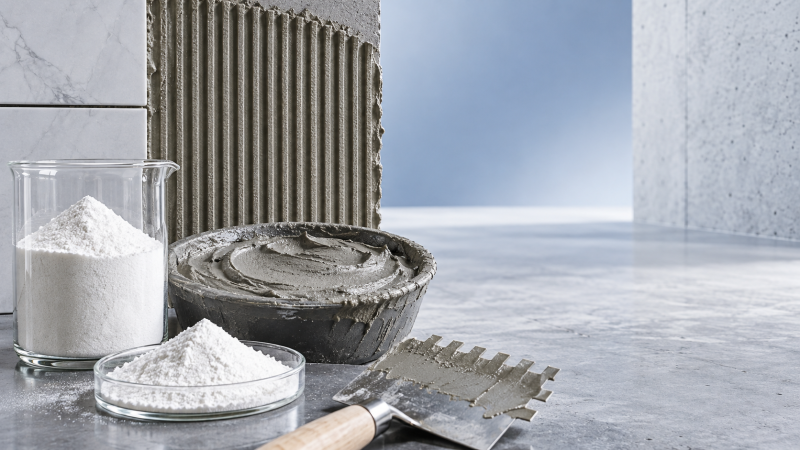
In dry-mix mortar and cement-based formulations, cellulose ether is not simply a thickener. Its primary value lies in controlling how water behaves after the powder is mixed on site. That control affects whether a tile adhesive remains workable, whether a render cures evenly, whether a wall putty spreads smoothly, and whether a cementitious layer develops sufficient bond instead of drying too quickly at the interface.
The practical consequence is important: a mortar can have acceptable strength on paper while still performing poorly during application. It may drag under the trowel, lose moisture into an absorbent substrate, slump on a vertical wall, form weak bonding zones, or develop surface defects during drying. Cellulose ether is used because it helps bring fresh-state behavior and early curing conditions under control. Its function is therefore closely linked to application reliability, not merely to viscosity.
What cellulose ether is doing after water is added
Cellulose ether is a water-soluble polymer derived from cellulose and chemically modified to obtain specified solubility, hydration, viscosity, and surface activity characteristics. In construction products, common types include hydroxypropyl methylcellulose (HPMC), methyl hydroxyethyl cellulose (MHEC), hydroxyethyl cellulose (HEC), and ethyl hydroxyethyl cellulose (EHEC). HPMC and MHEC are especially common in cement-based dry mixes because their balance of water retention, workability, and setting behavior suits many mortar systems.
When water is added to a dry-mix product, the cellulose ether particles hydrate and form a polymeric network in the mixing water. This network changes the rheology of the fresh mortar: it increases cohesion, helps stabilize the mixture, and slows the movement of water into porous substrates or into the surrounding environment.
Its performance does not come from one isolated mechanism. Water retention, consistency, adhesion development, sag resistance, air entrainment, and open time are related effects. Improving one of them may influence another. A formulation that retains more water, for example, can be easier to spread on a thirsty concrete block, but an unsuitable grade or dosage may also increase entrained air or retard the apparent setting response beyond what the product requires.
Water retention is the central function in cementitious mortars
Cement hydration requires water. Yet the water introduced during mixing is under immediate pressure from several directions: dry substrates absorb it, warm air promotes evaporation, and porous aggregates can redistribute it. Thin-layer products are particularly vulnerable because their surface-area-to-volume ratio is high. A tile adhesive applied with a notched trowel or a skim coat spread in a thin film can lose water far faster than a conventional thick mortar bed.
Cellulose ether holds part of the mixing water within the fresh mortar system and reduces the speed at which that water migrates. It does not “create” water, nor does it stop cement hydration. Rather, it makes water available for a longer period where hydration and interface formation need it.
This matters in several ways:
- More complete cement hydration: retained water supports the chemical reactions that contribute to hardened strength and matrix development.
- Improved substrate contact: the mortar is less likely to become locally dry before it has properly conformed to pores and surface irregularities.
- Reduced risk of premature skinning: the applied surface remains workable for longer, especially in thin applications.
- More consistent appearance and curing: uneven water loss can contribute to patchy drying, weak surface zones, and variable application quality.
Water retention should not be interpreted as an automatically positive maximum. The required level depends on the product, the substrate, layer thickness, ambient conditions, and the desired setting profile. A self-leveling underlayment and a vertical tile adhesive do not need the same rheological balance. The first must flow under its own weight; the second must retain ridges and resist tile slip.
Workability means controllable flow, not simply a softer mix
Fresh mortar is often described as “workable,” but that term covers several distinct properties. A plaster needs to pick up cleanly on a trowel, spread without tearing, and remain stable on the wall. A tile adhesive must comb into uniform ridges and transfer sufficiently to the back of the tile. A wall putty should feel smooth under the blade while avoiding excessive drag. A repair mortar may need body and cohesion without becoming hard to compact.
Cellulose ether helps create this practical handling window by modifying viscosity and flow behavior. In many formulations, the mortar becomes more cohesive at rest but still responsive under shear from mixing, pumping, troweling, or screeding. This is why two products with similar laboratory viscosity values can feel quite different during application. The polymer type, substitution pattern, particle size, hydration speed, cement composition, fillers, dispersible polymers, and additives all influence the final response.
A common misunderstanding is that higher viscosity cellulose ether always gives better workability. Higher viscosity can support water retention and anti-sag behavior, but it can also make a mortar feel heavy, reduce flow, complicate pumping, or trap more air. The correct target is not the highest viscosity available; it is the rheology that matches the application method and the user’s expected handling behavior.
Adhesion is improved indirectly and at the interface
Cellulose ether is sometimes described as an adhesion additive. That is directionally correct, but the mechanism needs qualification. It is not a replacement for redispersible polymer powder, which is commonly used when a formulation requires stronger flexibility, improved adhesion to challenging substrates, or better resistance to movement and water exposure. Instead, cellulose ether supports adhesion by keeping the mortar workable and sufficiently hydrated while the bond is forming.
At the interface between mortar and substrate, water loss is one of the main threats to bond formation. If the substrate draws moisture rapidly from the mortar, cement particles may not hydrate adequately near the contact zone. The mix may stiffen before it has developed intimate contact with the surface. By retaining water and improving wetting behavior, cellulose ether helps the mortar maintain a more continuous contact layer.
In tile adhesive, this contributes to open time and adjustability. Open time is the period during which a combed adhesive bed can still bond effectively after application. It should not be confused with pot life, which refers to how long the mixed material remains usable in the container. Both are affected by the formulation and conditions, but they are not interchangeable measures.
In wall putty and skim coat systems, the same water-management function supports smooth application and reduces the tendency for the coating to become difficult to rework as moisture leaves the surface. In renders, it helps maintain cohesion and contact across broader wall areas. The final bond strength, however, remains dependent on formulation design, substrate preparation, curing, contamination, and application thickness.
Why cellulose ether helps vertical mortars stay in place
For vertical applications, the material must resist movement under its own weight after it has been spread. This is generally referred to as sag resistance or anti-slip performance. Cellulose ether increases the internal cohesion of the fresh mix, making it less likely to slump, slide, or lose the profile created by the trowel.
In a tile adhesive, anti-slip behavior helps limit downward tile movement after placement. In a render or plaster, it helps the material remain on the wall rather than sagging in thicker sections. In a joint filler, it supports retention within the joint rather than flow-out during finishing.
Anti-sag performance is not solely determined by cellulose ether. Fine aggregate grading, filler level, water demand, polymer powder, starch ether, and the amount of mixing water all contribute. Hydroxypropyl starch ether, for example, is often used in certain dry mixes to adjust slip, texture, and troweling response alongside cellulose ether. The formulation works as a system; assigning every fresh-property improvement to a single additive can lead to poor troubleshooting decisions.
Air entrainment and setting behavior require careful control
Some cellulose ethers can introduce or stabilize air during mixing. A controlled amount of entrained air may improve creaminess and ease of application. Excessive or unstable air, however, can reduce density, affect strength, alter flow, and create surface defects. The effect depends on the cellulose ether grade, mixing conditions, defoamer selection, binder content, and the physical characteristics of the dry blend.
Setting is another area where simplistic assumptions are risky. Cellulose ether may influence the apparent rate at which a cement-based product stiffens or develops early properties. That influence varies with dosage, cement chemistry, temperature, supplementary cementitious materials, retarding or accelerating additives, and the water-to-binder ratio. A formulation designed for cool-weather application may require a different balance from one intended for rapid installation schedules.
For this reason, a cellulose ether selection should not be based only on a product data sheet value such as nominal viscosity. Water retention, dissolution behavior, gel temperature, particle treatment, pH tolerance, surface activity, and compatibility with the full formulation can matter as much as the viscosity classification.
Different cement-based products need different performance balances
Tile adhesives usually require strong water retention, adequate open time, good ridge stability, tile slip control, and reliable wetting. The preferred cellulose ether grade must work with the adhesive’s cement level, sand system, redispersible polymer powder, and intended installation environment.
Wall putties and skim coats prioritize smooth spreading, low drag, water retention, surface finish, and manageable reworking. An overly cohesive grade can make blade application feel difficult, while insufficient retention can lead to rapid drying and uneven finishing.
Cement renders and plasters need a balance between pumpability or hand application, resistance to sag, water retention, and compatibility with the selected aggregates. Thicker layers place different demands on the mix than thin coats do.
Self-leveling compounds illustrate the limits of generalization. They need water control and component stability, but excessive thickening can obstruct flow and leveling. The relevant cellulose ether approach is therefore often more restrained and must be coordinated with dispersants, defoamers, setting modifiers, and the required flow profile.
Grouts and repair mortars can vary widely. A non-sag repair mortar and a flowable precision grout have opposing rheological requirements. The additive choice must begin with the desired placement behavior rather than with a generic assumption that one construction-grade cellulose ether suits every cement product.
How to interpret viscosity and grade information
Viscosity is useful, but it is not a universal performance ranking. It is generally measured under specified conditions using a defined solution concentration, temperature, and test method. Results from different suppliers may not be directly comparable if those conditions differ. A viscosity number should therefore be read together with the test basis and the grade’s intended application.
Particle size and surface treatment also influence how quickly the powder disperses and hydrates. A rapidly dissolving grade may be appropriate where fast build-up is required, while a delayed-dissolution or surface-treated grade may help reduce lump formation in certain mixing processes. These distinctions become important in factory production, where mixer type, addition sequence, and mixing time can materially change the apparent behavior of the same formula.
Grade naming can also be misleading across industries. HPMC used in construction is selected for dry-mix mortar performance, while products formulated for other sectors may be assessed against entirely different requirements. For example, Detergent-grade HPMC belongs to a different application context and should not be assumed to provide the water-retention, rheology, or cement compatibility profile required for a tile adhesive or render merely because it shares the HPMC designation.
What can go wrong when the selection is oversimplified
The most frequent error is treating cellulose ether as a drop-in thickener. Increasing dosage to solve one problem may introduce another. More material can improve water retention but impair flow. A higher-viscosity grade can help vertical stability but increase trowel drag. A grade with favorable handling in one mortar may behave differently after a change in cement source, filler fineness, polymer powder, or water addition.
Another error is evaluating the additive only in a laboratory beaker or a small hand-mixed batch. Dry-mix mortar performance depends on industrial mixing, storage stability, bagged-powder homogeneity, water addition tolerance, and actual application conditions. A formula should be assessed in the form in which it will be manufactured and used, with attention to the substrate and climate conditions relevant to the intended market.
Cellulose ether also cannot compensate for poor substrate preparation. Dust, weak surface layers, excessive substrate movement, improper priming, incorrect water addition, and inadequate curing can all undermine application performance. An additive can widen the usable process window; it cannot remove the need for sound material and installation practice.
The useful way to view cellulose ether in dry-mix mortar is as a water-management and rheology-control component. It helps a cement-based product remain workable long enough to be applied correctly, maintain contact with the substrate, resist unwanted movement, and cure under more favorable moisture conditions. Its contribution is substantial, but it is always formulation-specific. The right question is not whether cellulose ether is needed in the abstract, but which balance of retention, flow, cohesion, air control, and setting response the finished product must achieve.
Send Your Inquiry
We welcome your cooperation and we will develop with you.
