


Low-Emission Construction Solutions: What Is Driving Additive Formulation?
Low-Emission Construction Solutions: What Is Driving Additive Formulation?
Low-emission construction is no longer discussed only in terms of cement substitution, energy-efficient buildings, or recycled aggregates. For many material buyers and business assessors, the more immediate question is less visible: how does the formulation behave when a project needs lower emissions without accepting poorer application, shorter open time, inconsistent bonding, or premature repair work?
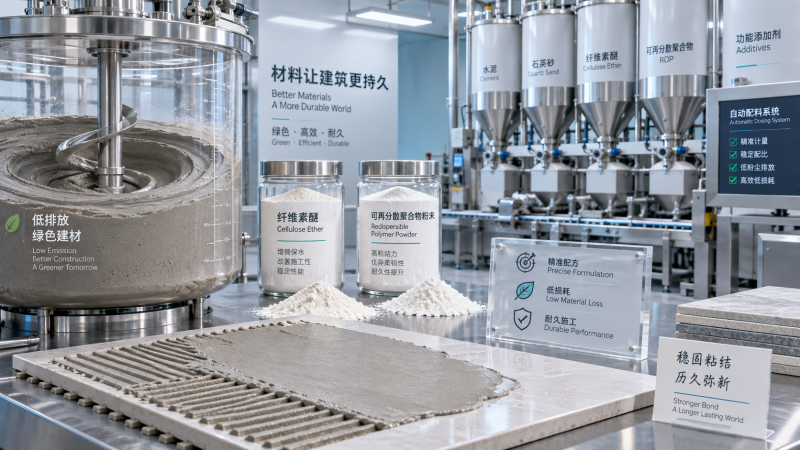
That question is moving additives from a secondary purchasing category into the center of material evaluation. Modern Construction Solutions increasingly rely on a combination of cellulose ethers, redispersible polymer powders, starch ethers, mineral fillers, and other formulation components to manage water, rheology, adhesion, strength development, and application tolerance. The “low-emission” label matters, but it is not enough on its own. A formulation that reduces one environmental burden while causing rework, waste, or site failures is not a convincing solution over the life of a project.
The market is therefore shifting toward a more practical form of sustainability: materials that can be mixed consistently, applied efficiently, transported sensibly, and used in systems that last. This is especially relevant in dry-mix mortar, tile adhesive, wall putty, skim coat, external insulation systems, gypsum-based products, and repair compounds, where small changes in additive selection can alter site performance dramatically.
The Pressure Is Coming From More Than Carbon Reporting
Embodied-carbon targets are one driver, but they are not the only one. Developers, contractors, distributors, and specification teams are also dealing with tighter indoor-air expectations, resource constraints, labor shortages, changing climate conditions, and a growing reluctance to absorb defects caused by material inconsistency. In practice, these pressures meet at the formulation stage.
Consider a tile adhesive installed in hot, dry weather. The technical problem is not simply whether the powder meets a laboratory strength target. The installer needs workable consistency, reasonable open time, wetting of the substrate, stable slip resistance where required, and reliable adhesion after curing. If the formulation loses water too quickly, workers may compensate with excess mixing water or repeated remixing. That can hurt performance and create unnecessary waste. Water-retention control, often supported by the right cellulose ether grade, becomes both a quality issue and an efficiency issue.
The same pattern appears in wall finishing compounds. A lower-material-use approach may sound attractive, but it fails commercially if the product drags under the trowel, shows poor spreadability, cracks due to unsuitable water balance, or requires extra passes. Business evaluation has become more lifecycle-oriented for a simple reason: site labor, rejected batches, callbacks, and repairs can outweigh a modest difference in raw-material cost.
This does not mean every project needs the highest-performance additive package. It means the formulation must be matched to the application, local climate, binder system, substrate, and contractor practice. A product designed for highly automated production and predictable site conditions may not be the best choice for markets where hand application, variable water quality, or large temperature swings are common.
Why Additives Have Become a Formulation Lever
Additives are often used in relatively low proportions, yet their influence can be disproportionate. They help formulators make better use of the binder and filler already in the system. In cement- or gypsum-based dry mixes, this is often about controlling fresh-state behavior before discussing hardened-state properties. If a material cannot be mixed, pumped, spread, combed, or finished reliably, its theoretical durability has limited practical value.
Hydroxypropyl methylcellulose (HPMC) is widely used to support water retention and rheology management. But treating HPMC as a generic commodity is a common procurement mistake. Viscosity is relevant, though it is not a complete selection criterion. Substitution level, particle behavior, dissolution characteristics, air entrainment tendencies, compatibility with cement and polymer systems, and the desired working feel all matter. A grade that performs well in a smooth wall putty may not give the required balance in a thick-bed adhesive or machine-applied mortar.
Redispersible polymer powder (RDP) brings a different set of controls, especially where adhesion, flexibility, cohesion, and resistance to substrate movement matter. It is frequently central to tile adhesives, repair mortars, and external insulation systems. Yet RDP is not a universal fix for weak formulation design. Increasing polymer content may improve one property while changing cost, workability, water demand, or curing behavior. A sensible formulator looks at the whole system rather than adding polymer to compensate for unsuitable aggregate grading or poor water control.
Hydroxypropyl starch ether (HPS) is also relevant where improved workability, anti-sag behavior, and application texture are needed. In many formulations, the best outcome comes from the interaction among ingredients rather than from one “hero” additive. That is why a low-emission formulation discussion should include formulation architecture, not just a list of ingredient claims.
Emission Reduction Has to Survive Real Application Conditions
There is a tendency to judge low-emission materials only at the factory gate. Manufacturing footprint is important, but it is not the full operational picture. For dry-mix products, assessors should also consider packaging efficiency, storage stability, batch consistency, mixing water demand, material loss during application, and expected service life. These factors cannot always be reduced to one universal number, but they can be examined during supplier qualification and product trials.
Powder-based systems can offer useful logistical advantages because they are transported as dry material and mixed at the point of use. The environmental result still depends on transport distance, local mixing practice, packaging recovery options, and the amount of product wasted on site. A formulation that allows stable performance at a predictable water addition can be preferable to one that demands constant adjustment by the installer.
There is also a durability argument. Better adhesion and crack resistance do not automatically prove a lower environmental footprint, but avoiding early failure is generally aligned with reducing replacement material and repair activity. This is why experienced buyers should be wary of single-attribute claims. Ask what has actually been measured, what test method was used, and whether the claimed benefit applies to the intended application. If data are unavailable, the correct response is not to assume the best case.
What a business assessment should compare
A useful review does not need to become a research project. It does need to move beyond price per kilogram. The following questions often expose the real commercial difference between apparently similar additive offers:
- Does the supplier provide consistent technical parameters relevant to the formulation, rather than only a headline viscosity or solids figure?
- How does the additive perform with the actual cement, gypsum, sand, filler, and mixing equipment used by the manufacturer?
- Is the product stable enough for the expected storage period and local logistics conditions?
- What happens when water addition varies slightly, as it often does outside a controlled laboratory?
- Can the supplier support troubleshooting when a formula behaves differently after a raw-material change?
- Are environmental, safety, and regulatory documents available for the destination market and intended use?
The last point deserves care. Requirements vary by jurisdiction and application. It is unwise to assume that a document accepted in one market automatically resolves all obligations in another. For business assessors, document readiness is part of supply reliability, not an administrative afterthought.
Formulation Trends: Fewer Trade-Offs, Not Zero Trade-Offs
The direction of travel is clear: formulators want materials that deliver more predictable performance with less resource waste. But “less” is not always better. Lower polymer dosage may reduce formulation cost and material intensity, yet it may undermine flexibility in a demanding tile application. Reducing water demand can improve handling in one mortar but make another system feel too stiff. Extending open time can be valuable in hot climates but may slow the workflow in a fast-turnaround interior job.
The stronger market position will often belong to suppliers that help customers navigate these trade-offs transparently. This requires technical depth, dependable manufacturing controls, and enough product range to avoid forcing every application into one grade. For example, HPMC grades with controllable viscosities from 400 to 200,000 CPS allow a formulator to target very different rheological needs, but grade selection still requires verification in the finished mix.
Jinan Ludong Chemical Co., Ltd., established in 2020, operates in this part of the value chain with cellulose ether production, trading, and integrated construction-material services. Its portfolio includes HPMC, RDP, and HPS, while its stated annual capacity reaches 45,000 tons. The company supplies HPMC series such as type 75 and type 60 for construction and chemical applications. Capacity alone is not a reason to approve a supplier, but it can matter when an assessor is weighing continuity of supply, grade availability, and the ability to support multiple formulation requirements.
Manufacturing capability also deserves a closer look than it usually receives. The combination of established process knowledge and intelligent automated production can help a producer manage repeatability, provided that quality controls are meaningful and consistently applied. Buyers should still request the relevant specification, batch documentation, test methods, and application guidance rather than treating a production-line description as proof of finished-product suitability.
Where Polyvinyl Alcohol Fits Into the Wider Conversation
Not every construction formulation is built around the same chemistry. In selected systems, Polyvinyl Alcohol may be considered alongside cellulose ethers and polymer powders where film formation, adhesion, or binder-related behavior is under review. Its relevance depends on the product design and performance target; it should not be inserted merely because it is available. Compatibility with other components, processing conditions, and the intended end use must be checked in the actual formulation.
That principle applies across the additive market. Sustainability-oriented purchasing is not about collecting “green” ingredients. It is about selecting materials that work together with minimal avoidable loss, acceptable emissions documentation, and a realistic service-life expectation.
The Next Market Test Will Be Evidence, Not Vocabulary
Terms such as low-carbon, low-VOC, bio-based, durable, and resource-efficient will continue to appear in construction-material discussions. Some are meaningful; some are used too loosely. The next phase of the market will reward suppliers and buyers that can connect these terms to evidence: declared product information where applicable, composition and safety documentation, controlled quality parameters, application testing, and clear statements about what has and has not been verified.
For assessors, the practical decision is rarely whether to choose performance or sustainability. The real task is to identify formulations where one supports the other. Start with the intended application, test under conditions close to actual use, review the supplier’s consistency and documentation, and calculate the cost of failure rather than only the cost of purchase. In low-emission Construction Solutions, the most credible additive formulation is usually the one that performs predictably enough that nobody has to use more material, more labor, or more repairs to make it work.
Send Your Inquiry
We welcome your cooperation and we will develop with you.
