


Construction Solutions for Preventing Sagging in Cement-Based Tile Adhesives
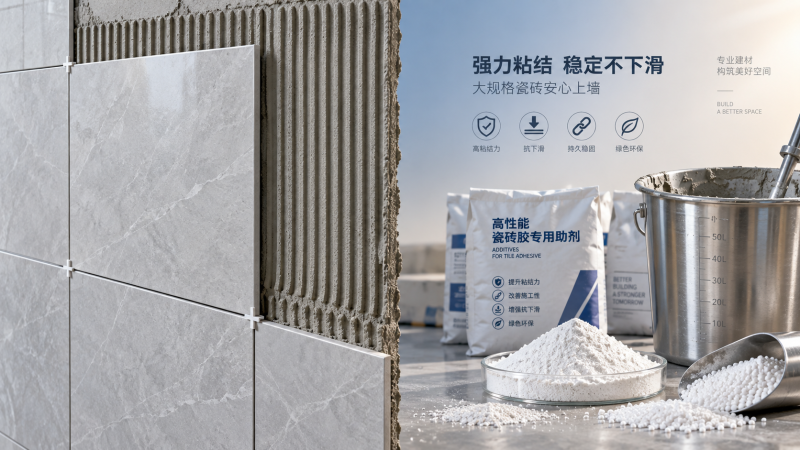
Construction Solutions for Preventing Sagging in Cement-Based Tile Adhesives
A wall tile that starts to slide only minutes after placement creates more than a cosmetic problem. Joint lines drift, spacers become overloaded, installers lose their working rhythm, and the finished wall may require adjustment long after the adhesive should have held the tile in place. In demanding areas such as bathrooms, kitchens, corridors, and façades, poor anti-sag performance can quickly turn an otherwise capable mortar into a source of delays and rework.
Effective Construction Solutions for cement-based tile adhesives begin with understanding that sagging is not caused by one factor alone. It is usually the visible result of an imbalance between water retention, early structural build-up, polymer support, aggregate grading, tile weight, and the operator’s mixing and application method. A practical anti-sag system must create enough body to hold a tile on a vertical surface while still allowing smooth troweling, proper wetting of the tile back, and adequate time for adjustment.
For adhesive producers, site supervisors, and installation crews, the goal is not simply to make the mortar thicker. A mortar that feels stiff but cannot transfer well to the substrate may create hollow spots or weak coverage. The right formulation should feel controlled under the trowel, remain stable on the wall, and keep the installer in command of the tile position.
What Sagging Looks Like on the Jobsite
Sagging, often referred to as tile slip or vertical slump, occurs when a freshly placed tile moves downward under its own weight before the adhesive develops sufficient internal strength. The movement can be subtle at first: a tile may drop a few millimeters, pinch the lower joint, or slowly pull away from its leveling clip. With larger formats, dense porcelain tiles, or thick adhesive beds, the effect can become much more obvious.
Operators often recognize the issue through recurring field signs:
- Tiles need repeated upward adjustment after being pressed into place.
- Spacers compress or shift under the weight of upper tiles.
- Vertical joints vary despite careful layout.
- Ridges collapse too quickly when the tile is bedded.
- The adhesive seems workable in the bucket but loses stability on the wall.
- Large tiles slide after alignment, especially in warm or humid conditions.
It is important to distinguish sagging from poor substrate preparation. A dusty, uneven, highly absorbent, or poorly primed wall can reduce bond development and make an installation appear unstable. However, when movement happens consistently even on a prepared substrate, the adhesive rheology and formulation deserve closer examination.
The Balance Behind a Non-Sag Adhesive
Cement-based tile adhesive is a multi-component system. Cement provides hydraulic binding, mineral fillers establish bulk and workability, polymers improve adhesion and flexibility, and rheology modifiers manage water and consistency. Preventing sagging depends on how these ingredients interact after water is added—not just on the dosage of any single additive.
A strong anti-slip profile generally requires three things to happen at once. The mortar must retain enough water for cement hydration and open time. It must build internal resistance rapidly enough to support the tile. And it must remain spreadable so the installer can create consistent adhesive ribs and achieve reliable contact coverage.
When water retention is too low, the substrate may draw water from the mortar prematurely. This can shorten open time, reduce transfer, and leave the adhesive dry or crumbly at the interface. When water retention is high but the system lacks structural control, the mortar may remain soft for too long and allow vertical movement. The most dependable Construction Solutions therefore focus on a balanced rheology package rather than a single “anti-sag” claim.
Cellulose Ether: Water Control and Application Feel
Cellulose ethers are central to the workability of many dry-mix tile adhesives. They help retain mixing water, improve consistency, reduce rapid moisture loss, and support better trowel application. Their selection affects how the adhesive hydrates, how it behaves during mixing, and how long it remains usable after spreading.
The right grade and viscosity should be chosen according to the adhesive class, filler system, climate, tile format, and desired application method. A formulation intended for thin-bed wall installation may require a different rheological profile from one designed for heavy porcelain panels or thicker-bed corrections. Excessive viscosity alone is not an answer; it can make mixing difficult, increase lump formation, or reduce the mortar’s ability to wet the tile back properly.
For formulators seeking a controlled water-retention and workability component, Hydroxypropyl Methyl Cellulose can be evaluated as part of the broader additive system. In practical production, the most useful approach is to test the cellulose ether together with the intended cement, sand, polymer powder, and starch ether rather than judging it in isolation.
Starch Ether: Building Early Body Without Losing Spreadability
Hydroxypropyl starch ether is frequently used in tile adhesive formulations to strengthen the anti-sag character of the fresh mortar. Its role is especially valuable when a producer needs a noticeable increase in slip resistance without turning the product into a hard-to-spread paste. In many systems, starch ether supports a more structured, “short” mortar feel: the adhesive stays where it is combed instead of flowing or relaxing excessively.
Dosage discipline matters. Too little may produce no meaningful improvement in vertical hold. Too much can make the mortar feel overly dry, reduce smoothness, or interfere with the installer’s preferred troweling response. The best result is often found through controlled trials using the actual sand grading and cement type planned for commercial production.
Redispersible Polymer Powder: Adhesion Support Beyond Initial Hold
Redispersible polymer powder does not replace a dedicated rheology modifier, but it has an important place in anti-sag adhesive design. It improves adhesion to common substrates and tile backs, contributes flexibility after curing, and can improve cohesion in the wet mortar. For low-absorption porcelain, demanding renovation substrates, or applications exposed to movement and temperature changes, polymer selection becomes particularly significant.
A practical formulation must avoid assuming that more polymer automatically means better vertical stability. Polymer level, cement content, filler ratio, and rheology package need to be aligned. Otherwise, the mortar may develop an application feel that is too soft, too sticky, or difficult to comb consistently. The target is a stable adhesive bed with dependable bond performance—not merely a higher polymer percentage.
Start Troubleshooting at the Mixer, Not Only on the Wall
When sagging is reported from the field, the temptation is to adjust the additive package immediately. Yet many failures begin with water addition, mixing sequence, or rest time. Before reformulating, operators should confirm that the adhesive is being prepared according to the recommended process.
Dry powder should be added gradually into clean measured water while mixing at an appropriate speed. Adding water into a pile of powder, using unmeasured water, or mixing too aggressively can introduce lumps, air, and inconsistent hydration. After initial mixing, a short maturation period allows cellulose ether, starch ether, cement, and polymer components to hydrate more uniformly. The mortar should then be remixed briefly before use.
“Making it easier to spread” by adding extra water is one of the most common causes of poor anti-sag behavior. The adhesive may look smoother in the bucket, but the internal structure weakens and tile movement becomes more likely. If the mortar feels too heavy at the specified water ratio, the solution may be a formulation adjustment rather than field dilution.
A Field Check That Reveals More Than a Simple Pull Test
Site teams can learn a great deal by observing the adhesive immediately after application. Comb the mortar on a vertical test panel with the intended notch trowel. Press a representative tile into the ridges using normal installation pressure, then align it and monitor its movement over the relevant working period. This simple check should be performed with the actual tile size and weight, not only with a small laboratory coupon.
During the check, look beyond whether the tile remains in place. Observe whether the ridges transfer to the tile back, whether the mortar tears during adjustment, and whether the tile can still be repositioned without losing support. A non-sag adhesive that produces poor transfer is not a complete solution. Good vertical adhesion requires both early hold and proper contact.
For production control, compare batches at a consistent water ratio, temperature, mixing procedure, and resting time. Changing several variables at once makes it difficult to identify the real reason for improvement or decline. A retained sample of approved production can be especially useful as a reference when operators notice changes in trowel feel.
Common Formulation and Application Mistakes
Using a high-viscosity cellulose ether as the only correction. This may improve body, but it can also create poor wetting or difficult mixing if the overall system is not adjusted. Water retention and anti-sag performance are related, yet they are not identical properties.
Ignoring sand particle distribution. Fine fillers may give a creamy appearance but can reduce structural stability if the packing design is weak. A well-considered aggregate blend helps the fresh mortar resist deformation while maintaining a workable texture.
Testing with a small ceramic tile only. A formulation that holds a small tile may fail with large-format porcelain, stone-look panels, or thicker adhesive ribs. Test conditions should reflect the product’s intended installation range.
Applying adhesive outside its workable time. A skin may form on the surface after excessive exposure to heat, airflow, or direct sun. Pressing tiles into skinned adhesive can result in weak contact, even if the mortar itself has excellent anti-sag properties.
Trying to compensate for an uneven wall with excessive adhesive thickness. Tile adhesives have intended bed thickness ranges. Large corrections should be addressed through suitable wall preparation or leveling materials before tile placement.
Choosing Construction Solutions by Application Type
For standard wall tiles, the priority is usually smooth spreading, sufficient open time, and modest anti-slip performance. A balanced cellulose ether and starch ether combination may provide the desired handling without making the mortar feel overly stiff.
For large-format porcelain tiles, the margin for error is narrower. The tile weight is greater, transfer requirements are higher, and installers need enough adjustment time to maintain alignment. Here, the cement-polymer-rheology balance should be designed around actual tile dimensions and installation technique, including back-buttering where required.
For exterior walls or areas exposed to changing temperatures, bond durability and deformation capacity become more important. Redispersible polymer powder selection, substrate preparation, and moisture-management practices should be considered alongside vertical hold. A mortar that resists sagging on day one but lacks durable adhesion under service conditions is not an adequate system.
In humid or hot environments, workability can change quickly. Rather than relying on on-site water adjustments, producers should evaluate retarding behavior, water retention, open time, and anti-sag response under representative temperatures. This is where integrated additive design gives installers a more predictable product from one project to the next.
Turning Better Formulation Into Better Installation Results
The most reliable anti-sag tile adhesive is one that gives the operator confidence: it mixes consistently, combs cleanly, holds the tile without constant correction, and still allows careful alignment before curing. Achieving that experience requires attention to raw materials, additive compatibility, production consistency, and field instructions.
For manufacturers, cellulose ether grades with controllable viscosity ranges can support formulation development across different adhesive categories. Jinan Ludong Chemical Co., Ltd. supplies cellulose ether systems alongside redispersible polymer powder and hydroxypropyl starch ether, enabling producers to assess compatible components for tile adhesive applications rather than treating each additive as a separate answer.
For the people holding the trowel, the practical message is straightforward: measure water accurately, allow the mortar to mature, use the correct trowel and bed thickness, and do not accept repeated tile movement as normal. When the formulation and application process are properly matched, sagging becomes a controllable issue instead of a recurring frustration on every vertical installation.
Send Your Inquiry
We welcome your cooperation and we will develop with you.
