


Selecting Construction Solutions for Tile Adhesives in Hot and Dry Climates
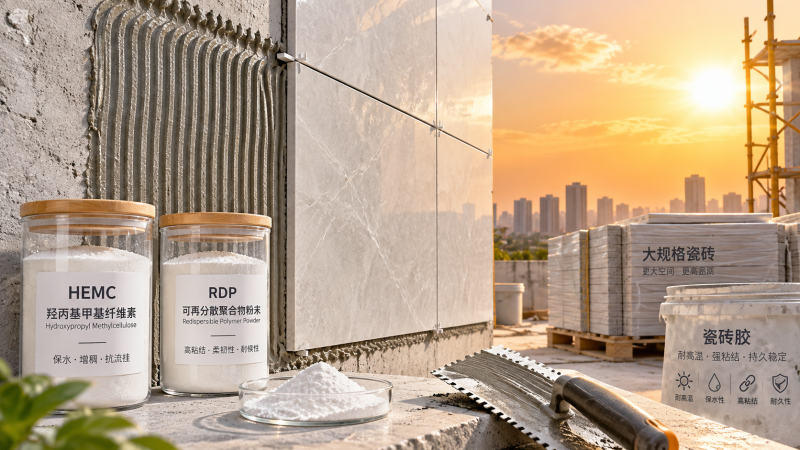
Tile adhesive work can become unreliable quickly when a wall or floor is exposed to high ambient temperature, low humidity, warm substrates, or moving air. The installer may mix a mortar that appears normal in the bucket, then find that it skins over on the wall before tiles are placed. Trowel ridges lose their shape, transfer to the tile back becomes uneven, and workers may add water on site to regain spreadability. These are not minor application inconveniences; they can lead to reduced coverage, poor bond development, delayed rework, and inconsistent installation quality across the same project.
For hot and dry conditions, the correct construction solution is not simply “more water” or a higher-viscosity thickener. The formulation should retain moisture, maintain workable open time, wet both the substrate and tile back effectively, resist slip where required, and still develop the intended strength after curing. Project decisions should therefore begin with the climate exposure, substrate condition, tile format, installation pace, and actual mixing practices—not with a single additive dosage.
Start with the site conditions that are accelerating water loss
Hot and dry climates are not defined by air temperature alone. A shaded indoor area at a moderate temperature may behave differently from a sun-exposed façade where the substrate has absorbed heat throughout the day. Cementitious tile adhesive loses water through several routes at once: evaporation into dry air, absorption by porous backgrounds, heating from the substrate, and airflow across the freshly combed adhesive bed.
Before selecting a formulation, identify which of these conditions is dominant. This helps distinguish a material limitation from an application problem.
- High substrate temperature: Concrete, render, screeds, and masonry can be substantially warmer than the surrounding air. A hot substrate draws heat into the adhesive layer and speeds evaporation at the interface where hydration is needed.
- Low relative humidity: Dry air accepts moisture readily. Fresh mortar may form a dry surface film even when the material underneath is still plastic.
- Wind or mechanical ventilation: Air movement over a trowelled bed can shorten usable open time more severely than a small increase in temperature.
- Absorbent backgrounds: Unprimed cement render, lightweight blocks, old leveling layers, and dry screeds may pull water from the adhesive before proper cement hydration and polymer film formation occur.
- Large tiles and slow placement: Large-format tiles require more handling time. Once placed, they also make incomplete contact harder to detect.
The key question is practical: can a freshly combed adhesive bed still transfer adequately to the tile back at the point of placement? If transfer becomes poor before the stated open time would normally be expected, the project needs to assess both formulation and site controls.
What performance should be protected first?
In hot weather, several properties compete with each other. Extending open time is essential, but an adhesive that remains overly soft, loses its anti-sag behavior, or cannot develop a stable bond is not an effective answer. Good Construction Solutions balance the following requirements according to the installation type.
A frequent mistake is to interpret a dry surface skin as proof that the mix is too thick. The real issue may be insufficient water retention, excessive ventilation, an overheated substrate, or spreading too much mortar at one time. Adding water after the mortar has begun to set can disturb the designed water-to-binder balance and may not restore proper performance.
Use cellulose ether selection to control moisture and application behavior
Cellulose ethers are central to cement-based tile adhesive formulations because they influence water retention, consistency, workability, and open-time behavior. In a hot and dry environment, selecting the appropriate grade involves more than choosing the highest available viscosity. Viscosity contributes to rheology, but substitution type, particle characteristics, dissolution behavior, dosage, cement system, fillers, and other additives all affect the final result.
A grade that gives strong water retention can help reduce rapid moisture loss from the adhesive bed. However, excessive thickening may make the mortar harder to spread, interfere with ridge collapse, increase mixing time, or create a heavy trowel feel that slows installation. The best choice is usually a formulation window in which the adhesive remains coherent and workable while still allowing efficient bedding of the tile.
For formulations requiring sustained workability under demanding drying conditions, Methyl Hydroxyethyl Cellulose (HEMC) may be evaluated as part of the water-retention and rheology package. Its suitability should be assessed in the actual cement, filler, polymer, and application system rather than assumed from a single laboratory property. Changes in fine aggregate grading, cement reactivity, or mixing energy can alter how the finished adhesive behaves on site.
Do not use viscosity as the only selection criterion
Higher viscosity may improve body and reduce water loss, but it does not automatically deliver better tile transfer. A project with dense porcelain tiles may need a mortar that wets the tile back readily and permits ridges to collapse during bedding. A wall application may require more yield value and anti-sag stability. Floor installation over an absorbent screed may place greater emphasis on water retention and working time. These needs should be considered together.
It is also useful to examine how quickly the dry mix hydrates after water is added. An adhesive that requires extended mixing or has poor dispersion can create false impressions of inadequate water or low workability. Establish a defined mixing sequence, mixing duration, and maturation period before changing additive levels.
Redispersible polymer powder helps when contact and durability are under pressure
In hot, dry installations, water can leave the adhesive before the cementitious and polymeric components have formed the intended bonding structure. Redispersible polymer powder is commonly used to improve adhesion, flexibility, cohesion, and contact with demanding surfaces. Its role becomes particularly relevant where tiles are dense or low-absorption, where substrate movement is expected, or where the adhesive must maintain robust bonding performance despite difficult placement conditions.
Polymer selection should match the job rather than be treated as a universal correction for short open time. A polymer can improve adhesion and deformability, yet it will not compensate for an installer spreading an excessive area under direct sun or placing tile onto a fully skinned adhesive surface. Similarly, increasing polymer content without balancing the cellulose ether and mineral system may change consistency, air content, setting behavior, or cost without resolving the root cause.
When comparing adhesive options, ask whether the polymer package supports the specific tile and substrate combination. Porcelain, vitrified tile, natural stone, cement render, calcium sulfate-based substrates, and old ceramic surfaces impose different requirements. Surface preparation, primer selection, and moisture condition remain part of the overall decision.
Starch ether can refine handling, but should not replace moisture control
Hydroxypropyl starch ether is often used in tile adhesive systems to adjust workability, consistency, and anti-sag characteristics. In a vertical installation, it may help maintain a clean, controlled trowel response and improve resistance to tile movement. For crews working quickly in warm conditions, this can make application more predictable.
Its function should be considered as a rheology adjustment within the broader formulation. Starch ether does not replace the need for adequate water retention from the cellulose ether system, appropriate polymer modification, or sensible site practice. Too much focus on anti-sag can produce a mortar that feels firm but does not bed tiles effectively. The target is not maximum structure in the bucket; it is stable, continuous adhesive contact after installation.
Compare formulation options against the installation scenario
Project managers can make the selection process more efficient by grouping the application into the actual risk scenario. The same adhesive may not be optimal for every area of a large project.
Interior floors with limited air movement
Where temperatures are elevated but the work area is shaded and relatively still, moderate water retention and good trowelability may be sufficient. Focus on consistent mixing, substrate moisture condition, and manageable spread areas. A formulation with excessive anti-sag structure may not be necessary for this work and can make rapid floor coverage more difficult.
Sun-exposed balconies, terraces, and exterior walls
These areas often combine hot substrates, low humidity, and airflow. Water-retention performance and open time become more critical, but site controls are equally important. Work should be scheduled to avoid the most severe exposure where possible. Materials should not be stored in direct sun, and hot substrates may require preparation in line with the adhesive system’s application guidance. Smaller spread areas and regular transfer checks are more reliable than assuming the nominal open time will apply unchanged.
Large-format tile on vertical surfaces
This condition combines the need for open time with slip resistance and high contact area. Select a system that maintains workable wet tack while controlling vertical movement. Back-buttering may be required by the tile format, substrate flatness, and coverage target. If the adhesive ridges skin before the tile is embedded, increasing bedding pressure alone is unlikely to restore full contact.
Absorbent or uneven cementitious backgrounds
Here, rapid water draw can be mistaken for a defective adhesive. Check whether the substrate is excessively dry, dusty, weak, or variable in porosity. Suitable priming or conditioning can reduce uncontrolled suction and provide a more uniform surface for the adhesive. A formulation with strong water retention is still valuable, but it should not be expected to correct a poorly prepared background.
Build a trial around observable installation checks
Laboratory screening is useful, yet hot-climate selection should include an application trial that reflects the actual job. The purpose is not to create a complex test program; it is to confirm that the material behaves acceptably at the pace and exposure expected during installation.
- Use the intended cement, fillers, polymer powder, cellulose ether, and water range. Record the mixing sequence and rest time.
- Prepare representative substrate panels, including the most absorbent or heat-prone background likely to be encountered.
- Apply the adhesive at the intended bed thickness with the trowel notch planned for the tile format.
- Place tiles at several intervals after combing, not only immediately after spreading. Lift selected tiles to inspect adhesive transfer and ridge collapse.
- Observe whether the mortar remains easy to spread, whether it skins at the surface, whether tiles slip on walls, and whether workers feel compelled to retemper the mix.
- Repeat under the warmest realistic conditions and with normal site ventilation where this is safe and representative.
Documenting these observations gives the formulation team and site management a more useful basis for adjustment than broad comments such as “the mortar dried too fast.” For example, good bucket life combined with poor wall open time points toward exposure or substrate suction. Good open time but poor vertical stability indicates a rheology balance issue. Poor transfer from the start may indicate mixing, trowel selection, substrate flatness, or wetting behavior rather than evaporation alone.
Control site practice alongside material selection
Even a well-designed adhesive can fail to perform as intended when application practice amplifies drying. Keep dry-mix bags and mixed mortar out of direct solar heating. Mix only the quantity that can be used within the working period. Avoid spreading large areas ahead of tile placement. Verify that trowel ridges are fresh and capable of transfer before setting each tile, especially at perimeter zones, exposed elevations, and transitions between shaded and sunlit work areas.
Substrate preparation deserves the same attention as additive selection. Remove dust, weak surface layers, curing residues, and contaminants. Check flatness so the adhesive is not forced into an unsuitable bed thickness. Manage highly absorbent surfaces according to the substrate and adhesive system requirements. Where ambient or substrate temperature exceeds the product’s intended application range, rescheduling the work or applying temporary environmental controls may be more responsible than attempting to compensate through field water addition.
The most reliable decision is therefore a balanced one: select a cementitious tile adhesive system with water retention suited to rapid drying, polymer modification appropriate for the tile and substrate, and rheology tuned for the installation orientation. Then verify that this formulation still provides adequate transfer, placement time, and stability under the actual exposure conditions. That approach addresses the source of hot-weather failures before they become widespread bond defects.
Send Your Inquiry
We welcome your cooperation and we will develop with you.
