


Construction Solutions: Which Chemical Additives Improve Mortar Workability?
Mortar workability is often described as “ease of application,” but that shorthand hides several separate requirements. A workable mortar must mix smoothly, spread without tearing, stay usable long enough for placement and adjustment, resist premature drying, and still develop reliable adhesion and strength after curing. One additive rarely improves every one of those properties equally. The best chemical package depends on whether the mortar is a tile adhesive, cement render, wall putty, skim coat, masonry mortar, or repair compound.
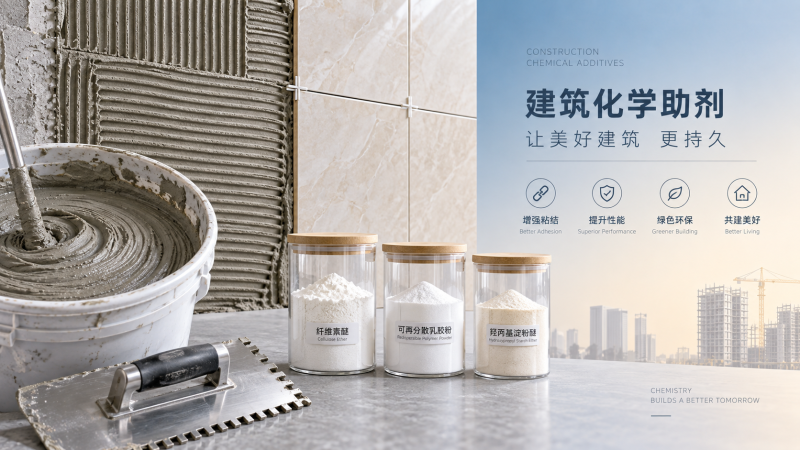
For dry-mix construction materials, the additives most often used to improve workability are cellulose ethers, redispersible polymer powders, and hydroxypropyl starch ethers. Each affects the mortar through a different mechanism. Cellulose ethers primarily manage water and consistency; polymer powders improve cohesion and adhesion after hydration; starch ethers adjust rheology and handling, particularly where a lighter, creamier feel is needed. Formulators get better results by matching those roles to the application rather than treating “workability” as a single specification.
Start with the failure mode, not the additive name
The first question is why the mortar is difficult to use. A mix that stiffens too quickly calls for a different intervention from one that slips on a vertical wall. A tile adhesive that combs poorly may need better water retention and rheological control, while a render that drags under the trowel may need a different balance of binder, aggregate grading, and viscosity modification.
This distinction matters because an additive that solves one complaint can worsen another. Raising water retention may improve application in hot or absorbent conditions, but excessive water retention can slow drying or make a mix feel overly sticky. Increasing polymer content can improve adhesion and flexibility, yet it may also change cost, air entrainment behavior, and open-time response. A useful formulation process starts by identifying the visible symptom:
- Rapid loss of plasticity: the mortar becomes hard to spread shortly after mixing or on a dry substrate.
- Poor trowelability: the material feels harsh, drags, tears, or leaves an uneven bed.
- Insufficient slip resistance: tiles, renders, or thick layers move after placement.
- Weak cohesion: the fresh mortar crumbles, segregates, or lacks a continuous, creamy body.
- Short open time: the applied layer skins over before a tile or finish can be properly embedded.
- Unsatisfactory bond after curing: fresh workability may appear acceptable, but the hardened system does not adhere reliably.
Substrate absorption, ambient temperature, aggregate moisture, cement type, filler level, and mixing energy can all produce similar symptoms. Chemical additives should therefore be evaluated in the complete mortar system. Changing only the additive while ignoring a highly absorptive sand, an unsuitable water-to-binder ratio, or inadequate mixing can lead to misleading conclusions.
Cellulose ethers: the main tool for water retention and application consistency
Cellulose ethers are usually the first additive family considered when the objective is to make cement-based dry mortars more workable. In practical terms, they increase the water-holding capacity of the fresh mix and alter its viscosity. This gives the applicator more time to spread, comb, level, or finish the material before water is drawn away by the substrate or lost through evaporation.
Hydroxypropyl methylcellulose, commonly abbreviated as HPMC, is widely used in tile adhesives, plasters, renders, skim coats, and related dry-mix formulations. It can improve consistency without simply adding more mixing water. That is important because excess water may make a mortar easier to move initially but can reduce strength, increase shrinkage, and create a less stable application profile.
A suitable cellulose ether can contribute to several linked properties:
- Improved water retention, especially on porous masonry, concrete, or cementitious substrates.
- More uniform hydration of cementitious binders.
- Longer workable time and, in many systems, a more usable open time.
- Better lubricity during trowel application.
- More stable fresh mortar body, reducing the tendency for water separation or dry pockets.
Viscosity is an important selection parameter, but it should not be used as a shortcut for performance. A higher-viscosity grade may provide stronger thickening and water retention, yet the response depends on dosage, dissolution behavior, particle-size distribution, cement chemistry, fillers, and the target consistency. Two products with a similar nominal viscosity may not produce the same feel in a tile adhesive or render. Surface treatment, substitution pattern, gel behavior, and batch consistency also influence how the polymer performs after mixing.
For a researcher comparing materials, an appropriate starting point is to test a cellulose ether within the intended formula at a controlled water demand. The useful question is not “Which viscosity is best?” but “At the same application consistency, which grade provides the required water retention, spreadability, and open time without excessive stickiness or delayed set?” In product-development work, a material such as Hydroxypropyl Methyl Cellulose should be assessed as part of that balance, alongside the full binder and aggregate system.
Where cellulose ether selection commonly goes wrong
One frequent assumption is that more cellulose ether automatically produces better workability. At low or moderate dosage, an increase may improve cohesion and water retention. Beyond the useful range, the mortar can become too viscous, difficult to wet out, overly sticky under the trowel, or slow to develop the surface condition required for the next operation. In tile adhesives, excessive thickening can impair ease of combing. In renders and plasters, it can make pumping, spraying, or finishing less efficient.
Another mistake is to judge performance only in a laboratory cup or immediately after mixing. Mortar behavior during the first few minutes can look satisfactory while the same formula performs poorly after standing, on a highly absorbent wall, or under warm, dry air. Workability testing should include the time-dependent condition relevant to the intended application: initial mixing, post-restirring behavior, spreadability after a defined period, and substrate contact.
Redispersible polymer powder: when workability must support adhesion
Redispersible polymer powder, often called RDP, serves a different purpose from a cellulose ether. Once mixed with water, it redistributes through the mortar and can form a polymer film as the system dries. This contributes to adhesion, cohesion, flexibility, and resistance to stress at the interface between mortar and substrate.
RDP is particularly relevant where workability cannot be separated from bond performance. Tile adhesives need a mortar that is easy to comb and that wets the back of the tile, but they also need sufficient adhesion after curing. Exterior insulation and finishing systems, repair mortars, flexible coatings, and certain renders may similarly require improved resistance to movement or substrate stress. In these cases, a cellulose ether may make the mortar workable while the polymer powder helps preserve the mechanical result of that workable application.
The practical interaction between RDP and cellulose ether deserves attention. A mortar with good water retention but insufficient polymer modification may remain easy to apply yet fail to provide the adhesion or deformability expected by the end use. Conversely, an aggressive polymer addition does not remove the need for suitable rheology. If the fresh mix does not wet the substrate, hold its form, or allow proper embedding, the potential adhesive benefit of the polymer may not be fully realized.
Polymer selection should be connected to the binder chemistry and service requirement. Different polymer compositions can influence flexibility, adhesion, water resistance, and setting behavior differently. Rather than selecting by generic labels alone, compare the resulting mortar against the performance requirements that matter for the intended use. For an information-stage review, the most useful screening criteria are often fresh consistency, substrate wetting, open-time behavior, vertical slip where relevant, and hardened adhesion under the applicable test conditions.
Hydroxypropyl starch ether: useful for rheology, but not a substitute for the whole system
Hydroxypropyl starch ether, or HPS, is often used in dry-mix mortars to refine the feel and rheology of the material. It can help provide a smoother, more lubricated troweling response and may improve sag resistance in formulations applied on vertical surfaces. It is particularly relevant when the target is a mortar that applies easily but remains stable after application.
Its role is commonly complementary. In a tile adhesive, for example, HPS may help the mortar maintain a workable, creamy character and improve handling at the trowel, while HPMC supports water retention and RDP supports adhesive performance. In plasters and renders, the balance may lean more heavily toward application feel, resistance to slump, and finishability.
However, starch ether should not be treated as a universal replacement for cellulose ether. It does not provide the same water-retention profile, and it cannot independently deliver the adhesion contribution of a polymer powder. Its value lies in tuning the fresh-state behavior. A formulation that relies on HPS to compensate for poor aggregate grading, insufficient water retention, or an unsuitable binder balance may still be difficult to use under site conditions.
Different mortar types need different workability profiles
“Good workability” has a different meaning in each product category. This is why additive selection should begin with application method and end-use expectations.
The aggregate system changes the answer substantially. Fine, angular sand may demand more lubrication than a rounded aggregate. High filler content can increase water demand and alter apparent viscosity. Lightweight fillers affect density and stability. A workability package that performs well in one region or plant may require adjustment when local sand gradation or cement source changes.
How to evaluate additives without relying on marketing claims
Suppliers may describe an additive as offering “high water retention,” “excellent workability,” or “enhanced adhesion.” Those descriptions are directionally useful, but they are not enough for a formulation decision. The same additive can behave differently across cement grades, filler combinations, polymer levels, and water contents.
A practical comparison uses a fixed base formula and changes one variable at a time. Keep cement, filler, sand grading, water addition, mixing sequence, mixing time, and temperature as consistent as possible. Then observe properties that match the real application process rather than relying only on a single flow value.
- How easily does the powder wet and disperse during mixing?
- Does the mortar reach the target consistency at a reasonable water demand?
- How does it feel under the trowel immediately after mixing and after standing?
- Does it retain moisture on the actual substrate type?
- Does the surface remain workable for the required application window?
- For vertical applications, does the material sag, slump, or permit tile movement?
- After curing, have adhesion, cohesion, strength, and surface appearance remained acceptable?
Testing should also account for application environment. A formula that works in a controlled room may require stronger water management on a hot, dry, or highly absorbent substrate. Conversely, a very high water-retention system may be less attractive where drying time and finishing sequence are more critical. The goal is not the maximum value for any single property; it is a workable window that supports correct installation and reliable cured performance.
A balanced additive package is usually more useful than a single “best” additive
For many dry-mix mortars, the most effective Construction Solutions come from assigning each additive a clear job. Cellulose ether manages moisture and fresh consistency. Redispersible polymer powder reinforces adhesion and cohesion where the use case demands it. Hydroxypropyl starch ether fine-tunes rheology, trowel feel, and stability. The exact combination depends on the mortar type, application method, substrate, and performance target.
That framework also helps avoid a common selection error: choosing additives solely by headline properties. A highly viscous cellulose ether, a high-polymer formula, or a strong rheology modifier can each look impressive in isolation. The useful formulation is the one that allows a worker to mix, spread, adjust, and finish the mortar predictably while preserving the required hardened properties. For early-stage evaluation, that is the decision standard that matters most.
Send Your Inquiry
We welcome your cooperation and we will develop with you.
