


XCMG XE1350E Battery-Electric Excavator Enters Mass Delivery in SEA
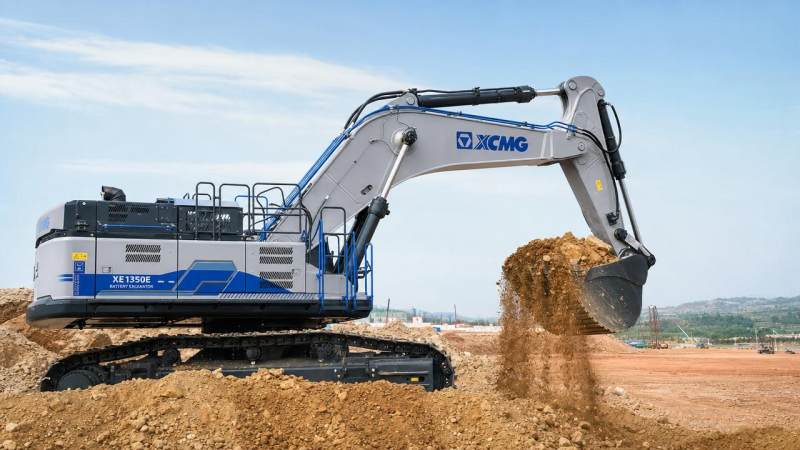
On April 30, 2026, XCMG commenced mass delivery of its XE1350E battery-electric hydraulic excavator — the largest-tonnage pure-electric excavator in its lineup. The first batch entered service at a sand and aggregate site supporting the Jakarta–Bandung highway expansion project in Indonesia. This development is particularly relevant for equipment importers, rental operators, and EPC contractors active in Southeast Asian infrastructure — as it introduces a validated total cost of ownership (TCO) alternative to imported diesel models.
Event Overview
XCMG’s XE1350E battery-electric hydraulic excavator entered mass delivery in late April 2026. The initial deployment is at a sand and aggregate production facility tied to the Jakarta–Bandung high-speed railway expansion in Indonesia. According to publicly disclosed information, the model delivers a 62% reduction in energy-related operating cost versus comparable diesel-powered excavators and reduces maintenance frequency by 45%. Its adoption marks the first real-world TCO validation for a large-tonnage electric excavator in a Southeast Asian heavy civil infrastructure context.
Industries Affected by This Development
Equipment Importers & Distributors: Directly face shifting competitive dynamics in the 10–15 tonne excavator segment. With local TCO data now available from an actual construction site, pricing negotiations and product positioning for imported diesel alternatives may require recalibration — especially where energy cost volatility or tightening emissions compliance timelines are concerns.
Rental Fleet Operators: Experience altered fleet economics for medium- to long-term contracts on infrastructure projects. The 45% lower maintenance frequency and verified energy savings affect depreciation assumptions, residual value modeling, and contract bid pricing — particularly for multi-year sand/aggregate supply or earthworks packages.
EPC Contractors & Infrastructure Developers: Gain a new equipment option with quantified operational savings for fixed-duration, high-utilization applications like quarrying or bulk excavation. Unlike pilot deployments, this is a production-grade unit deployed under commercial contract — meaning procurement teams can now assess it against standard technical and financial evaluation criteria.
Local Equipment Service Providers: Face evolving after-sales demand patterns. Reduced maintenance frequency implies lower volume of routine service labor but higher technical requirements for high-voltage system diagnostics, battery health monitoring, and thermal management support — potentially reshaping technician training and parts inventory strategies.
What Relevant Enterprises or Practitioners Should Focus On Now
Monitor official technical documentation and regional certification status
The XE1350E’s current deployment is in Indonesia. Importers and contractors considering rollout across other ASEAN markets should track whether type approvals, safety certifications (e.g., SNI, BIS, or Singapore PSB), and local grid compatibility assessments have been completed — as these directly impact timeline feasibility and customs clearance risk.
Assess applicability to specific project typologies — not just tonnage class
While rated at 135 tonnes operating weight, the unit’s economic advantage is tied to high daily utilization (>8 hours) and stable charging infrastructure. Firms should evaluate suitability for their typical work profiles — e.g., continuous quarry loading vs. intermittent urban excavation — rather than treating it as a drop-in replacement for all diesel 13–15t units.
Distinguish between verified field performance and broader product roadmap claims
The reported 62% energy cost reduction and 45% maintenance reduction apply specifically to the Jakarta–Bandung aggregate site conditions: stable off-grid charging, predictable shift cycles, and centralized maintenance oversight. These figures do not automatically extend to decentralized, low-utilization, or remote-site operations without further validation.
Prepare internal procurement and financing alignment
For rental firms and contractors evaluating capital expenditure, upfront cost remains higher than equivalent diesel models. Stakeholders should review internal ROI thresholds, explore OEM financing terms (if disclosed), and align procurement timing with upcoming tender cycles — especially for government-backed infrastructure programs with stated decarbonization targets.
Editorial Perspective / Industry Observation
Observably, this is less a standalone product launch and more a TCO benchmarking milestone — one grounded in actual infrastructure project execution, not lab testing or demonstration sites. Analysis shows the significance lies not in the machine’s novelty alone, but in the emergence of empirically supported operating economics for large electric excavators in tropical, developing-market conditions. It signals growing maturity in localized electrification viability — though scalability beyond this specific use case remains contingent on charging infrastructure readiness and regional policy alignment. The industry should treat this as an early-stage reference point, not yet a broad-based inflection.
Concluding, this delivery confirms that battery-electric excavators can achieve validated TCO parity in select high-utilization infrastructure subsegments within Southeast Asia — but only where operational conditions closely match those of the initial deployment. It does not indicate immediate wholesale displacement of diesel equipment; rather, it identifies a narrow but commercially meaningful entry point for electrification in the region’s heavy equipment market.
Source: Publicly announced delivery event by XCMG (April 30, 2026); project location and performance metrics confirmed in official press release. No third-party verification or independent audit data has been published to date. Continued observation is warranted regarding cross-border deployment status and long-term reliability data beyond the initial operational period.
Send Your Inquiry
We welcome your cooperation and we will develop with you.
