


2026 Market Shifts Affecting Redispersible Polymer Powder Supplier Selection
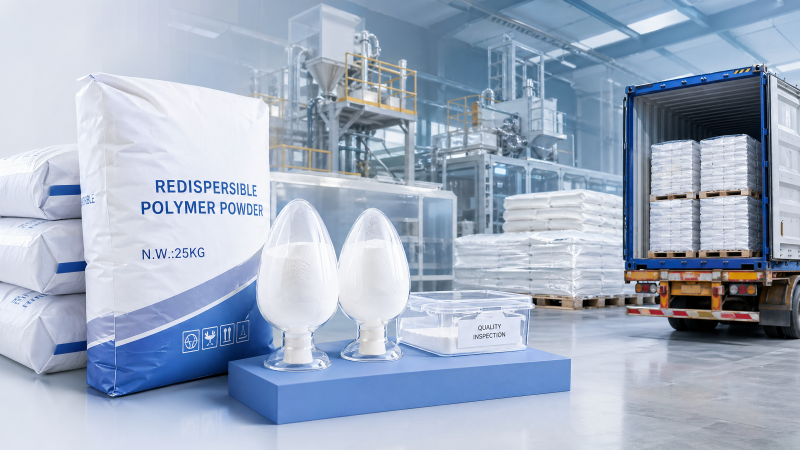
As 2026 market shifts reshape construction materials sourcing, choosing the right Redispersible Polymer Powder supplier is becoming a critical business decision. From cost volatility and quality consistency to supply chain resilience and technical support, procurement teams must evaluate more than price alone. This article explores the key factors influencing supplier selection and how to identify partners that can support long-term performance and global project demands.
Understanding the 2026 Supplier Selection Context
For business evaluators in the chemicals and construction materials sector, a Redispersible Polymer Powder supplier is no longer judged only by quotation speed or nominal price per ton. In 2026, supplier assessment is shaped by a wider set of concerns: raw material fluctuations, tighter project tolerances, variable freight lead times, and growing expectations for formulation support. Redispersible polymer powder remains a critical additive in dry-mix mortar, tile adhesive, self-leveling compounds, repair mortar, and insulation systems because it directly affects adhesion, flexibility, water resistance, and workability.
In practical sourcing terms, many procurement teams now evaluate supplier performance across 5 to 8 dimensions rather than 2 or 3. Typical review areas include batch consistency, moisture control, ash content stability, particle size distribution, packaging reliability, technical documentation, and response time for corrective action. This broader view reflects a market reality: a small variation in polymer powder behavior can create downstream losses that far exceed the original material savings.
The role of a Redispersible Polymer Powder supplier also intersects with adjacent additives. In many mortar systems, polymer powder performance is evaluated together with cellulose ether, starch ether, fillers, and cement chemistry. That is why experienced manufacturers with integrated additive knowledge often provide better support than traders focused only on spot pricing. Companies such as Jinan Ludong Chemical, with large-scale cellulose ether manufacturing and integrated service capabilities, fit this market direction because procurement decisions increasingly favor solution-oriented partners.
Why market attention is increasing
The 2026 environment highlights the cost of inconsistency. If a supplier changes polymerization characteristics, anti-caking performance, or packing discipline without proper notice, the result may be reduced open time, unstable workability, or poor bond strength in the finished mortar. On a project scale of 500 to 2,000 tons of dry mix, even a 1% to 2% formulation disturbance can trigger costly rework, claims, or delayed handover.
In addition, supply chain resilience matters more when procurement windows are short. Many buyers now build quarterly or semi-annual sourcing plans instead of monthly spot purchasing. A capable Redispersible Polymer Powder supplier should therefore demonstrate not only manufacturing capacity, but also order scheduling discipline, export handling experience, and the ability to communicate lead-time changes early enough for planning adjustments.
For global buyers, supplier evaluation is also becoming more technical. Product data sheets, storage guidance, application recommendations, and sample validation procedures are increasingly part of the commercial review. This shift does not make price irrelevant; it makes price meaningful only when tied to reliable performance over 6-month to 12-month procurement cycles.
Core evaluation focus in one view
The table below summarizes how the main market shifts in 2026 influence the selection logic for a Redispersible Polymer Powder supplier.
This overview shows why supplier choice in 2026 should be treated as a performance-risk decision, not a simple commodity purchase. A Redispersible Polymer Powder supplier that can explain process stability, provide predictable scheduling, and support practical formulation needs will usually create better total procurement value than one competing only on a lower initial unit price.
What a Reliable Redispersible Polymer Powder Supplier Should Offer
A dependable Redispersible Polymer Powder supplier should provide a clear combination of manufacturing capability, quality discipline, and service response. Buyers should ask whether the supplier runs stable production lines, whether batches are traceable, and whether quality parameters are controlled within a defined internal range. Even when exact values differ by grade, consistency in redispersion behavior and application effect is often more valuable than chasing the lowest listed number on a specification sheet.
Technical compatibility is another major factor. RDP is rarely used alone; it interacts with cellulose ethers, defoamers, retarders, gypsum, cement, sand grading, and other system components. For this reason, suppliers that understand broader dry-mix chemistry can often help reduce trial cycles from 4 to 6 rounds down to 2 or 3. In some formulations, related materials such as Hydroxypropyl Methyl Cellulose are assessed together with polymer powder to optimize water retention, sag resistance, and open time.
Business evaluators should also review how a supplier handles documentation and communication. A supplier may have acceptable product quality but still create operational friction if data sheets are unclear, samples arrive late, packaging labels are inconsistent, or complaints require 10 to 14 days for response. In 2026, the best suppliers are those able to combine product reliability with disciplined execution across commercial and technical touchpoints.
Key capability areas to assess
- Production stability: annual capacity, process continuity, and ability to support repeat orders over 3-month to 12-month planning windows.
- Quality consistency: controlled moisture, stable bulk density range, reliable redispersibility, and batch traceability records.
- Technical service: application recommendations, formula adjustment input, and realistic sample evaluation support.
- Commercial execution: transparent quotations, packing standards, lead-time communication, and claim handling procedure.
- Export readiness: palletization, moisture-protection packaging, shipping documentation, and understanding of destination market requirements.
These factors help convert supplier screening into measurable business criteria. They are especially important for distributors, importers, and dry-mix mortar manufacturers serving multiple project sites where consistency from one container to the next matters as much as lab approval.
Practical indicators for supplier review
The following table can be used as a practical framework when comparing a short list of candidates.
When a Redispersible Polymer Powder supplier performs well across these points, the benefit is usually seen in lower hidden costs: fewer production interruptions, reduced sample repetition, more predictable container planning, and faster support when formulations need adjustment for local cement or climate conditions.
How Supplier Choice Affects Application Value
Supplier selection matters because RDP performance is directly tied to end-use results. In tile adhesive, buyers usually focus on bond strength, anti-slip behavior, and open time. In external insulation systems, flexibility and crack resistance often receive more attention. In self-leveling or repair systems, flow behavior, cohesion, and adhesion to substrate can be equally important. A Redispersible Polymer Powder supplier that understands these distinctions can recommend grades and dosage ranges more effectively than a generic seller.
Application value is also linked to formulation efficiency. A polymer powder that performs steadily within a dosage band of 1.5% to 5.0% by dry mix may allow better cost control than a lower-priced alternative that requires repeated adjustment. For business evaluators, this means total formulation economics should be reviewed alongside purchase price. The right supplier can help maintain a stable recipe instead of forcing constant reformulation due to variability.
Another aspect is trial speed. If the supplier can provide guidance on interaction with cement grade, filler ratio, and cellulose ether system, qualification can be completed faster. For producers launching products into new export markets or climate zones, this can shorten commercialization lead time by several weeks. That is a measurable business advantage, not just a technical convenience.
Typical application categories and selection priorities
Because application needs differ, business evaluators should align supplier selection criteria with the target product line rather than using one generic checklist for every grade.
This classification helps procurement teams connect chemical purchasing with downstream product performance. It also clarifies why the best Redispersible Polymer Powder supplier for one application may not be the best choice for another. Evaluation should follow actual product positioning, customer expectations, and formulation sensitivity.
Integrated additive understanding matters
A supplier with knowledge of broader dry-mix systems can be especially useful when application performance depends on additive balance rather than a single raw material. For example, the interaction between polymer powder and Hydroxypropyl Methyl Cellulose often influences water retention, workability retention, and construction feel. This is one reason integrated manufacturers are increasingly relevant in 2026 sourcing discussions.
For companies with multiple SKUs, this integrated view can reduce the risk of solving one problem while creating another. A change made to improve flexibility should not unexpectedly weaken site handling or increase labor difficulty. The supplier’s ability to discuss these trade-offs is a practical signal of real technical value.
In short, supplier choice influences not only incoming material acceptance, but also product positioning, claim control, and market competitiveness. That is why a Redispersible Polymer Powder supplier should be reviewed as part of a formulation ecosystem, not as an isolated commodity source.
Practical Evaluation Steps for Business Teams
A structured selection process helps convert broad supplier claims into verifiable decision inputs. For most organizations, a 4-step or 5-step review model works well: pre-screening, sample testing, commercial validation, supply risk review, and final approval. The depth of each stage can vary based on annual volume, product criticality, and the number of plants or markets involved.
At the pre-screening stage, business evaluators should confirm production scope, product range, annual capacity, export capability, and communication efficiency. Jinan Ludong Chemical, for example, reports annual production capacity reaching 45,000 tons across major cellulose ether series, showing the type of scale information buyers often review when assessing long-term production support. While RDP evaluation remains product-specific, scale and integrated manufacturing infrastructure can be useful indicators of operational strength.
The sample stage should go beyond one favorable lab result. It is better to request at least 2 rounds of samples or compare retained and fresh material where possible. This allows the team to observe stability in handling, dispersion, and application effect. If the project base is international, storage and transport simulation over several weeks may also be worth considering.
Suggested review process
- Define the application target: tile adhesive, skim coat, repair mortar, self-leveling, or insulation system.
- List the critical performance indicators, such as adhesion, flexibility, open time, or workability retention.
- Shortlist 2 to 4 suppliers and collect technical documents, packing details, and normal lead-time ranges.
- Run sample comparison and check repeatability, not only one-time peak performance.
- Review commercial terms, complaint response path, and supply continuity plan before approval.
This process reduces the chance of selecting a Redispersible Polymer Powder supplier based on incomplete impressions. It also helps align technical, procurement, and operations teams around the same decision criteria. In many companies, misalignment between these functions is a bigger sourcing problem than price itself.
Common selection mistakes to avoid
- Approving a supplier after only one lab pass without checking batch repeatability.
- Comparing unit price without calculating dosage efficiency and reformulation cost.
- Ignoring packaging and storage behavior, especially in humid or long-transit conditions.
- Overlooking response speed for technical questions or complaint investigation.
- Treating all grades as interchangeable across different dry-mix applications.
Avoiding these errors improves the quality of supplier decisions and reduces downstream operational risk. In 2026, the strongest procurement teams will be those that use a disciplined evaluation model while still remaining flexible enough to adapt to market changes in cost, logistics, and application requirements.
A Long-Term View: Partner Quality Over Short-Term Convenience
The best Redispersible Polymer Powder supplier in 2026 is not necessarily the one with the lowest initial price or the fastest first quotation. It is more often the supplier that can support stable procurement over 6 to 12 months, maintain quality discipline across repeat orders, and communicate clearly when market conditions change. For business evaluators, this long-term view provides a better balance of risk, cost, and performance.
In the chemicals industry, especially in construction additives, the real cost of a supplier problem appears late: failed field performance, slower production, excess safety stock, repeated lab work, or delayed customer shipments. A structured review of technical and commercial reliability helps prevent these issues before they affect project delivery. This is why many companies now treat supplier selection as part of strategic operations rather than simple purchasing administration.
Jinan Ludong Chemical’s positioning as a global manufacturing enterprise focused on cellulose ethers, RDP, and integrated construction solutions aligns with this market direction. Buyers increasingly value manufacturers that combine modern production lines, practical service capability, and flexibility for different customer needs. For multinational sourcing programs or growing regional brands, that combination can be more useful than fragmented supply from multiple narrowly focused vendors.
Why choose us
If you are reviewing a Redispersible Polymer Powder supplier for 2026 sourcing plans, we can support your evaluation with practical and product-focused information. Our business covers cellulose ethers, RDP, and integrated construction additive services, helping customers assess compatibility across dry-mix systems rather than isolated material items.
You can contact us for application-oriented product selection, sample support, discussion of dosage and formulation direction, delivery cycle confirmation, packaging details, and export supply arrangements. We can also assist with comparing product options for tile adhesive, repair mortar, self-leveling compounds, and other construction material systems.
For procurement teams, technical managers, and commercial evaluators, the next step is simple: share your target application, performance priorities, required delivery window, and testing expectations. We will help you review suitable grades, qualification steps, quotation details, and supply planning so you can choose a Redispersible Polymer Powder supplier with greater confidence.
Send Your Inquiry
We welcome your cooperation and we will develop with you.
