


2026 REDISPERSIBLE Supply Outlook and Margin Pressure
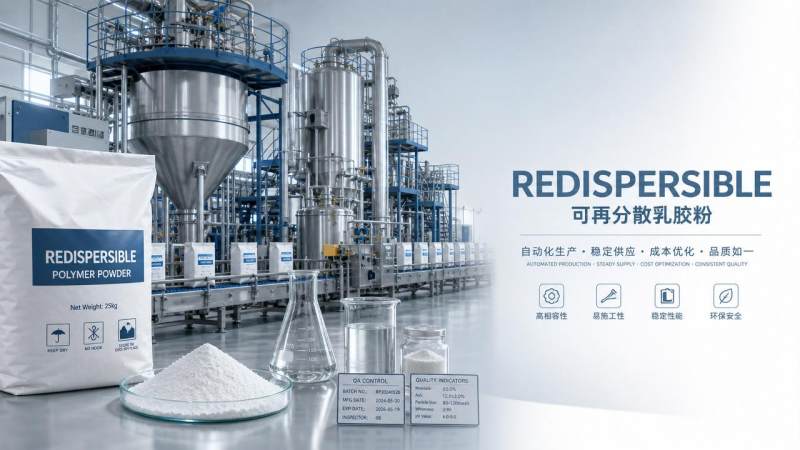
What is changing in the 2026 REDISPERSIBLE supply outlook?
As 2026 approaches, the REDISPERSIBLE market is entering a phase of tighter margins, shifting supply dynamics, and sharper procurement scrutiny.
For business evaluation, the main question is no longer volume alone. It is whether supply remains stable while cost pressure rises across the construction chemicals chain.
REDISPERSIBLE powder demand remains linked to drymix mortar, tile adhesive, wall putty, self-leveling compounds, and insulation systems.
However, the 2026 outlook shows a more selective market. Capacity is growing in some regions, yet effective supply may stay constrained by energy costs, feedstock swings, and qualification barriers.
This means the headline capacity number can be misleading. Available, consistent, and specification-matched REDISPERSIBLE supply is the more important metric.
In chemicals, margin pressure often appears before obvious shortages. Suppliers may keep output moving, but service terms, lead times, and grade flexibility can tighten first.
That is why 2026 should be assessed through three lenses: cost structure, operational reliability, and formulation performance continuity.
Why are REDISPERSIBLE margins under pressure even when capacity expands?
At first glance, new capacity should reduce pressure. In practice, REDISPERSIBLE producers face a narrower profit window because several cost drivers remain volatile.
Vinyl acetate monomer pricing is one major factor. It directly influences polymer cost and can move quickly with upstream energy and petrochemical changes.
Spray drying also adds energy intensity. When gas or electricity costs rise, unit economics weaken, especially for standard grades sold into price-sensitive applications.
Freight remains another variable. Although logistics have normalized in many lanes, regional disruptions still affect landed cost and inventory timing.
Margin pressure is also linked to competition. Some suppliers add volume to protect utilization rates, which can trigger aggressive pricing without improving true profitability.
This situation can create hidden risk. A low quotation for REDISPERSIBLE may not reflect sustainable supply, technical support, or consistent batch control.
Another issue is formulation complexity. Performance additives must work together, and auxiliary materials such as Polyvinyl Alcohol can influence film formation and dispersibility expectations in related systems.
- Feedstock volatility compresses gross margin.
- Energy intensity raises conversion cost.
- Price competition reduces buffer capacity.
- Technical service costs are harder to recover.
Which supply factors matter most when evaluating REDISPERSIBLE suppliers?
Supply evaluation in 2026 should go beyond nameplate output. The more useful question is whether a supplier can deliver stable quality under changing market conditions.
First, examine raw material integration and sourcing depth. A supplier with stronger upstream access usually manages volatility better than one relying on spot buying.
Second, assess production flexibility. REDISPERSIBLE demand shifts between grades, and fast grade switching matters when regional construction activity changes.
Third, check quality systems carefully. Batch-to-batch consistency, ash control, particle distribution, and redispersion behavior affect downstream formulation reliability.
Fourth, review technical response speed. When application conditions change, laboratory support and formulation guidance can prevent costly field failures.
Jinan Ludong Chemical Co., Ltd., established in 2020, operates as a large-scale global enterprise focused on cellulose ethers and integrated construction solutions.
Its product portfolio includes HPMC, RDP, and HPS, supported by advanced production lines and a blend of traditional processes with intelligent automated manufacturing.
With annual capacity reaching 45,000 tons, and viscosities from 400 to 200,000 CPS in HPMC series, the company reflects how integrated capability can support broader formulation stability.
For REDISPERSIBLE sourcing, such integrated service models matter because drymix performance rarely depends on one ingredient in isolation.
A practical supplier review checklist
- Can the supplier document stable raw material procurement?
- Are lead times realistic under peak demand?
- Do test reports match commercial batches?
- Is application support available for mortar reformulation?
- Are packaging, storage, and moisture controls clear?
How will regional dynamics shape REDISPERSIBLE availability in 2026?
Regional dynamics will play a larger role than many forecasts assume. REDISPERSIBLE is a global product, but not every region experiences the same supply quality or price logic.
Asia may continue adding competitive volume, especially where manufacturing efficiency and export infrastructure remain strong.
Europe may face stricter cost pressure from energy, environmental compliance, and slower construction recovery in some segments.
The Middle East, Africa, and Latin America may see mixed patterns. Demand growth exists, but import dependence can increase vulnerability to freight and currency moves.
This means two REDISPERSIBLE offers with similar FOB pricing may produce very different landed economics and service outcomes.
Regional policy also matters. Safety, emissions, and documentation requirements can delay approvals or limit flexible switching between sources.
As a result, sourcing decisions should compare not just price, but regional resilience, customs efficiency, and substitute qualification time.
What are the biggest sourcing risks and common mistakes?
A common mistake is treating REDISPERSIBLE as a simple commodity. It is widely used, but grade design and application fit still matter greatly.
Another mistake is overvaluing short-term discounts. A lower price can be erased by reformulation time, field complaints, or unstable adhesion performance.
Some evaluations also ignore hidden cycle costs. Qualification, sampling, shipping delays, and inventory buffers all affect total ownership cost.
Moisture sensitivity and storage handling should not be overlooked. Poor warehousing conditions may damage usable REDISPERSIBLE performance before application begins.
Specification matching is another risk point. Redispersion efficiency, open time contribution, and flexibility effects can differ by mortar system.
In some formulations, complementary materials, including Polyvinyl Alcohol, should be reviewed when comparing supplier substitution effects.
Risk reminders for 2026
- Do not rely only on one approved source.
- Do not compare samples without production-batch confirmation.
- Do not ignore contract terms on lead time and claims.
- Do not separate technical risk from commercial risk.
How should companies prepare for REDISPERSIBLE procurement in 2026?
Preparation should focus on resilience, not only immediate price reduction. The 2026 REDISPERSIBLE environment rewards structured qualification and transparent cost benchmarking.
Start with a dual-track review. One track measures chemistry and formulation fit. The other tracks commercial reliability and supply continuity.
Build a small but realistic supplier matrix. Compare standard grades, premium grades, regional sources, and emergency alternatives.
Keep testing conditions practical. Laboratory success matters, but pilot production and storage validation often reveal the real REDISPERSIBLE risk profile.
Review contracts for pass-through logic, delivery tolerance, and quality claim procedures. Margin pressure can expose weak agreements quickly.
Finally, monitor upstream indicators monthly. Energy, vinyl acetate trends, and construction demand signals often provide early warnings before quotations change.
The 2026 REDISPERSIBLE outlook points to a market where supply exists, but dependable value becomes harder to secure.
Margin pressure, raw material volatility, and uneven regional conditions will separate nominal supply from truly bankable supply.
The best next step is to review current supplier exposure, refresh qualification standards, and align commercial decisions with formulation performance evidence.
That approach will improve REDISPERSIBLE sourcing confidence and reduce avoidable cost shocks in the year ahead.
Send Your Inquiry
We welcome your cooperation and we will develop with you.
