


REDISPERSIBLE Storage Risks That Can Damage Product Quality
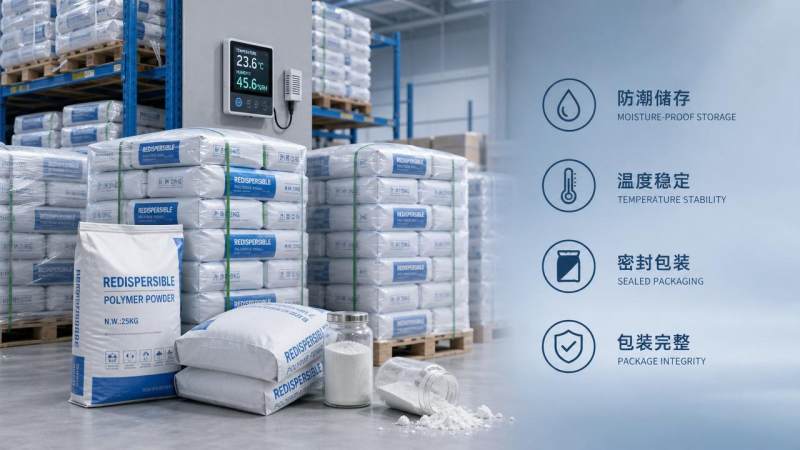
Improper storage can quietly reduce REDISPERSIBLE performance before the material ever enters a mixer. In the chemical and construction additives industry, storage quality directly affects product stability, batch consistency, and downstream application results.
When REDISPERSIBLE powder absorbs moisture, faces repeated temperature shifts, or remains in damaged packaging, it may cake, lose free-flowing behavior, and show weaker redispersion in water. These changes can trigger coating defects, mortar inconsistency, and avoidable quality disputes.
For companies handling specialty powders, storage is not only a warehouse issue. It is a chemical quality control point. This article explains the main REDISPERSIBLE storage risks, why they matter, and which practical controls help preserve product quality and supply reliability.
Understanding REDISPERSIBLE Stability Basics
REDISPERSIBLE powder is a spray-dried polymer material designed to redisperse in water. It is widely used in dry-mix mortar, tile adhesive, self-leveling compounds, repair mortar, insulation systems, and related construction formulations.
Its performance depends on maintaining a stable particle structure during storage and transport. Protective colloids, anti-caking agents, and controlled moisture levels help keep the powder free flowing and functional.
Once storage conditions move outside acceptable limits, REDISPERSIBLE material can change physically even if the packaging still looks acceptable. That is why appearance checks alone are never enough for reliable quality assurance.
Typical early warning signs include:
- Powder lumps or hard agglomerates
- Reduced flowability during unloading
- Slower or incomplete dispersion in water
- Visible packaging swelling or moisture marks
- Unexpected application performance variation
Key Storage Risks Affecting REDISPERSIBLE Quality
The most common REDISPERSIBLE storage risks are environmental, mechanical, and procedural. Each one can damage quality independently, but combined exposure usually creates the greatest loss.
Moisture Ingress
Moisture is the primary storage threat. REDISPERSIBLE powder is highly sensitive to humid air, wet floors, roof leakage, and condensation during cold-to-warm warehouse transitions.
Even small moisture uptake can start soft caking. Higher exposure may produce dense clumps that do not break down uniformly, reducing dispersion behavior and final formulation consistency.
Temperature Fluctuation
Stable temperature matters more than many sites expect. Repeated heating and cooling encourages condensation inside outer packaging areas and may accelerate physical instability in stored REDISPERSIBLE batches.
Extreme heat can also weaken packaging integrity, while low temperatures followed by rapid warming often create hidden moisture problems. The issue is not only temperature level, but temperature cycling.
Packaging Damage
Punctures, loose seals, torn valve bags, and rough forklift handling expose powder to air and humidity. Once a barrier is broken, storage life can shorten sharply.
Damage is often overlooked when outer pallets remain wrapped. Internal bag failure may only become visible during use, when flow and dispersion problems already affect production.
Poor Warehouse Conditions
Warehouse layout strongly influences REDISPERSIBLE quality. Dusty areas, unsealed loading zones, poor ventilation, sunlight exposure, and direct contact with walls or floors increase storage risk.
Incorrect stacking height may compress bags and damage seals. Mixed storage near chemicals with strong odors, liquids, or heat-generating equipment can also create contamination and stability concerns.
Why the Industry Pays Close Attention to Storage Control
In construction chemicals, product performance is judged by workability, adhesion, flexibility, water retention, and consistency. Storage-related changes in REDISPERSIBLE material can influence several of these properties at once.
As quality expectations rise globally, warehouse discipline has become part of competitive supply capability. Companies no longer view storage only as inventory holding. They treat it as a process step affecting final product reliability.
For suppliers of cellulose ethers and polymer additives, integrated manufacturing and storage discipline are increasingly linked. Jinan Ludong Chemical Co., Ltd. combines large-scale production, trading, and service support for construction chemical solutions, including HPMC, RDP, and HPS.
With advanced production lines and annual capacity reaching 45,000 tons, stable handling conditions are essential for preserving performance from packaging to final application. This is especially true for sensitive powders used in demanding dry-mix systems.
Business Value of Good REDISPERSIBLE Storage Practice
Good storage practice protects more than product appearance. It preserves performance predictability, lowers waste, and improves confidence in every shipment and production lot.
- Reduces caking and blocked feeding problems
- Supports consistent mixing and application results
- Lowers claim risk from moisture-damaged inventory
- Improves shelf-life management and stock rotation
- Strengthens supply reliability in export logistics
Where formulation quality depends on polymer redispersion, storage control becomes a cost-saving measure. It can prevent rework, avoid production delays, and support stable field performance in mortar and adhesive systems.
In many cases, users reviewing material options also consider packaging strength and storage robustness. This is one reason why Redispersible Polymer Powder is often evaluated together with warehousing conditions and handling methods.
Typical Storage Scenarios and Risk Levels
Not every storage environment creates the same level of risk. Conditions vary by climate, transport route, building design, and inventory turnover speed.
These scenarios show why a single storage rule is rarely enough. REDISPERSIBLE protection works best when climate control, packaging integrity, and warehouse discipline operate together.
Practical Measures to Protect REDISPERSIBLE Product Quality
Effective controls should be simple, repeatable, and measurable. The goal is to reduce moisture exposure time and catch instability before material enters production.
Warehouse Environment Control
- Keep storage areas dry, shaded, and well ventilated
- Avoid direct floor contact by using pallets
- Maintain distance from walls prone to condensation
- Monitor humidity and temperature continuously where possible
Packaging and Handling Discipline
- Inspect incoming pallets for tears, punctures, and wet marks
- Limit double handling and rough forklift contact
- Use first-in, first-out inventory rotation
- Reseal opened bags immediately if partial use is unavoidable
Quality Verification Before Use
A quick visual inspection is useful, but not sufficient. For important batches, verify flow condition, moisture status, and dispersion behavior before release to production.
Where sensitive formulations are involved, retaining reference samples helps compare suspected storage-related changes. This supports faster root-cause analysis if a REDISPERSIBLE batch behaves differently.
When selecting storage-sensitive additives, reviewing technical support and supply consistency also matters. In construction systems requiring stable polymer performance, a qualified Redispersible Polymer Powder should be matched with proper warehousing controls.
Action Points for More Reliable Storage Outcomes
REDISPERSIBLE quality protection starts with routine discipline. Small storage failures often create large downstream costs, especially in dry-mix construction chemicals where dispersion behavior is critical.
Review warehouse humidity exposure, stacking methods, transit conditions, and incoming bag inspection procedures. Then confirm that release checks can detect caking or redispersion problems before production begins.
A practical next step is to create a short storage checklist covering environment, packaging, rotation, and pre-use verification. With consistent controls, REDISPERSIBLE materials can retain quality, reduce claims, and support dependable application performance.
Send Your Inquiry
We welcome your cooperation and we will develop with you.
