


Hydroxypropyl Methyl Cellulose in Tile Adhesive Formulations
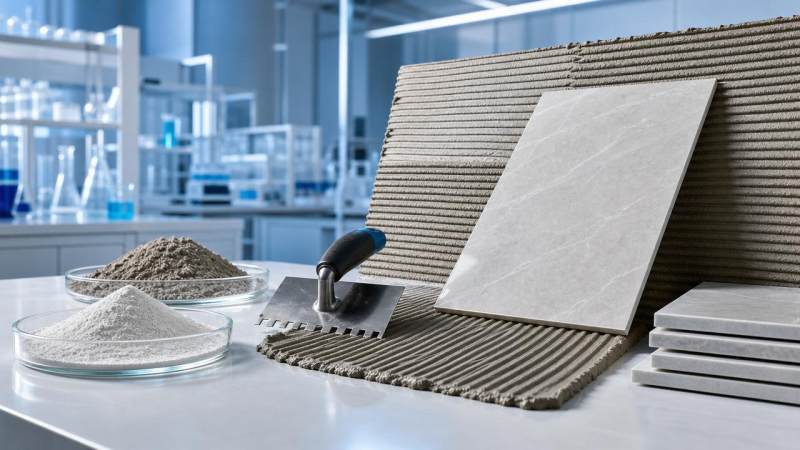
Hydroxypropyl Methyl Cellulose in tile adhesives is moving from additive to performance driver
HYDROXYPROPYL METHYL CELLULOSE has become a decisive component in modern tile adhesive formulations.
Its role now extends beyond simple thickening.
It directly influences water retention, open time, sag resistance, wetting ability, and final bond stability.
As tile sizes increase and substrates become more complex, formulation tolerance is shrinking.
This makes HYDROXYPROPYL METHYL CELLULOSE selection a technical priority rather than a routine purchasing decision.
The market is also shifting toward faster installation, lower rework rates, and more predictable site performance.
In that context, HPMC grade matching must align with cement chemistry, filler system, polymer powder, and construction conditions.
This article reviews the latest performance expectations, the reasons behind them, and the practical formulation implications.
Application expectations are rising across tile adhesive systems
Tile adhesive technology is changing in response to material and installation trends.
Larger porcelain tiles absorb less water and demand better initial wetting.
Thin-bed applications require stable rheology with controlled slip and smooth troweling.
Extended open time is also more important on hot, dry, or absorbent jobsite conditions.
These changes are pushing formulators to optimize HYDROXYPROPYL METHYL CELLULOSE more precisely.
A generic cellulose ether often cannot deliver balanced performance across all required indicators.
Attention is moving toward viscosity consistency, substitution uniformity, and compatibility with redispersible polymer powder.
This trend is especially visible in premium C1 and C2 grade adhesives.
Why the performance bar keeps rising
The core functions of HYDROXYPROPYL METHYL CELLULOSE are becoming more measurable
In tile adhesives, HYDROXYPROPYL METHYL CELLULOSE supports several performance mechanisms at the same time.
Water retention is the first and most recognized benefit.
It slows moisture migration into porous substrates and reduces premature cement dehydration.
That helps maintain hydration and improves bonding development.
Workability is another major function.
A suitable HPMC grade gives smoother mixing, better creaminess, and more uniform trowel feel.
Open time depends strongly on moisture control and surface wetting behavior.
If the adhesive skins too quickly, transfer efficiency falls and bond quality becomes inconsistent.
Slip resistance also matters, especially on walls.
The correct rheological profile helps keep tiles in position after pressing.
Key performance areas influenced by HPMC
- Water retention during hydration
- Mixing behavior and lump reduction
- Application smoothness and spreadability
- Open time and tack retention
- Anti-sag behavior on vertical surfaces
- Bond uniformity under variable conditions
Grade selection is increasingly tied to viscosity, substitution, and compatibility
Not all HYDROXYPROPYL METHYL CELLULOSE grades behave the same in dry-mix tile adhesives.
Viscosity range is a common starting point, but it should not be the only criterion.
Low-viscosity grades may improve wetting and easy mixing.
Higher-viscosity grades often support anti-sag and stronger body.
However, excessive viscosity can reduce spreadability or create dragging during application.
Substitution degree affects thermal gelation, hydration rate, and water retention balance.
Particle size and surface treatment also influence dispersibility in cold water systems.
Compatibility with RDP, cement alkalinity, limestone filler, and retarders must be verified experimentally.
A strong formulation uses HYDROXYPROPYL METHYL CELLULOSE as part of a system, not as an isolated ingredient.
Typical selection considerations
Production and application impacts now extend beyond the lab
The effects of cellulose ether choice are visible across mixing, packaging, storage, and field application.
In production, inconsistent powder flow or hydration behavior can slow blending efficiency.
During storage, poor formulation balance may increase caking risk or moisture sensitivity.
At the construction site, the wrong HPMC profile often appears as short open time, poor transfer, or excessive slip.
These issues can increase material waste and create avoidable installation defects.
Jinan Ludong Chemical Co., Ltd., established in 2020, supports this need with integrated cellulose ether production and global supply capability.
Its annual capacity reaches 45,000 tons, including construction-grade HPMC with controllable viscosities from 400 to 200,000 CPS.
That range helps align product selection with tile adhesive performance windows and processing requirements.
In adjacent formulation fields, products such as Detergent-grade HPMC also show how tailored cellulose design serves different rheology and retention targets.
Where attention should be focused now
- Check open time under realistic temperature and humidity conditions
- Evaluate tile slip with actual tile dimensions and weight
- Measure water retention with the target cement and filler system
- Verify compatibility with RDP and setting regulators
- Track lot-to-lot consistency, not only nominal viscosity
- Compare mixing time, lumping tendency, and powder flow behavior
A more resilient formulation strategy is built on testing and system thinking
Current market conditions favor tile adhesive systems with wider application tolerance.
That means formulation decisions should be based on combined performance, not a single indicator.
A useful approach is to define the target adhesive class first.
Then match HPMC grade, dosage, polymer level, and mineral skeleton to that target.
Pilot testing should include open time, tensile adhesion, anti-sag, consistency retention, and user application feel.
When performance margins are tight, supplier technical support becomes more valuable.
A producer with stable manufacturing and viscosity control can shorten optimization cycles.
Suggested next-step framework
- Define tile type, substrate, climate, and installation method.
- Screen several HPMC grades across low, medium, and high viscosity ranges.
- Test with final cement and RDP sources, not substitute materials.
- Record both laboratory values and real application observations.
- Lock in a grade only after consistency and scale-up verification.
HYDROXYPROPYL METHYL CELLULOSE will remain central to tile adhesive innovation because it connects processing behavior with end-use reliability.
As performance expectations continue rising, careful grade selection will increasingly determine whether a formulation is merely workable or truly competitive.
For better formulation stability and more predictable field results, compare technical data with application testing and align with a supplier capable of sustained quality control.
Send Your Inquiry
We welcome your cooperation and we will develop with you.
