


Cellulose Ethers Explained: Structure–Function Relationships for Industrial Formulators
Time:Oct 09, 2026
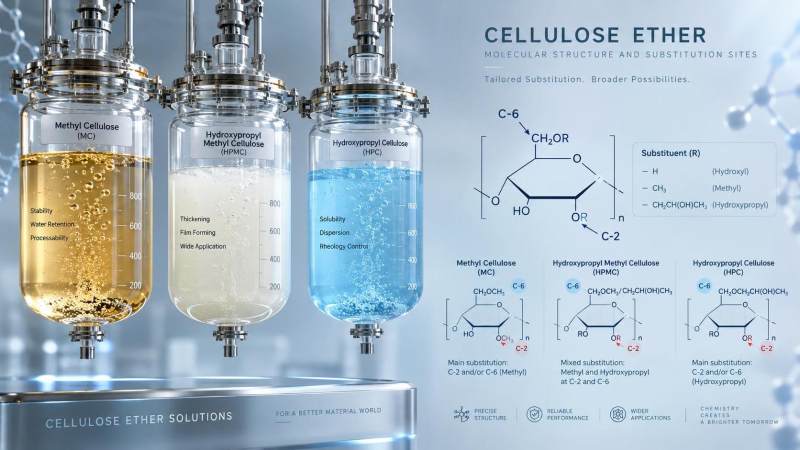
Cellulose ethers are not generic thickeners—they are precision-engineered macromolecules whose performance in industrial formulations is dictated by three interdependent structural variables: the pattern and degree of ether substitution, the distribution of substituents along the cellulose backbone, and the molecular weight (and thus viscosity) profile. For formulators working across construction mortars, pharmaceutical suspensions, or food stabilizers, treating cellulose ethers as interchangeable functional additives leads directly to inconsistent batch behavior, poor water retention under real curing conditions, or unexpected rheological collapse during high-shear mixing. The root cause lies not in raw material quality alone, but in how subtle shifts in chemical architecture translate into macroscopic functionality.
The cellulose backbone itself is inert—linear, highly crystalline, and insoluble in water and most organic solvents. Etherification disrupts this crystallinity by attaching hydrophilic side groups (e.g., methyl, hydroxypropyl, ethyl) to the anhydroglucose units. But it is not the *presence* of substituents that matters most—it is their *location*, *density*, and *chemical identity*. Each anhydroglucose unit has three reactive hydroxyl groups (at C-2, C-3, and C-6 positions), and substitution rarely occurs uniformly. C-6 hydroxyls react most readily; C-2 is moderately reactive; C-3 is sterically hindered and least accessible. As a result, even two HPMC samples with identical nominal substitution degrees (e.g., 1.8–2.0 methoxy + 0.15–0.25 hydroxypropoxy) can exhibit markedly different hydration kinetics and film-forming behavior if the hydroxypropyl groups preferentially occupy C-2 versus C-6 sites—a distinction detectable only via advanced NMR analysis, not standard QC assays.
This positional heterogeneity directly governs solubility onset temperature. HPMC dissolves in cold water but gels upon heating—a property leveraged in tile adhesives to delay open time while ensuring rapid setting after troweling. That thermal gelation is not triggered solely by temperature; it requires sufficient hydrophobic interaction between methyl groups. If hydroxypropyl substitution is concentrated near C-2, it sterically shields adjacent methyl groups, raising the gel point by 5–10°C compared to a C-6–dominant analog of identical average substitution. Formulators who rely only on supplier-provided viscosity and substitution data—and do not verify batch-to-batch consistency in substitution *distribution*—will observe unexplained variations in sag resistance or re-dispersion stability after drying.
Molecular weight introduces a second axis of control—one that interacts non-linearly with substitution. Viscosity (measured in mPa·s or cP at defined concentrations and shear rates) is often used as a proxy for molecular weight, but it is not linearly proportional. A 40,000 cP HPMC may have a weight-average molecular weight (Mw) of ~180,000 Da, while a 150,000 cP grade may reach ~420,000 Da—but the relationship flattens above ~200,000 cP due to chain entanglement saturation. More critically, high-Mw grades deliver superior film strength and cohesion in dry-state applications (e.g., external thermal insulation composite systems), yet they also increase mixing energy demand and reduce air entrainment efficiency in self-leveling compounds. Low-Mw variants (<10,000 cP) offer rapid dissolution and low shear-thinning, making them preferable for pharmaceutical immediate-release tablets where uniform dispersion is critical—but they provide negligible green strength in fresh mortar.
The third structural variable—substituent type—determines compatibility beyond water solubility. Hydroxypropyl methylcellulose (HPMC) balances thermal gelation, water retention, and alkali stability, making it dominant in cementitious systems. Hydroxyethyl cellulose (HEC), lacking methyl groups, does not thermally gel and exhibits higher solution clarity—valuable in clear coatings—but its lower hydrophobicity reduces film integrity in dry films and increases sensitivity to electrolytes. Ethyl hydroxyethyl cellulose (EHEC) adds further hydrophobic character, improving water resistance in exterior renders, though at the cost of slower hydration. These are not incremental differences; they reflect distinct hydrogen-bonding capacities, hydration shell thicknesses, and inter-chain association thresholds—each measurable via dynamic light scattering or rheometry under controlled humidity and ion concentration.
Real-world formulation failures often trace back to overlooking these structural dependencies. A common misconception is that “higher viscosity always means better water retention.” In fact, water retention in cement mortar correlates more strongly with *substitution uniformity* than with viscosity alone. An HPMC with moderate viscosity (20,000 cP) but narrow substitution distribution can outperform a 100,000 cP grade with broad heterogeneity—because uniform substitution ensures consistent hydration front propagation and capillary pressure development within the microstructure. Similarly, assuming all HPMC types behave identically in redispersible polymer systems is misleading. When paired with Redispersible Polymer Powder, HPMC acts not just as a thickener but as a colloidal stabilizer during spray-drying and a protective colloid during redispersion. Here, low-viscosity, high-substitution HPMC grades (e.g., type 60) often yield superior redispersion ratios because their shorter chains allow faster rehydration without steric hindrance from entangled polymers.
Manufacturing consistency becomes decisive at this level. Achieving tight control over substitution distribution requires precise reaction kinetics—temperature gradients, alkali concentration, and etherifying agent addition rate must be synchronized within seconds, not minutes. Batch-scale reactors struggle with this; continuous flow synthesis with inline NIR monitoring enables real-time adjustment of substitution profiles. Likewise, viscosity control demands strict molecular weight distribution management—polydispersity index (PDI) must remain below 2.5 to avoid bimodal rheology, where low-Mw fractions plasticize while high-Mw fractions dominate elasticity. This explains why global suppliers with integrated intelligent manufacturing—capable of maintaining ±2% viscosity tolerance across 45,000 tons/year capacity—deliver fewer formulation recalibrations for technical teams managing multi-site production.
For information researchers evaluating cellulose ethers, the priority is not cataloging every derivative, but recognizing which structural parameters are *actionable* in formulation design. Substitution degree sets baseline solubility; substitution pattern governs thermal and ionic response; molecular weight distribution dictates processing window and dry-film mechanics. No single specification sheet captures all three. Reliable sourcing hinges on suppliers’ ability to report not just average values, but batch-specific substitution mapping (via ¹³C-NMR) and PDI (via SEC-MALS)—not as marketing claims, but as routinely released QC data. Without that, “cellulose ether” remains a category—not a controllable ingredient.
Send Your Inquiry
We welcome your cooperation and we will develop with you.
