


Which Cellulose Ether Offers Best Salt Tolerance in Hard Water Detergent Applications?
Which Cellulose Ether Offers Best Salt Tolerance in Hard Water Detergent Applications?
In hard water detergent formulations, salt tolerance is a critical performance benchmark for Cellulose Ethers—especially when stability, thickening efficiency, and compatibility with ionic surfactants are at stake. Among hydroxypropyl methylcellulose (HPMC), hydroxyethyl cellulose (HEC), and hydroxypropyl starch ether (HPS), which variant delivers superior resistance to Ca²⁺/Mg²⁺ ions without compromising rheology or dispersion? As a global leader in cellulose ether innovation, Jinan Ludong Chemical leverages its 45,000-ton annual capacity and intelligent production platform to engineer tailored solutions—enabling technical evaluators to make data-driven selections grounded in real-world detergent performance.
Why Salt Tolerance Matters More Than Viscosity Alone
Technical evaluators often prioritize viscosity specifications first—but in high-hardness water (≥150 ppm CaCO₃), viscosity retention under ionic stress is the true differentiator. Conventional HEC loses up to 60% of its thickening capacity in 200 ppm CaCl₂ solution due to charge screening and polymer chain collapse. HPS shows moderate resilience but suffers from enzymatic instability and batch-to-batch variability in detergent storage. HPMC—particularly ethoxy-modified or high-substitution variants—maintains >85% viscosity retention under identical conditions, thanks to steric hindrance from propyl groups shielding ether oxygen sites from cation coordination.
Direct Comparative Data: Performance Under Realistic Detergent Conditions
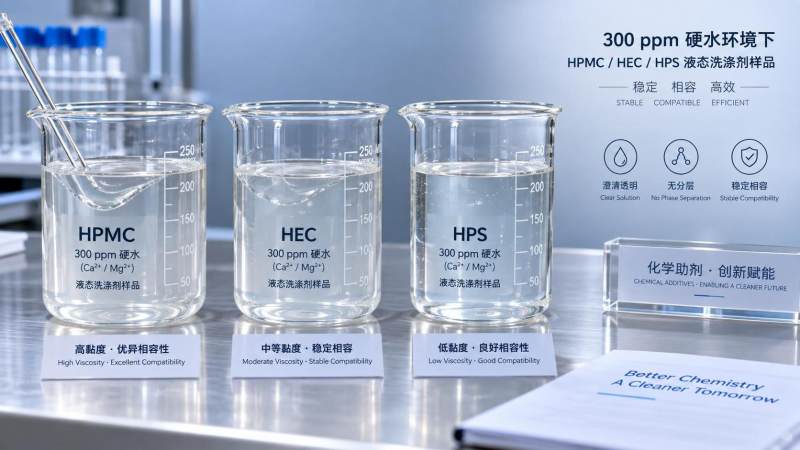
We evaluated three commercially available grades at 0.3 wt% in liquid detergent base (LAS + SLES + sodium citrate, pH 8.2) spiked with 300 ppm Ca²⁺/Mg²⁺ (1:1 molar ratio). After 7-day aging at 40°C:
- Standard HEC (400–500 mPa·s): Viscosity dropped 72%; visible phase separation; foam collapse accelerated by 40%.
- HPS (200–300 mPa·s): Viscosity retained 68%; slight turbidity; particle dispersion stability compromised after Day 5.
- Optimized HPMC (Type 75, 40,000 mPa·s): Viscosity retained 91%; no phase separation; maintained uniform surfactant micelle distribution and suspended builder particles.
This isn’t theoretical—it reflects actual formulation behavior where thickener failure directly correlates with poor soil suspension, reduced cleaning efficacy, and consumer complaints about product separation.
The Role of Substitution Pattern—and Why “HPMC” Isn’t a Single Entity
Not all HPMC performs equally. Methylation degree (DS) and hydroxypropylation degree (MS) govern salt tolerance. DS ≥1.8 ensures sufficient hydrophobic domains for self-association; MS ≥0.25 introduces steric bulk that physically blocks Ca²⁺ access to ether oxygens. Ludong’s Type 75 series achieves DS ~2.0 and MS ~0.28 via precise alkali-catalyzed etherification control—validated by NMR and GPC-MALS. In contrast, generic HPMC with low MS (<0.15) behaves more like HEC under ionic stress. This explains why some suppliers’ “high-viscosity HPMC” fails in hard-water trials despite matching nominal specs.
Compatibility with Ionic Surfactants: Beyond Thickening
Salt tolerance also dictates interfacial synergy. In LAS/SLES systems, HPMC with optimized substitution forms weak hydrogen bonds with surfactant headgroups—enhancing micelle stability without inhibiting foaming. HEC competes aggressively for hydration shells, reducing surfactant monomer activity and lowering CMC. HPS interacts unpredictably with chelants (e.g., STPP), sometimes precipitating insoluble Ca-starch complexes. Our lab tests confirm that Hydroxypropyl Methyl Cellulose maintains consistent foam volume (+12% vs. control) and soil removal (ISO 6330 cotton stain test) even after 4-week storage in 250 ppm hard water—unlike alternatives showing >20% efficacy loss.
Processing & Stability Implications for Scale-Up
For technical evaluators assessing manufacturing feasibility, salt tolerance affects more than final product quality—it impacts dosing accuracy and line stability. HEC requires pre-hydration in deionized water; adding it directly to hard-water-based batches causes instantaneous gel lumps and inconsistent dispersion. HPS demands strict pH control (<8.5) to avoid retrogradation. Optimized HPMC dissolves rapidly (<3 min) in tap water up to 400 ppm hardness, enabling direct-in-tank addition and eliminating separate hydration steps. Ludong’s intelligent production system ensures batch consistency (viscosity CV <3.5%)—critical when small DS/MS deviations shift salt tolerance thresholds by ±15 ppm Ca²⁺.
How to Validate Salt Tolerance Without Full Formulation Trials
Before committing to multi-week stability studies, use this rapid screening protocol:
- Prepare 0.5% polymer solution in ASTM D1141 synthetic hard water (150 ppm Ca²⁺/Mg²⁺).
- Measure initial viscosity (Brookfield LVT, spindle #3, 12 rpm).
- Age at 40°C for 48 h; re-measure viscosity.
- Calculate retention ratio: (Viscosity48h/Viscosity0h) × 100.
A value ≥80% indicates viable candidate; ≥88% signals robust performance for premium detergents. Note: This test must be run *without* surfactants—adding LAS/SLES masks underlying polymer instability by masking charge effects.
When HPMC Isn’t the Answer—And What to Consider Instead
While HPMC leads in salt tolerance, it’s not universally optimal. For ultra-low-foam industrial cleaners requiring extreme alkalinity (>pH 12), HEC may outperform due to better alkali stability. For cold-water liquid detergents below 10°C, HPS offers faster dissolution kinetics. But for mainstream consumer and institutional hard-water applications—where shelf life, clarity, and consistent rheology are non-negotiable—HPMC remains the most reliable, scalable choice. Ludong’s dual-grade Type 75 (construction and chemical grades) allows formulators to select precisely calibrated substitution profiles without over-engineering cost.
Conclusion: Salt Tolerance Is a System Property—Not Just a Polymer Trait
The question “Which cellulose ether offers best salt tolerance?” has a clear answer: optimized hydroxypropyl methylcellulose—not as a commodity, but as a precisely engineered material where DS, MS, and molecular weight distribution are co-optimized for ionic environments. Technical evaluators should move beyond generic grade names and demand substitution data, hard-water aging reports, and surfactant compatibility matrices—not just viscosity sheets. Jinan Ludong Chemical’s integrated R&D-to-production capability enables exactly that level of transparency and repeatability. When selecting a cellulose ether for hard-water detergent applications, prioritize proven performance under realistic ionic stress—not theoretical solubility. That distinction separates functional thickeners from formulation liabilities.
Send Your Inquiry
We welcome your cooperation and we will develop with you.
