


How Substitution Pattern (DS/MS) Dictates Solubility and Gel Temperature in Cellulose Ethers
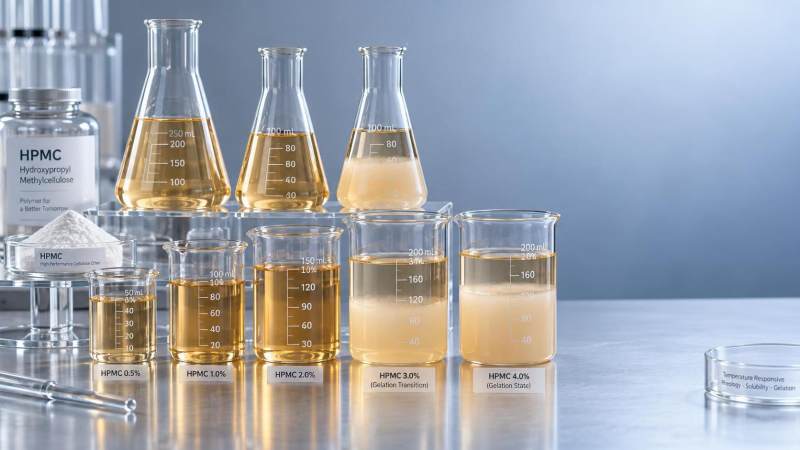
When formulating construction mortars or tile adhesives with hydroxypropyl methylcellulose (HPMC), technical evaluators often observe inconsistent hydration onset or premature gelation during summer months—even when batch viscosity and pH appear identical. This isn’t a raw material impurity issue or a mixing error. It’s frequently rooted in subtle but decisive differences in substitution pattern: specifically, the degree of substitution (DS) and molar substitution (MS). These two parameters govern not only water solubility at room temperature but also the precise thermal threshold at which the polymer transitions from soluble to gel phase—a critical determinant for open time, sag resistance, and final film integrity.
The core relationship is direct: higher DS generally improves cold-water solubility but lowers gel temperature; higher MS tends to raise gel temperature while maintaining broader solubility across pH ranges. Yet this isn’t linear or universal—especially across cellulose ether types. For HPMC used in Type 60 or Type 75 construction grades, a DS of 1.6–1.9 and MS of 0.2–0.3 typically delivers optimal balance between rapid dispersion and delayed gelation above 65°C. Deviations outside this window shift performance boundaries: lower DS increases insoluble residue risk during cold mixing; higher MS may delay gelation beyond practical application windows, compromising early strength development.
How DS and MS Independently Influence Solubility
Solubility in cellulose ethers isn’t binary—it’s a function of hydrogen bonding capacity, steric hindrance, and hydrophobic/hydrophilic balance. DS reflects the average number of hydroxyl groups per glucose unit substituted with ether groups (e.g., methyl or hydroxypropyl). Each substitution reduces intermolecular hydrogen bonding between cellulose chains, increasing chain mobility and solvent accessibility. But DS alone doesn’t tell the full story: it says nothing about *which* substituents are present or their distribution.
That’s where MS becomes essential. Molar substitution quantifies the average moles of substituent per anhydroglucose unit—regardless of type. In HPMC, MS captures the combined contribution of both methyl and hydroxypropyl groups. Because hydroxypropyl introduces bulkier side chains than methyl, high MS values—even at moderate DS—create greater steric shielding of remaining hydroxyls. This suppresses aggregation in cold water, enhancing apparent solubility. However, that same steric effect also impedes the cooperative dehydration required for thermal gelation, pushing the gel point upward.
Crucially, DS and MS interact non-additively. A sample with DS = 1.8 and MS = 0.25 behaves differently than one with DS = 1.6 and MS = 0.45—even if total substitution count is similar—because methyl groups dominate hydrophobic character while hydroxypropyl contributes more to steric stabilization and hydration shell persistence.
Gel Temperature: Not a Fixed Value, but a Tunable Threshold
Gel temperature—the point at which aqueous cellulose ether solutions undergo reversible phase separation—isn’t an intrinsic constant. It shifts predictably with DS/MS profile, ionic strength, and concentration. For standard HPMC grades, gel temperature typically falls between 55°C and 75°C. But this range collapses or expands significantly when DS/MS deviates from target specifications.
Empirically, every 0.1 increase in DS (holding MS constant) lowers gel temperature by ~2–4°C. Conversely, each 0.1 rise in MS (at fixed DS) elevates it by ~3–5°C. These trends hold across viscosities—from 400 CPS to 200,000 CPS—but magnitude varies slightly due to chain-length effects on entanglement density. In high-viscosity chemical-grade HPMC, for example, the same DS/MS shift produces a smaller gel temperature change because longer chains dominate rheology more than substitution-driven thermoresponsiveness.
This tunability matters operationally. In hot-climate applications, formulations requiring extended open time benefit from higher MS—pushing gel onset past 70°C. In cold-weather tile setting, lower DS ensures full dissolution below 10°C without prolonged agitation. Neither adjustment compromises functionality if substitution parameters remain within validated ranges for the intended grade.
Practical Verification Methods for Technical Evaluators
You don’t need full NMR analysis to assess DS/MS impact. Three field-applicable checks provide immediate insight:
- Cold-water dispersion test: Disperse 2 g of HPMC in 100 mL deionized water at 5°C with gentle stirring (no shear). Observe after 15 minutes. Complete clarity indicates adequate DS (>1.7); persistent cloudiness or undissolved specks suggest DS < 1.5 or uneven substitution distribution.
- Heating curve observation: Heat the same solution at 1°C/min while monitoring viscosity (rotational rheometer preferred). Note the temperature at which viscosity peaks then drops sharply—this is gel point. Repeat with duplicate batches. >±3°C variation signals inconsistent DS/MS control.
- pH stability check: Adjust solution pH to 10.5 and 4.5 separately. Re-test gel temperature. A shift >5°C between extremes points to disproportionate hydroxypropyl placement—indicating MS heterogeneity rather than absolute MS value.
These tests correlate strongly with real-world behavior: poor cold dispersion predicts lump formation in dry-mix mortar; low gel temperature correlates with reduced sag resistance in thick-bed adhesives; wide pH-dependent gel shifts indicate formulation instability under alkaline cement conditions.
Product Integration in Application-Specific Profiling
Consistent DS/MS control requires tight process discipline—not just raw material selection. At Jinan Ludong Chemical, intelligent alkali pretreatment and etherification reactors enable reproducible targeting across the full HPMC spectrum, from Type 60 (DS ≈ 1.75, MS ≈ 0.22) to high-viscosity chemical grades (DS ≈ 1.85, MS ≈ 0.28). This precision extends to specialty variants like Methyl Hydroxyethyl Cellulose (HEMC), where ethyl group positioning further modulates thermal hysteresis—making it suitable for systems demanding narrow gel-transition windows.
For technical evaluators validating supplier consistency, request batch-specific DS/MS certificates—not just viscosity or ash content. Cross-reference those values against your formulation’s thermal and hydration requirements. If gel temperature drift exceeds ±2°C across three consecutive lots, investigate whether DS/MS variation—not viscosity deviation—is the root cause before adjusting dosage or co-additives.
Why Substitution Pattern Overrides Viscosity in Critical Applications
Viscosity defines flow behavior; DS/MS defines *when* and *how* that flow stops. In self-leveling compounds, for instance, viscosity ensures pumpability—but gel temperature determines how long the material remains fluid enough to level before locking into shape. A 60,000 CPS HPMC with DS = 1.5 may gel at 60°C, causing premature surface skinning; the same viscosity with DS = 1.8 gels at 52°C, risking slumping before set. Neither fails viscosity specs—but only one meets functional thermal criteria.
Similarly, in redispersible polymer powder (RDP) blends, cellulose ether DS/MS affects film-forming kinetics of the acrylic component. High-MS HPMC delays coalescence onset, allowing better particle packing before film formation—directly impacting tensile bond strength. Here, substitution pattern isn’t secondary to viscosity; it’s the primary design lever.
Ultimately, DS and MS aren’t abstract metrics—they’re operational handles. When gel temperature or solubility deviates unexpectedly, start there—not with equipment calibration or ambient conditions. That’s where formulation control begins, and where consistent performance across 45,000 tons/year of production is anchored.
Send Your Inquiry
We welcome your cooperation and we will develop with you.
