


Why Certain Cellulose Ethers Fail in Low-Temperature Liquid Detergents — And How to Fix It
Time:Oct 14, 2026
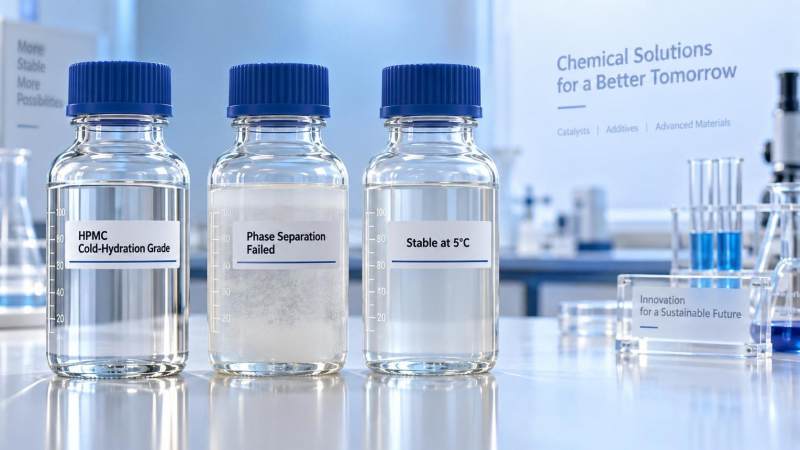
Low-temperature liquid detergents demand precise rheology control—especially during winter formulation, transport, and storage. Yet viscosity collapse, phase separation, or poor particulate suspension frequently occur when cellulose ethers are used without accounting for their thermal hydration behavior and surfactant compatibility. For quality control and safety professionals, these failures aren’t merely cosmetic: they trigger batch rejections, noncompliance with shelf-life specifications, and—critically—unintended changes in active ingredient distribution that may compromise cleaning efficacy or introduce dosing variability in concentrated formulations.
The root cause lies not in polymer purity or molecular weight alone, but in how substitution patterns govern hydration kinetics at sub-10°C conditions. Standard hydroxypropyl methylcellulose (HPMC) grades hydrate progressively as temperature rises, reaching full solubilization near 25–30°C. Below 10°C, many commercial HPMC types exhibit incomplete chain unfolding and delayed network formation. This results in transient, weak gel structures that fail under shear or over time—particularly when co-formulated with anionic surfactants like linear alkylbenzene sulfonates (LAS) or alcohol ethoxysulfates (AES), which compete for water molecules and disrupt hydrogen bonding essential for cellulose ether thickening.
Crucially, this failure mode is *not* uniform across HPMC grades. Methylation degree (DSMe) and hydroxypropylation degree (MSHP) determine both cloud point and cold-water dispersibility. High DSMe (>1.8) raises the cloud point but often reduces low-temperature solubility due to increased hydrophobicity. Conversely, high MSHP (>0.6) improves cold-water dispersion but may lower thermal gelation onset—creating a narrow operational window where the polymer hydrates too slowly below 15°C yet gels prematurely above 30°C. Most off-the-shelf construction-grade HPMC prioritizes high-viscosity performance at room temperature and ignores this kinetic mismatch entirely.
Surfactant–polymer interaction further complicates stability. Anionic surfactants bind electrostatically to protonated hydroxyl groups on partially hydrated HPMC chains, altering local charge density and steric hindrance. In low-temperature systems, where hydration shells are thin and dynamic, even minor surfactant concentration shifts (±0.5 wt%) can tip the balance from stable dispersion to micro-phase aggregation. This manifests not as immediate precipitation—but as slow, irreversible viscosity decay over 7–14 days at 5°C, often missed during standard 25°C QC checks.
Another overlooked factor is residual solvent content in dried HPMC powders. Ethanol or isopropanol traces—common in spray-dried grades—lower local dielectric constant at particle interfaces. During cold reconstitution, these residues delay water penetration into the polymer matrix, causing heterogeneous swelling and “fisheye” formation. These undissolved aggregates act as nucleation sites for surfactant crystallization or micelle destabilization, accelerating phase separation. Batch-to-batch variation in residual solvent—often unreported in COAs—explains why identical formulation protocols yield inconsistent results across supplier lots.
Fixing this requires shifting from *viscosity-targeted selection* to *hydration-kinetic qualification*. First, replace generic “high-viscosity HPMC” with grades specifically engineered for cold-start hydration: those with balanced DSMe/MSHP ratios (e.g., DSMe ≈ 1.5–1.7, MSHP ≈ 0.4–0.5) and narrow substitution distribution (confirmed via NMR, not just titration). Second, validate performance under *dynamic thermal profiling*: simulate real-world storage by measuring viscosity recovery after 48h at 5°C, followed by 30-min ramp to 25°C and hold. Static 25°C measurements miss the critical lag phase where instability initiates.
Third, assess surfactant compatibility using oscillatory rheology—not just steady-shear viscosity. A storage modulus (G′) drop >30% within 24h at 8°C under 0.1% strain indicates early-stage network disintegration, long before macroscopic separation occurs. This parameter correlates strongly with field-reported shelf-life failures but is rarely included in supplier technical data sheets.
Fourth, require residual solvent testing (GC headspace) with limits ≤0.3 wt% for ethanol/isopropanol—especially for spray-dried material. Vacuum-dried or coagulated HPMC grades avoid this issue entirely but trade off higher bulk density and slower dispersion; their suitability depends on mixer design and powder handling infrastructure.
Finally, recognize that “low-temperature stability” isn’t a binary pass/fail property—it’s a function of three interdependent variables: formulation pH (optimal range 7.2–8.5 for HPMC), ionic strength (<0.15 M to prevent charge screening), and shear history during manufacturing. High-shear homogenization at cold temperatures can mechanically fragment nascent polymer networks, while insufficient shear leaves dry pockets that later hydrate unevenly. Process validation must therefore include in-line viscosity monitoring at both 5°C and 25°C post-mixing—not just final QC.
For quality control teams, this means revising incoming inspection protocols: move beyond Brookfield viscosity at 25°C and pH alone. Add cold-hydration time-to-clarity (measured visually or via turbidity decay), G′ stability tracking at 8°C, and mandatory residual solvent reporting. For safety managers, the implication is clear: viscosity loss in cold-stored detergent concentrates can alter active ingredient sedimentation rates—potentially leading to overdosing in diluted use scenarios or underdosing in undiluted applications. Neither meets labeling claims or regulatory consistency requirements under EU Regulation (EC) No 648/2004 or US EPA Safer Choice criteria.
Hydroxypropyl Methyl Cellulose formulations designed for low-temperature liquid detergents must prioritize hydration kinetics over nominal viscosity. The right grade doesn’t just thicken—it hydrates predictably, interacts controllably with surfactants, and maintains structural integrity across the full intended storage temperature range. That distinction separates functional rheology modifiers from latent formulation risks.
Send Your Inquiry
We welcome your cooperation and we will develop with you.
