


How Redispersible Polymer Powder Improves Mortar Bonding
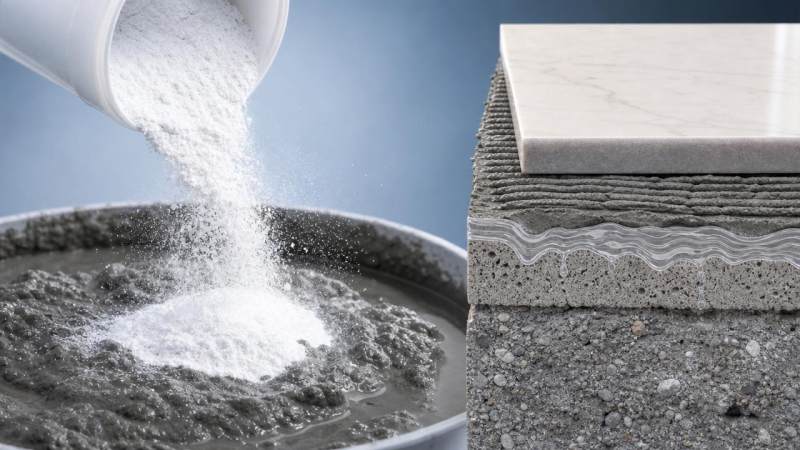
RDP improves mortar bonding by creating a flexible polymer network inside the cement matrix, strengthening adhesion to substrates and reducing brittle failure.
For technical evaluators, the key question is not whether RDP works, but whether a grade matches the mortar system, substrate, and performance target.
In dry-mix mortar, bonding depends on hydration, surface wetting, cohesive strength, water control, and resistance to shrinkage stress during curing.
RDP affects each of these factors, making it one of the most important modifiers in tile adhesives, repair mortars, renders, and skim coats.
Why Mortar Bonding Fails Without Polymer Modification
Traditional cement mortar bonds through mechanical interlocking and hydration products that grow into pores and surface irregularities of the substrate.
This mechanism works well on absorbent mineral surfaces, but it becomes less reliable on dense concrete, ceramic tiles, insulation boards, or old substrates.
Bond failure often starts when the mortar loses water too quickly, cannot wet the surface properly, or develops shrinkage stresses during drying.
Cementitious systems are also relatively brittle, so small movement, temperature cycling, or impact can create cracks at the interface.
For evaluators, these failure modes explain why compressive strength alone is not enough to judge mortar quality or bonding reliability.
A mortar may test strong in compression but still show poor pull-off strength, open time, flexibility, or freeze-thaw resistance in field conditions.
How RDP Works Inside a Cement-Based Mortar
RDP is produced as a dry powder that redisperses into polymer particles when mixed with water at the jobsite or production line.
During mortar mixing, these particles distribute through the cementitious slurry and move with water into capillaries, pores, and the substrate interface.
As hydration and drying proceed, the polymer particles come closer, deform, and form continuous films across cement hydrates and aggregate surfaces.
This film formation is central to bonding improvement because it bridges mineral phases and creates a more flexible internal structure.
The polymer does not replace cement hydration; instead, it complements it by adding adhesion, deformability, and better stress distribution.
In a well-designed formulation, cement provides mineral strength, while RDP improves interface performance and compensates for brittleness.
The Main Bonding Benefits Technical Evaluators Should Measure
The first measurable benefit is improved tensile adhesion, especially on challenging substrates where plain cement mortar cannot develop reliable mechanical anchoring.
RDP enhances wetting and contact at the interface, helping the fresh mortar spread more evenly and maintain intimate contact during curing.
The second benefit is higher cohesive strength within the mortar layer, reducing the risk that failure occurs inside the mortar itself.
Evaluators should distinguish adhesive failure at the substrate from cohesive failure in mortar because each indicates different formulation weaknesses.
The third benefit is improved flexibility, which helps the mortar absorb stress from thermal expansion, vibration, or slight substrate movement.
Flexibility is especially important for tile adhesives, external insulation systems, and repair mortars exposed to changing temperatures or structural movement.
The fourth benefit is improved water resistance after curing, because polymer films can reduce capillary pathways and limit water penetration.
However, water resistance depends on polymer chemistry, dosage, cement ratio, and curing conditions, so it should be verified by application testing.
Why Water Retention Is Closely Linked to Bond Strength
Although cellulose ethers are usually the primary water-retention additives, RDP also contributes to a more stable and workable mortar structure.
Water retention matters because cement hydration requires sufficient moisture, and premature water loss weakens both surface adhesion and internal cohesion.
On absorbent substrates, rapid suction can pull water from the mortar before hydration products and polymer films develop correctly.
When this happens, bonding can look acceptable at early inspection but fail under later load, moisture exposure, or temperature cycling.
A balanced additive system improves open time, reduces skinning, and allows installers to achieve stronger contact with the substrate.
Technical evaluation should therefore include open time adhesion, not only initial tensile adhesion measured under ideal laboratory timing.
How RDP Improves Workability and Application Quality
Bonding is partly a material property and partly an application outcome, so workability has a direct influence on final performance.
RDP can improve mortar consistency, reduce sagging, and support smoother troweling when the formulation is correctly balanced with cellulose ether.
Better workability helps installers maintain correct bed thickness, improve substrate coverage, and reduce voids behind tiles or render layers.
For technical evaluators, this means laboratory tests should include practical handling observations, not only numerical strength data.
A mortar that feels sticky but spreads poorly may cause uneven coverage, while a smooth mortar with poor body may slip or shrink.
The ideal formulation should combine easy mixing, stable viscosity, strong wet adhesion, and predictable working time under local climate conditions.
Important Performance Indicators for Comparing RDP Grades
Not all RDP grades deliver the same bonding effect, because polymer composition, glass transition temperature, protective colloid, and particle behavior vary.
Technical evaluators should first check whether the grade is designed for tile adhesive, wall putty, render, repair mortar, or insulation systems.
A grade optimized for flexibility may not deliver the same water resistance or early strength as a grade designed for tile applications.
Key laboratory indicators include tensile adhesion strength, open time adhesion, shear strength, flexibility, water absorption, and freeze-thaw durability.
Evaluators should also examine ash content, bulk density, residual moisture, particle size, redispersibility, and consistency between production batches.
For procurement teams assessing Redispersible Polymer Powder, batch stability is as important as single-sample performance.
A supplier with controlled production and technical support can help reduce formulation risk, especially when raw materials or climate conditions change.
Dosage Considerations: More Polymer Is Not Always Better
RDP dosage must be matched to performance requirements, because excessive dosage can raise cost and sometimes alter setting or mechanical balance.
Low-dosage formulations may improve handling slightly but fail to deliver meaningful adhesion gains on dense or low-absorption substrates.
Medium dosages are common in general tile adhesive, skim coat, and bonding mortar where adhesion and workability both matter.
Higher dosages are usually reserved for flexible tile adhesives, repair systems, external insulation mortars, and applications requiring deformation resistance.
Evaluators should avoid choosing dosage based only on supplier recommendations without verifying performance in the full formula.
Cement type, filler grading, sand shape, cellulose ether viscosity, defoamer, and accelerator selection can all influence the effective RDP demand.
Interaction With HPMC, HPS, Cement, and Fillers
RDP rarely works alone in a dry-mix system, so its value must be judged through interaction with the complete additive package.
HPMC improves water retention, thickening, and workability, creating a favorable environment for cement hydration and polymer film formation.
HPS can adjust rheology, improve anti-sag behavior, and support application stability in selected mortar and putty formulations.
Cement chemistry influences setting, alkalinity, and hydration rate, which affect when polymer particles consolidate and how the matrix develops strength.
Fillers and aggregates influence packing density, water demand, shrinkage, and the available surface area requiring polymer coverage.
A technically sound evaluation should test the complete formula under realistic mixing, resting, application, curing, and exposure conditions.
Application Areas Where Bonding Improvement Is Most Valuable
Tile adhesives are one of the clearest examples, because adhesion must remain reliable under water exposure, heat aging, and mechanical stress.
In large-format tile installations, polymer modification helps reduce debonding risk caused by lower grout-line relief and greater stress concentration.
External insulation systems also rely on strong bonding between insulation boards, base coat mortar, mesh reinforcement, and mineral finishing layers.
Repair mortars benefit from RDP because repaired zones must bond to old concrete while tolerating shrinkage and service movement.
In renders and skim coats, improved adhesion reduces peeling, powdering, and cracking, especially on variable or renovation substrates.
For each application, the correct evaluation standard and failure mode analysis should guide grade selection and dosage adjustment.
How to Evaluate Bonding Performance in the Laboratory
A useful laboratory program begins with a reference mortar and one variable change, allowing the evaluator to isolate the RDP effect.
Samples should be mixed with controlled water addition, fixed mixing time, resting time, and application thickness to reduce testing variation.
Tensile adhesion should be measured after standard curing, water immersion, heat aging, and freeze-thaw cycling when relevant to the application.
Open time tests help determine whether adhesion remains strong after the mortar is exposed before tile or board placement.
Failure mode documentation is essential because substrate failure, adhesive failure, and cohesive failure communicate different technical conclusions.
Evaluators should also record workability, slip resistance, wet tack, air entrainment, density, and shrinkage because these factors influence bonding.
Field Evaluation: What Laboratory Data Cannot Fully Predict
Laboratory results are necessary, but field performance can be affected by substrate dust, temperature, humidity, wind, and installer technique.
High temperatures and wind accelerate water loss, making open time and water retention more critical than they appear in controlled testing.
Cold conditions can delay cement hydration and polymer film formation, potentially reducing early adhesion and increasing sensitivity to disturbance.
Uneven substrates, contaminated surfaces, or incorrect water addition can reduce bonding even when the formulation is technically strong.
For major projects, pilot application and pull-off testing on actual substrates provide valuable confirmation before full-scale use.
Technical evaluators should treat field trials as risk reduction, not as a replacement for laboratory qualification and supplier documentation.
Common Misunderstandings When Selecting RDP
One common misunderstanding is that higher apparent viscosity automatically means better bonding, although viscosity is mainly controlled by other additives.
Another misconception is that all white polymer powders with similar ash content will perform similarly in mortar applications.
In practice, polymer chemistry, film-forming behavior, protective colloid quality, and redispersibility can create significant performance differences.
Some evaluators focus only on initial adhesion, but long-term water resistance and heat aging often reveal weaknesses more clearly.
Cost comparison should be based on achieved performance per ton of mortar, not only on additive price per kilogram.
A slightly higher-quality grade may reduce dosage, improve consistency, lower complaint risk, and provide better overall project economics.
Supplier Factors That Influence Technical Confidence
Reliable mortar performance requires additive consistency, so supplier production control is a technical issue, not only a purchasing issue.
Jinan Ludong Chemical Co., Ltd. focuses on cellulose ethers, RDP, and related construction additives for global dry-mix mortar applications.
Its production capability and integrated solution approach support formulation matching across construction grades, viscosities, and different regional requirements.
For evaluators, useful supplier support includes technical data, sample consistency, application guidance, batch traceability, and responsiveness during formulation adjustment.
A capable supplier should help interpret test results, not simply provide a product specification sheet without application context.
This support becomes especially important when customers need to reformulate for local cement, sand grading, climate, or cost constraints.
A Practical Selection Framework for Technical Evaluators
Start by defining the application target, including substrate type, exposure condition, required standard, working time, flexibility, and expected service life.
Next, select candidate grades that match the application, rather than testing general-purpose products without a clear performance rationale.
Then build a controlled comparison using identical cement, filler, cellulose ether, water ratio, and mixing procedure for all samples.
Measure initial adhesion, aged adhesion, open time, flexibility, water resistance, workability, and failure mode under relevant curing conditions.
Finally, calculate total formulation value, including dosage efficiency, process stability, supplier support, logistics reliability, and complaint prevention.
This framework helps separate real performance improvement from marketing claims and creates a clearer basis for technical approval.
Conclusion: What RDP Really Adds to Mortar Bonding
RDP improves mortar bonding by enhancing interface adhesion, internal cohesion, flexibility, water resistance, and practical application quality.
Its value is strongest where plain cement mortar struggles with dense substrates, movement, moisture exposure, or demanding service conditions.
For technical evaluators, the best choice is not the most expensive grade or the highest dosage, but the best-matched formulation component.
A rigorous evaluation should combine laboratory testing, field validation, failure mode analysis, and supplier consistency assessment.
When selected correctly, RDP turns mortar from a brittle mineral binder into a more reliable, durable, and application-friendly bonding system.
Send Your Inquiry
We welcome your cooperation and we will develop with you.
