


Redispersible Polymer Powder Dosage Guide for Dry Mix Mortar
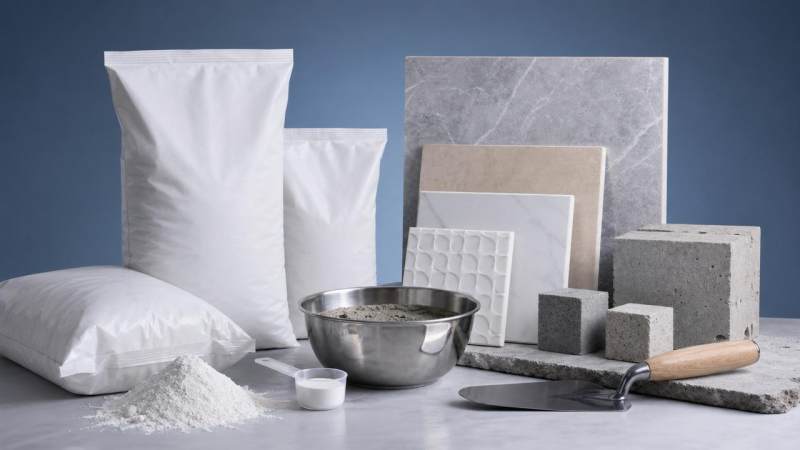
Getting the right Redispersible Polymer Powder dosage is essential for achieving consistent workability, adhesion, flexibility, and durability in dry mix mortar applications.
For on-site use, even small dosage changes can affect mixing behavior, open time, water retention, and final strength.
This guide explains practical dosage ranges, application trends, and adjustment logic for tile adhesives, wall putty, repair mortar, and related formulations.
Dry Mix Mortar Is Moving Toward More Precise Polymer Modification
The dry mix mortar market is shifting from basic cement-sand blends to more engineered systems with stable jobsite performance.
Redispersible Polymer Powder is central to this change because it improves adhesion, cohesion, flexibility, abrasion resistance, and surface durability.
In modern formulations, dosage is no longer selected only by habit or cost pressure.
It is increasingly determined by substrate type, cement quality, climate, application thickness, and required performance standards.
As construction specifications become stricter, Redispersible Polymer Powder dosage control has become a practical quality management issue.
Why Redispersible Polymer Powder Dosage Matters More Than Before
After mixing with water, Redispersible Polymer Powder redisperse into polymer particles and form a continuous film during drying.
This film bridges cement hydrates, fillers, and aggregate particles, improving bonding and reducing brittleness.
If dosage is too low, mortar may lose adhesion, flexibility, and resistance to cracking under thermal or mechanical stress.
If dosage is too high, cost rises and setting, viscosity, or sanding behavior may become difficult to control.
The best Redispersible Polymer Powder dosage balances performance, processing stability, and total formulation economics.
Key performance areas affected by dosage
- Adhesion to concrete, brick, ceramic tile, insulation board, and gypsum-based surfaces.
- Flexibility and resistance to shrinkage cracking in thin or stressed layers.
- Water resistance, freeze-thaw durability, and abrasion resistance after curing.
- Workability, anti-sag performance, open time, and surface finishing quality.
Common Dosage Ranges Are Becoming More Application-Specific
There is no single universal Redispersible Polymer Powder dosage for every dry mix mortar.
However, common application ranges provide a useful starting point for laboratory adjustment and field verification.
These ranges should be treated as formulation windows, not fixed final values.
Cement type, filler gradation, cellulose ether, starch ether, and local sand quality can all shift the ideal dosage.
Tile Adhesive Demand Is Pushing RDP Dosage Upward
Large-format tiles, low-absorption porcelain tiles, and heated floors require stronger and more flexible bonding systems.
This trend often increases the required Redispersible Polymer Powder dosage in cement-based tile adhesive.
For standard ceramic tile adhesive, 1.0% to 2.5% may be enough under moderate conditions.
For improved tile adhesive, the Redispersible Polymer Powder dosage commonly moves toward 2.5% to 4.0%.
For deformable or high-performance grades, dosage may reach 4.0% to 5.0%, depending on standards and substrate movement.
Signals that tile adhesive may need more RDP
- Insufficient tensile adhesion after water immersion or heat aging tests.
- Tile slippage under vertical application conditions.
- Poor open time in hot, dry, or windy environments.
- Cracking caused by substrate deformation or thermal expansion.
Wall Putty Formulations Require a Different Balance
Wall putty usually needs cohesion, smooth finishing, good sanding, and resistance to powdering.
The Redispersible Polymer Powder dosage is usually lower than in tile adhesive or repair mortar.
For interior putty, 0.5% to 1.2% may improve adhesion and surface strength without making sanding difficult.
For exterior putty, 1.0% to 2.0% is often used to improve water resistance and weather durability.
Too much Redispersible Polymer Powder may reduce sandability, increase stickiness, or cause a rubber-like surface feeling.
Repair Mortar and Insulation Systems Need Durability-Led Adjustment
Repair mortar faces stronger demands for adhesion, toughness, impact resistance, and long-term durability.
In these systems, Redispersible Polymer Powder dosage is often selected according to structural stress and exposure conditions.
A dosage of 2.0% to 4.0% may suit general repair layers and patching mortars.
Higher-performance repair systems may require 4.0% to 6.0%, especially where flexibility and water resistance are critical.
External insulation mortars also rely on Redispersible Polymer Powder to improve bonding with EPS, XPS, and mineral wool boards.
Dosage Decisions Are Driven by Several Formulation Factors
The same Redispersible Polymer Powder dosage can perform differently in two formulas.
This difference usually comes from cement reactivity, mineral composition, particle packing, and additive compatibility.
Compatibility with water-retaining additives is especially important in practical formulation design.
For example, Methyl Hydroxyethyl Cellulose (HEMC) can support workability and water retention in cement-based dry mix systems.
How to Adjust Redispersible Polymer Powder Dosage Step by Step
Practical dosage selection should begin with a target performance profile, not only a cost target.
A controlled laboratory process helps avoid unstable field performance and unnecessary additive waste.
- Define application requirements, including adhesion, flexibility, open time, and water resistance.
- Select a starting Redispersible Polymer Powder dosage from the relevant application range.
- Prepare trial batches with 0.3% to 0.5% dosage intervals.
- Test wet properties, including mixing time, viscosity, sag resistance, and trowel feel.
- Test cured properties, including tensile adhesion, flexural strength, and water resistance.
- Confirm the dosage through field simulation before commercial production.
This method prevents overcorrection and helps identify the true performance contribution of Redispersible Polymer Powder.
Common Problems Often Point to Dosage or Compatibility Issues
Many dry mix mortar problems are linked to dosage imbalance, additive conflict, or raw material variation.
Before changing the entire formula, review whether the Redispersible Polymer Powder level matches the performance demand.
- Low adhesion may indicate insufficient RDP, weak cement, or excessive water addition.
- Poor flexibility may require higher polymer dosage or a softer polymer grade.
- Sticky mortar may result from excessive polymer, high viscosity, or unsuitable cellulose ether.
- Powdering may come from low binder content, low polymer dosage, or poor curing.
- Short open time may require better water retention and optimized Redispersible Polymer Powder selection.
Business Impact: Stable Dosage Reduces Risk Across the Supply Chain
Accurate Redispersible Polymer Powder dosage affects more than laboratory test results.
It influences production consistency, complaint rates, project reliability, inventory planning, and long-term brand trust.
For dry mix mortar production, stable dosage helps reduce batch variation and improve predictable application behavior.
For construction use, it supports easier mixing, better adhesion, longer service life, and fewer failure risks.
This is why formulation optimization increasingly focuses on both polymer chemistry and practical jobsite tolerance.
What to Watch When Selecting an RDP Grade
Dosage is only one part of Redispersible Polymer Powder performance.
Polymer composition, glass transition temperature, ash content, protective colloid system, and redispersion quality also matter.
- Choose harder grades for strength, abrasion resistance, and surface hardness.
- Choose softer grades for flexibility, crack resistance, and deformable tile adhesive.
- Check redispersion behavior under actual mixing conditions.
- Evaluate compatibility with cement, fillers, cellulose ethers, and starch ethers.
- Confirm storage stability in humid or high-temperature environments.
Jinan Ludong Chemical Co., Ltd. focuses on cellulose ethers and integrated construction chemical solutions.
Its product system includes HPMC, Redispersible Polymer Powder, and HPS for diverse dry mix mortar applications.
With advanced production lines and flexible automated manufacturing, the company supports stable formulation needs worldwide.
Practical Dosage Strategy for Future Formulation Upgrades
Future dry mix mortar development will likely require more precise Redispersible Polymer Powder selection.
Higher-performance tiles, lightweight substrates, energy-saving systems, and extreme climates are raising application difficulty.
A reliable dosage strategy should combine reference ranges, comparative testing, and field feedback.
This approach turns Redispersible Polymer Powder from a cost item into a controlled performance tool.
Next Steps for Confident Dosage Optimization
Start with a clear application target and select a realistic Redispersible Polymer Powder dosage window.
Then test wet performance, cured strength, water resistance, and construction tolerance under local conditions.
For stable dry mix mortar quality, avoid adjusting RDP dosage alone without checking cellulose ether and filler interactions.
When the dosage, grade, and supporting additives are matched correctly, mortar performance becomes more predictable and durable.
For formulation evaluation or product selection, compare Redispersible Polymer Powder grades using real application tests before scaling production.
Send Your Inquiry
We welcome your cooperation and we will develop with you.
