


How Redispersible Polymer Powder Improves Mortar Flexibility
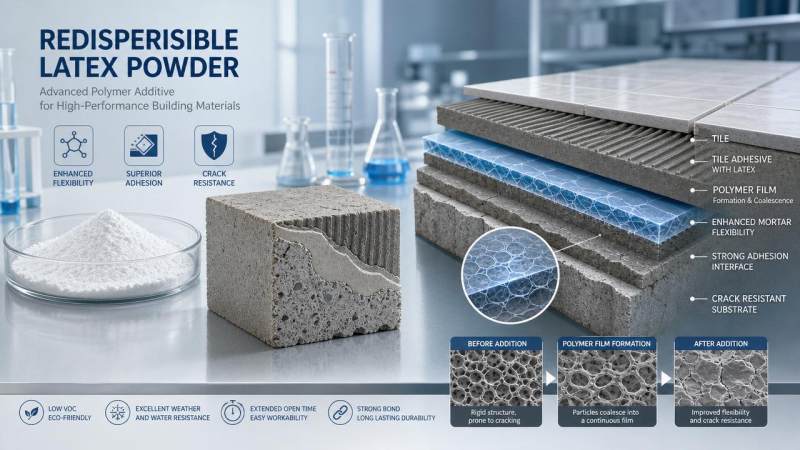
In modern dry-mix formulations, Redispersible Polymer Powder plays a key role in improving mortar flexibility, adhesion, and crack resistance. For applicators and operators, understanding how this additive works can help achieve more stable construction performance and better finished surfaces. This article explains the practical value of Redispersible Polymer Powder in mortar and why it matters in demanding building applications.
What is Redispersible Polymer Powder and why does mortar need it?
Redispersible Polymer Powder is a spray-dried polymer binder designed for dry-mix systems. When water is added, the powder redistributes into fine polymer particles.
These particles form a continuous polymer film during mortar curing. That film works together with cement hydration products and mineral fillers.
Traditional cement mortar is strong in compression but weak in deformation. It can crack under movement, vibration, thermal change, or substrate shrinkage.
Redispersible Polymer Powder helps solve that weakness. It improves flexibility without removing the structural benefits of cement-based materials.
In practical terms, this means the mortar can better absorb stress. It also keeps stronger contact with the substrate and covering material.
This chemical additive is widely used in tile adhesive, skim coat, repair mortar, self-leveling compounds, ETICS systems, and exterior wall finishing layers.
How does Redispersible Polymer Powder improve mortar flexibility?
The main mechanism is film formation. After mixing and application, water evaporates and cement hydrates. The polymer then creates elastic bridges inside the hardened matrix.
These bridges connect cement particles and fillers. They reduce brittleness and allow the mortar to deform slightly before cracking.
Redispersible Polymer Powder also improves internal cohesion. This helps mortar resist stress from surface impact, freeze-thaw cycles, and temperature swings.
Another important point is crack distribution. Instead of one large visible crack, modified mortar can disperse stress more evenly across the microstructure.
That behavior is valuable on challenging substrates. Examples include lightweight blocks, old concrete, gypsum boards, and insulation boards with slight movement.
Flexibility is not the same as softness. A well-designed formulation still keeps sufficient strength, dimensional stability, and durability for construction use.
Key performance gains from polymer modification
- Higher flexural strength and better deformation tolerance
- Improved bonding to absorbent and non-absorbent surfaces
- Reduced crack formation from drying shrinkage
- Better resistance to water exposure and weathering
- Greater workability and smoother application behavior
Where does Redispersible Polymer Powder make the biggest difference?
Not every mortar application needs the same level of polymer modification. The largest benefits appear where movement, adhesion, and durability matter most.
Tile adhesives are a classic example. Tiles and substrates expand differently, especially under sunlight, heating systems, or moisture changes.
Redispersible Polymer Powder improves bond strength and flexibility in these systems. It lowers the risk of debonding, hollow spots, and edge lifting.
Exterior insulation finishing systems also depend on flexible mortar layers. Wind load, seasonal expansion, and thermal shock can damage brittle materials.
Repair mortars benefit as well. Old substrates often move differently from fresh repair layers, making polymer modification essential for reliable compatibility.
Skim coats and wall putties use Redispersible Polymer Powder to improve spreadability, surface strength, and crack resistance in thin applications.
In some formulations, additives work together for balanced rheology. One helpful partner can be Hydroxypropyl Starch Ether, which supports water retention and anti-sag behavior.
How can you judge the right Redispersible Polymer Powder for a mortar formula?
Choosing Redispersible Polymer Powder should start with application needs. The correct grade depends on flexibility target, bond requirement, water exposure, and open time.
Polymer chemistry matters. Common bases include vinyl acetate ethylene, vinyl acetate vinyl versatate, and acrylic types.
Each type offers different balance points. Some favor adhesion, some support water resistance, and others perform better in highly deformable systems.
Ash content and minimum film-forming temperature are also important. They affect film quality, handling, and low-temperature performance during curing.
Dosage must be matched to the formula. Too little Redispersible Polymer Powder may not deliver flexibility. Too much can raise cost and alter setting behavior.
Compatibility with cellulose ether is another practical consideration. Stable synergy helps maintain water retention, workability, and consistent site performance.
Quick selection checklist
What mistakes reduce the benefits of Redispersible Polymer Powder?
A common mistake is treating Redispersible Polymer Powder as a universal fix. It improves performance, but it cannot compensate for poor aggregate grading or wrong cement balance.
Another issue is incorrect dosage selection. Under-dosing leads to weak flexibility gains, while over-dosing may increase tackiness or slow strength development.
Improper mixing can also reduce effectiveness. Dry blending should be even, and water addition should follow the designed ratio carefully.
Storage conditions matter more than expected. Moisture pickup before use can affect powder flowability and consistent redispersion.
Application conditions should not be ignored. Very low temperatures, rapid drying, or unstable substrates can limit final mortar performance.
It is also risky to evaluate Redispersible Polymer Powder only by price. A cheaper grade may create hidden costs through failure, rework, or shorter service life.
Common problem and response table
Why does supplier capability matter for consistent mortar performance?
Redispersible Polymer Powder performance depends not only on chemistry, but also on production consistency, quality control, and formulation support.
Jinan Ludong Chemical Co., Ltd., established in 2020, focuses on cellulose ethers, RDP, and integrated construction material solutions for global markets.
Its annual production capacity reaches 45,000 tons. The product range includes HPMC series with viscosities controllable from 400 to 200,000 CPS.
This scale supports stable supply and flexible response to varied mortar formulations. Intelligent automated production also helps reduce batch variation.
For many dry-mix systems, performance comes from additive synergy rather than one material alone. This may include HPMC, Redispersible Polymer Powder, and Hydroxypropyl Starch Ether.
When technical support and product consistency are available together, it becomes easier to fine-tune mortar flexibility, water retention, and application stability.
What should be the next step when evaluating Redispersible Polymer Powder?
Start with the specific mortar target. Define whether the priority is flexibility, adhesion, anti-cracking, water resistance, or a balanced combination.
Then compare Redispersible Polymer Powder grades through lab tests. Focus on tensile adhesion, flexural behavior, open time, workability, and crack resistance.
Field validation is equally important. Real substrates, climate conditions, and operator habits can reveal issues that laboratory data alone may miss.
A good formula does more than pass one test. It should remain stable across production, transport, storage, and on-site mixing conditions.
In summary, Redispersible Polymer Powder improves mortar flexibility by forming elastic polymer films inside the cement matrix. That change leads to stronger adhesion, better crack resistance, and more reliable long-term performance.
For demanding dry-mix applications, choosing the right Redispersible Polymer Powder and matching it with compatible additives is the most practical path to durable mortar results.
Send Your Inquiry
We welcome your cooperation and we will develop with you.
