


How polymer powder changes tile adhesive workability
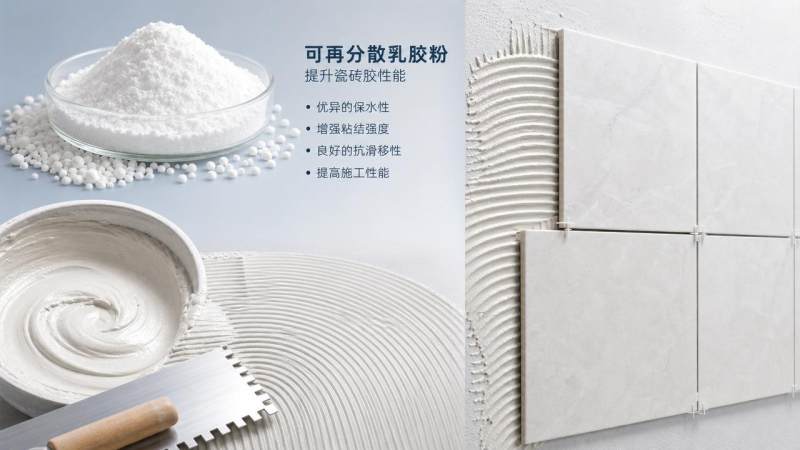
In tile adhesive applications, workability directly affects mixing ease, open time, slip resistance, and installation efficiency. Redispersible Polymer Powder for tile adhesive plays a key role by improving flexibility, adhesion, and water retention, helping operators achieve smoother spreading and more reliable bonding. Understanding how this polymer additive changes daily application performance is essential for better construction results and consistent quality.
Why does workability matter so much in tile adhesive application?
For operators, tile adhesive is not judged first by lab data. It is judged by how it feels in the bucket, how easily it wets the substrate, and how steadily it holds the tile after combing.
When workability is poor, common jobsite problems appear quickly: hard mixing, dry troweling, short open time, tile slip on walls, uneven bed thickness, and repeated rework. These issues increase labor pressure and reduce installation consistency.
That is why Redispersible Polymer Powder for tile adhesive is more than a formula additive. It changes daily handling performance, especially in demanding installation conditions such as large-format tiles, vertical surfaces, warm weather, or absorptive substrates.
- It improves mortar cohesion, so the mix stays creamy instead of becoming sandy or loose.
- It supports better wetting of tile backs and substrates, which helps contact formation.
- It contributes to flexibility and bonding strength after curing, reducing the risk of brittle failure.
- It helps installers maintain workable time on site without sacrificing placement control.
What operators usually feel first
The first visible effect is usually smoother mixing and better spreadability. A well-designed polymer-modified tile adhesive forms a stable paste that resists segregation and supports uniform trowel ridges.
On vertical jobs, installers also notice reduced tile slippage. On floor jobs, they often report easier bedding and less force needed to collapse the ridges under the tile.
How does Redispersible Polymer Powder for tile adhesive change mortar behavior?
The powder redistributes in water during mixing and forms a polymer film as the mortar sets and dries. This film bridges mineral particles and supports better internal cohesion and adhesion to surfaces.
In practical terms, Redispersible Polymer Powder for tile adhesive affects both fresh-state handling and hardened-state durability. Operators benefit during application, while project owners benefit after installation.
The table below summarizes the main workability changes that operators commonly observe when polymer powder is properly matched to the adhesive system.
The key point is balance. Too little polymer support can leave the adhesive dry and brittle, while poor formulation balance can also create handling issues. Good performance comes from matching polymer type, dosage, fillers, and water-demand control.
Fresh-state benefits that matter on site
For the installer, fresh-state behavior often determines productivity. Better water retention keeps the cement hydration process more stable and slows premature moisture loss into porous surfaces.
This is especially useful when laying ceramic tiles on absorbent cementitious bases. The adhesive remains workable for longer, allowing better ridge transfer and a more complete contact area.
Hardened-state improvements
After curing, polymer modification can improve deformability, adhesion, impact resistance, and resistance to microcracking caused by movement or temperature changes. These gains support long-term installation stability, not just easier application.
Which jobsite scenarios benefit most from Redispersible Polymer Powder for tile adhesive?
Not every tile job stresses the adhesive in the same way. Operators should evaluate substrate, tile size, climate, and installation orientation before selecting a polymer-modified system.
- Large-format tiles need better deformability and strong contact formation because coverage gaps can lead to hollow spots or breakage.
- Wall tiles require stable anti-slip behavior so installers can align pieces without repeated adjustment.
- Dense porcelain tiles need stronger adhesion support because their low absorption limits mechanical grip.
- Warm, dry, or windy conditions can shorten open time, making polymer-supported water retention more important.
- Renovation projects often involve mixed substrates, where flexible bonding performance reduces compatibility risk.
The next table helps compare where Redispersible Polymer Powder for tile adhesive delivers the most visible operational value.
This comparison shows why operators should not choose a tile adhesive only by price per bag. The actual cost of poor workability appears later through slower laying speed, callbacks, wasted material, and inconsistent bond quality.
What should operators and buyers check before choosing a polymer-modified tile adhesive system?
Selection points that influence real performance
When evaluating Redispersible Polymer Powder for tile adhesive, users should look beyond the phrase “contains polymer.” The practical result depends on compatibility with cement, cellulose ether, fillers, and the target tile category.
- Check the target application: wall, floor, interior, exterior, porcelain, ceramic, or large format. Each case places different demands on flexibility and slip resistance.
- Review open time and adjustment time expectations. If installers work in warm climates or on large layouts, a stable placement window becomes critical.
- Confirm water addition range. A narrow water tolerance may create jobsite inconsistency, especially when crews vary in mixing habits.
- Assess compatibility with rheology modifiers and retention agents. Balanced systems often combine polymer powder with cellulose ethers for smoother application.
- Ask for guidance on substrate conditions, especially for renovation, old concrete, or high-absorption bases.
A practical note on formulation synergy
Polymer powder rarely works alone in a high-performance adhesive. In many systems, it is paired with cellulose ether to support water retention, sag control, and smooth consistency. In some formulations, related additives such as Methyl Hydroxyethyl Cellulose (HEMC) may also be considered when optimizing rheology and construction feel.
This is where supplier know-how matters. Formula balance is often more valuable than chasing a single additive number.
How can a reliable supplier reduce formulation and delivery risk?
In the chemicals industry, consistency is not only a production issue. It is a site-performance issue. Variations in powder quality, dispersion behavior, or viscosity support can change the final feel of the adhesive and create avoidable complaints from applicators.
Jinan Ludong Chemical Co., Ltd. focuses on cellulose ethers, redispersible polymer powder, and integrated construction material solutions. Its production and service model is relevant for buyers who need both stable supply and technical coordination across additive systems.
- The company provides core construction chemistry products including HPMC, RDP, and HPS, which supports coordinated formulation discussions instead of isolated product decisions.
- Its annual production capacity of 45,000 tons helps buyers planning regular shipments or volume-based procurement programs.
- Controllable viscosities from 400 to 200,000 CPS in the HPMC range can help match different adhesive performance targets.
- The combination of traditional process experience and intelligent automated production is useful where repeatability and batch-to-batch stability are priorities.
For an operator or purchasing team, this means a better chance of receiving consistent material, clearer application guidance, and faster adjustment when a formula must be adapted for climate, substrate, or tile type.
Common mistakes when using Redispersible Polymer Powder for tile adhesive
Mistake 1: assuming more polymer always means better performance
Higher dosage does not automatically produce the best handling. Excessive modification can affect cost efficiency and may disturb the intended balance among workability, setting profile, and mechanical properties.
Mistake 2: ignoring substrate absorption and weather
A formula that performs well indoors may not behave the same way on a hot exterior wall or a highly porous screed. Workability must be evaluated under realistic site conditions.
Mistake 3: adjusting water randomly on site
Installers sometimes add extra water to improve spreadability. This may temporarily soften the mix, but it can reduce cohesion, increase shrinkage risk, and weaken the designed polymer-cement balance.
Mistake 4: selecting only by initial bag price
Cheaper adhesive with poor troweling, short open time, or weak slip resistance often increases total installation cost. Labor efficiency and reduced rework usually have greater economic impact than a small raw material saving.
FAQ: practical questions from operators and buyers
How do I know whether Redispersible Polymer Powder for tile adhesive is necessary for my tile project?
If you are laying porcelain, large-format tiles, wall tiles, exterior tiles, or tiles on variable substrates, polymer modification is usually important. These cases need stronger adhesion, better flexibility, and more stable workability than simple cement-sand mixes can provide.
What performance signs should I observe during mixing and application?
Look for fast wet-out, low lump formation, smooth paste development, clean combed ridges, stable anti-slip behavior, and good transfer to the tile back. If the adhesive skins too quickly or feels sandy, the workability system may not be well balanced.
Can Redispersible Polymer Powder for tile adhesive help in hot or dry climates?
Yes, it can support a more usable open time and better moisture management, especially when combined with suitable cellulose ether. However, installers should still follow recommended water ratios, mixing time, and substrate preparation practices.
What should procurement teams ask suppliers before ordering?
Ask about the intended application range, compatibility with your existing formulation, recommended dosage direction, batch consistency, supply lead time, packaging options, and whether sample evaluation is available. It is also useful to discuss whether additives such as Methyl Hydroxyethyl Cellulose (HEMC) should be reviewed together for rheology optimization.
Why choose us for tile adhesive additive support?
If your team is evaluating Redispersible Polymer Powder for tile adhesive, the decision should not stop at product availability. You need support on handling behavior, formula matching, supply continuity, and application fit.
Jinan Ludong Chemical Co., Ltd. can support discussions around RDP, HPMC, HPS, and related construction chemistry solutions for tile adhesive systems. This is especially useful when you need to align spreadability, open time, slip resistance, and bond reliability rather than optimize only one parameter.
- Consult on parameter confirmation for your target tile type, substrate condition, and construction environment.
- Discuss product selection for standard ceramic tile, dense porcelain tile, wall applications, or large-format systems.
- Check delivery cycle expectations and supply planning for regular purchasing or project-based demand.
- Request guidance on customized formulation direction when balancing workability, cost, and performance targets.
- Ask about sample support and quotation communication before scaling to larger orders.
When tile adhesive workability directly influences labor efficiency and final bond quality, choosing the right additive partner becomes a practical construction decision. A focused discussion on formulation goals, site conditions, and supply requirements can help reduce trial-and-error and speed up reliable product matching.
Send Your Inquiry
We welcome your cooperation and we will develop with you.
