


How to Avoid Viscosity Collapse in HPMC-Based Detergents During Storage at 40°C
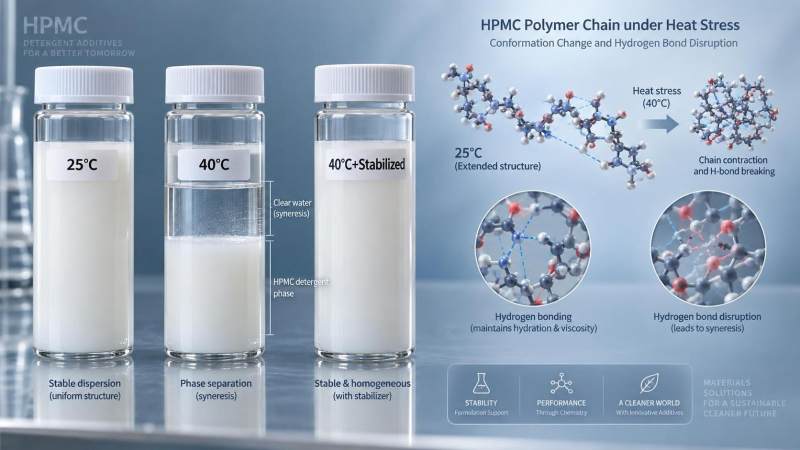
Viscosity collapse in HPMC-based detergents stored at 40°C isn’t a theoretical concern—it’s a recurring operational failure. Formulators see it as inconsistent thickening after two weeks; production supervisors flag it as batch rework; warehouse managers report gel separation or syneresis in pallets held through summer months. When viscosity drops 30–70% under accelerated storage, the detergent fails rheological specs, loses suspension capacity for abrasives or enzymes, and often triggers customer complaints about phase separation or poor dispensing. This isn’t degradation due to microbial growth or pH shift—it’s thermal destabilization of the HPMC network, triggered by subtle but cumulative molecular changes.
It’s Not Just “Heat”—It’s How HPMC Responds to Sustained Thermal Stress
HPMC’s thermogelling behavior is well known: it gels upon heating and redissolves on cooling. But in detergent formulations—where HPMC acts as a rheology modifier, not a gelling agent—the real issue isn’t gel formation itself. It’s the irreversible breakdown of hydrogen-bonded microdomains that maintain viscosity in the hydrated state. At 40°C, especially over days to weeks, methyl and hydroxypropyl substituents undergo subtle conformational rearrangement. The polymer chain contracts, water-binding capacity declines, and entanglement density drops—not uniformly, but preferentially in low-substitution regions. That’s why viscosity loss isn’t linear: it often holds steady for 7–10 days, then accelerates sharply between Day 12 and Day 21.
This means shelf-life testing at 25°C gives false confidence. Real-world distribution centers in Southeast Asia, the Middle East, or southern U.S. routinely hit 38–42°C for extended periods—and ambient storage in uncooled warehouses exceeds 40°C for >6 hours daily during peak season. If your stability protocol stops at 30°C/30 days, you’re validating performance under conditions your product won’t face.
Three Conditions That Make Collapse Almost Certain (and One That Prevents It)
Viscosity collapse isn’t inevitable—but it becomes highly probable when any two of these conditions coexist:
- pH drift above 9.5: Alkaline builders (sodium carbonate, silicates) accelerate ether bond hydrolysis, especially when combined with heat. Even brief exposure to pH >10 during mixing—common in high-foaming liquid detergent bases—can initiate chain scission before packaging.
- Presence of high-ionic-strength electrolytes: Sodium sulfate, sodium chloride, or even high levels of sodium tripolyphosphate (>8%) screen electrostatic repulsion between HPMC chains. This promotes chain aggregation at elevated temperature, followed by irreversible precipitation upon cooling.
- Low degree of substitution (DS) & low hydroxypropyl molar substitution (MS): Standard construction-grade HPMC (e.g., Type 60 with DS ~1.8, MS ~0.2) lacks sufficient hydrophobic shielding. Its backbone dehydrates faster at 40°C, collapsing the hydrodynamic volume. Detergent-specific grades require DS ≥2.0 and MS ≥0.25 to sustain hydration shell integrity under thermal stress.
The counterweight? Precise thermal history control during HPMC synthesis. Not just final viscosity—but how the polymer was dried, cooled, and conditioned post-reactor. Rapid hot-air drying above 85°C creates surface crosslinking that masks instability; slow fluidized-bed drying at ≤65°C preserves uniform substitution distribution and minimizes residual stress. This difference doesn’t show up in Brookfield viscosity at 25°C—but it dictates whether viscosity holds at 40°C for 60 days or collapses by Day 18.
What “Stable” Really Means in Practice
Don’t rely on “viscosity retention ≥90% after 30 days at 40°C” claims without asking: measured at what shear rate? With what spindle? After what rest time? Many suppliers report data using spindle #3 at 6 rpm—conditions where even partially collapsed HPMC appears stable because low-shear viscosity masks structural breakdown. In actual use—during pump transfer, nozzle dispensing, or agitation in a washing machine drum—the formulation experiences transient high-shear rates (100–500 s⁻¹). If the polymer network can’t recover quickly, viscosity plummets mid-cycle.
A robust stability test must include:
- Brookfield measurement at both 6 rpm (low-shear) and 60 rpm (medium-shear) after 15-min rest post-storage;
- Visual inspection for syneresis (water pooling), stringiness, or graininess;
- Rheology sweep (0.1–100 Pa) to detect yield stress erosion or loss of thixotropic recovery;
- Centrifugation test (3000 rpm, 15 min) to quantify suspended solids settling—since viscosity loss directly correlates with reduced particle suspension capacity.
If your current HPMC passes low-shear tests but fails centrifugation or high-shear recovery, you’re not seeing formulation failure—you’re seeing early-stage collapse masked by measurement method.
Where Additives Fit—and Where They Don’t
Some formulators add polyacrylates or associative thickeners to “boost” viscosity. That rarely solves thermal collapse—it only delays detection. These additives mask the underlying HPMC degradation but don’t prevent it. Worse, they can interfere with enzyme stability or foam profile. A more effective lever is pairing HPMC with Redispersible Polymer Powder, which enhances film-forming integrity and reduces interfacial tension between dispersed phases—improving overall colloidal stability without masking HPMC’s thermal limits.
But additives aren’t substitutes for correct HPMC selection. No stabilizer compensates for insufficient MS or excessive residual alkali. Focus first on polymer architecture—not formulation band-aids.
Actionable Next Steps
Start with one verification: pull three recent batches of your current HPMC-for-detergent grade. Run parallel 40°C/60-day tests—not just viscosity, but also centrifugation and high-shear recovery. Compare results against baseline specs. If >15% viscosity loss occurs before Day 30—or if syneresis appears before Day 25—your current grade isn’t fit for purpose in thermally stressed markets.
When sourcing replacement material, prioritize suppliers who:
- Specify DS and MS values—not just “detergent grade”;
- Provide viscosity data at both 25°C and 40°C, measured at ≥60 rpm;
- Disclose drying method and post-treatment conditioning;
- Offer lot-to-lot consistency reports covering substitution uniformity (via NMR or methylation analysis), not just viscosity.
Thermal stability in HPMC isn’t a function of molecular weight alone. It’s governed by substitution homogeneity, drying kinetics, and residual process chemistry. Treat it like a critical raw material parameter—not a secondary specification.
Send Your Inquiry
We welcome your cooperation and we will develop with you.
