


Is Your HPMC Batch Suitable for Enzyme-Containing Detergents? 3 Critical QC Checks You’re Missing
Is Your HPMC Batch Suitable for Enzyme-Containing Detergents? 3 Critical QC Checks You’re Missing
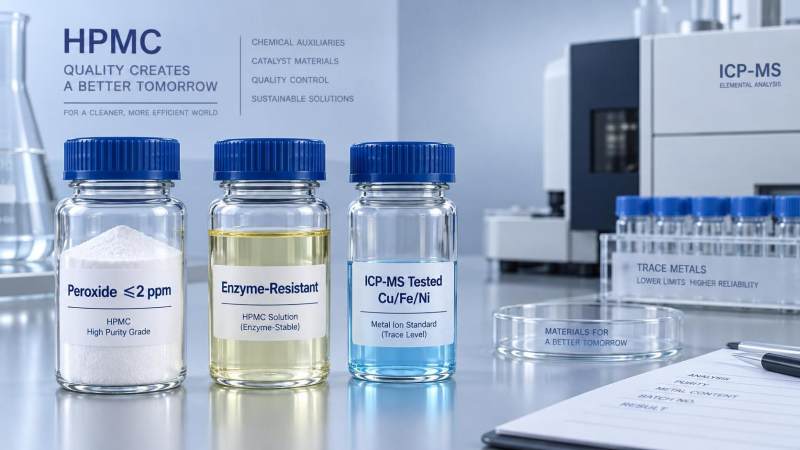
If your HPMC for detergent formulations is failing stability or enzyme compatibility tests, the issue may lie in undetected batch variability—not raw material specs alone. For QC and safety professionals in enzyme-based detergent manufacturing, three often-overlooked quality control checks—residual peroxide content, enzymatic hydrolysis resistance, and heavy metal trace profiling—are critical to ensuring HPMC doesn’t compromise efficacy or regulatory compliance. At Jinan Ludong Chemical, our ISO-certified HPMC for detergent (Type 60/75, 400–200,000 CPS) undergoes rigorous enzyme-stability validation—so you don’t have to guess.
Why “HPMC for detergent” isn’t just about viscosity or substitution degree
Most spec sheets list viscosity, methoxy/hydroxypropyl ratios, and ash content—but those numbers tell only part of the story when enzymes are involved. Proteases, amylases, and lipases operate under narrow pH and temperature windows. They’re also highly sensitive to oxidizing agents, trace metals, and even subtle structural changes in polymer backbones. A batch of HPMC that meets all standard chemical specs can still accelerate enzyme denaturation—or worse, introduce unpredictable degradation pathways during storage.
That’s why relying solely on supplier COAs with generic “HPMC for detergent” labeling is risky. What matters isn’t whether the material *can* be used in detergents—it’s whether it’s been validated *under real formulation conditions*, with real enzymes, over real shelf life.
Check #1: Residual peroxide content — the silent destabilizer
Peroxide residues stem from hydrogen peroxide used in bleaching or purification steps during cellulose ether synthesis. Even at ppm levels (<5 ppm), residual peroxides initiate oxidative chain scission in enzyme proteins—especially proteases. This doesn’t always show up in initial activity assays; it manifests as accelerated activity loss after 4–6 weeks at ambient storage.
Standard HPMC testing rarely includes peroxide quantification. It’s not in ASTM D1751 or ISO 11922. Yet for enzyme-containing systems, it’s non-negotiable. We test every lot of Detergent-grade HPMC using iodometric titration (AOAC 967.22 adapted), with acceptance capped at ≤2 ppm. That threshold reflects actual stability data—not theoretical safety margins.
Check #2: Enzymatic hydrolysis resistance — not just “inertness”
“Chemically inert” is a misleading term. HPMC isn’t hydrolyzed by most detergent enzymes—but some amylase variants (especially those engineered for low-pH performance) exhibit measurable glycosidase side activity toward cellulose ether linkages. That’s rare, but real. And when it happens, it releases low-MW fragments that alter rheology, increase foaming, or interfere with enzyme binding sites.
We don’t assume resistance—we verify it. Our validation protocol exposes HPMC samples to 5x standard dosage of commercial protease/amylase blends (pH 8.5–10.2, 40°C, 72 hrs), followed by GPC analysis. Batches showing >3% shift in Mw distribution are rejected—even if viscosity remains nominal. Because viscosity alone masks early-stage depolymerization.
Check #3: Heavy metal trace profiling — beyond “heavy metals, total”
COAs often report “heavy metals, total” as ≤10 ppm (by Pb). That’s insufficient. Copper and iron—even at 0.1–0.3 ppm—catalyze Fenton reactions in presence of peroxide traces and accelerate enzyme oxidation. Nickel and cobalt can chelate active-site histidines. And while zinc is essential for some enzymes, excess free Zn²⁺ inhibits others.
At Jinan Ludong Chemical, we run ICP-MS on every production lot—not just for totals, but for individual elements: Cu, Fe, Ni, Co, Zn, Mn, Cr. Limits are set based on published enzyme inhibition thresholds (e.g., Cu ≤0.15 ppm for alkaline proteases), not generic safety caps. This level of profiling requires dedicated lab capacity—and willingness to discard batches that pass “total” but fail elemental thresholds.
What “batch-to-batch consistency” really means in practice
Jinan Ludong Chemical Co., Ltd., established in 2020, is a large-scale global manufacturing enterprise primarily engaged in the production, trading, and integrated services of cellulose ethers. It is a leading global provider of comprehensive construction solutions, with main products including hydroxypropyl methylcellulose (HPMC), redispersible polymer powder (RDP), and hydroxypropyl starch ether (HPS). Ludong Chemical boasts state-of-the-art and comprehensive production lines and integrated solutions. While adhering to traditional production processes, it has achieved a perfect fusion of traditional and intelligent automated production, flexibly meeting the diverse needs of global customers. Currently, its annual production capacity reaches 45,000 tons, including HPMC series products such as type 75 and type 60 (construction and chemical grades), with viscosities controllable from 400 to 200,000 CPS.
But scale and automation alone don’t guarantee enzyme compatibility. What does is closed-loop feedback between QC labs and formulation teams—tracking not just pass/fail against specs, but correlating analytical outliers (e.g., slight peroxide drift in Lot #LD-2308-B) with downstream stability failures in customer trials. That kind of linkage takes time, cross-functional access, and willingness to treat QC data as predictive—not just compliance-driven.
When to retest—and when to revisit supplier qualification
If your current HPMC supplier doesn’t routinely report peroxide, enzymatic hydrolysis resistance, or elemental profiles—don’t assume they’re testing them silently. Ask for method details, detection limits, and historical lot data. If results aren’t available within 5 business days of request, that’s a signal. Not necessarily of poor quality—but of misaligned priorities.
Also consider: Are you qualifying HPMC against finished detergent stability—or just against isolated enzyme activity? The former matters more. Formulation matrices (surfactants, chelants, builders) modulate how HPMC interacts with enzymes. A batch stable in buffer may destabilize in high-sodium carbonate systems. Real-world validation beats theoretical compatibility every time.
For teams validating new enzyme systems or scaling up production, start with lots tested under your exact conditions—not generic “detergent-grade” claims. And if your internal QC lab lacks ICP-MS or enzymatic challenge capability, partner with suppliers who do—and ask to see the raw data, not just summaries.
Send Your Inquiry
We welcome your cooperation and we will develop with you.
